Blue light glasses are sold to fight eye strain, protect your eyes and improve sleep. A 2023 Cochrane review of 17 trials found they probably do none of those things better than ordinary lenses. The real cause of screen fatigue is how you use the screen, not the light coming off it.
1No eye-strain benefit · a 2023 Cochrane review of 17 trials found no clear advantage over normal lenses
2No proven sleep help · effects on sleep were mixed and inconclusive across the studies
3Screens do not blind you · the AAO says blue light from devices is not damaging your eyes
4The real culprit · you blink about half as often on a screen, which dries and tires your eyes
5What works · the free 20-20-20 habit does more than any lens you can buy
If you spend your day in front of screens, someone has probably told you to buy blue light glasses. The pitch is everywhere: they cut eye strain, shield your retinas, and help you sleep. It is a tidy story. The evidence behind it is not.
In 2023, Cochrane, the group whose systematic reviews sit near the top of the evidence pyramid, pooled every eligible trial on blue-light filtering lenses. The verdict was quietly damning: the glasses probably make no meaningful difference to eye strain, and their effect on sleep is unclear.
1
What they promise
A Product Built on a Worry
Blue-light filtering lenses block part of the short-wavelength light that screens and the sun give off. Makers claim this improves comfort at the computer, protects the back of the eye, and preserves your sleep. Those are three separate promises, and the review set out to check all three against actual trials.
2
The evidence
Cochrane Pooled 17 Trials and Found Nothing
The reviewers gathered 17 randomised trials from six countries, covering more than 600 people. On eye strain, they found there may be no difference between blue-light filtering lenses and ordinary lenses. On visual sharpness, probably little or no effect. Certainty was low, because most trials carried a high risk of bias.
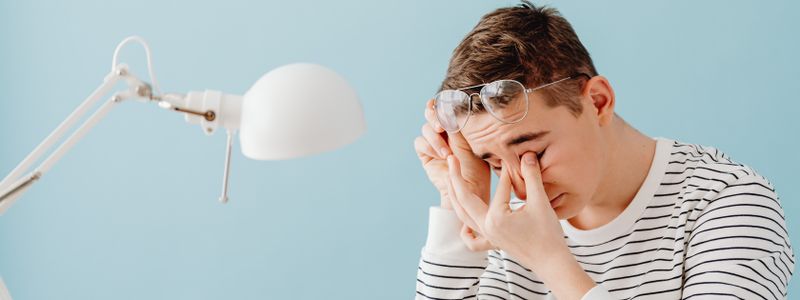
The screen fatigue people blame on blue light is better explained by how long, and how unblinkingly, we stare at our devices.
3
The sleep claim
The Sleep Promise Is Not Settled Either
Sleep is where the marketing leans hardest, and the data is thinnest. Six trials looked at sleep. Three reported an improvement, three found no difference, and the groups were too different to combine. None of them even measured melatonin, the hormone the whole claim rests on.
4
The real cause
Your Blink Rate Falls by Half
If your eyes feel tired after a screen day, there is a well-established reason, and it is not the color of the light. The American Academy of Ophthalmology notes that people blink about 15 times a minute normally, but only 5 to 7 times a minute while staring at a screen. Fewer blinks means a thinner tear film, which leaves eyes dry, tired and strained.
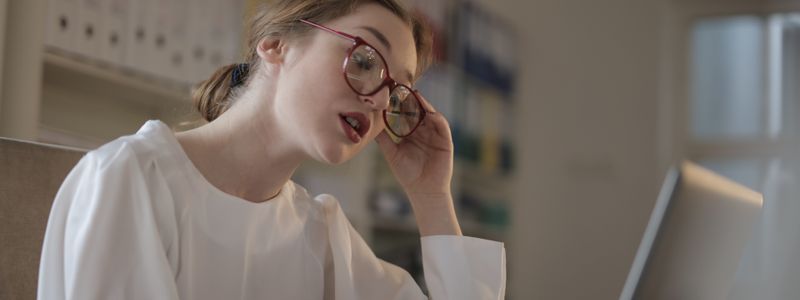
Digital eye strain comes from reduced blinking and long focus, not from blue light, and it does not cause lasting damage.
5
What actually helps
The 20-20-20 Rule Costs Nothing
The fix the AAO actually recommends is free. It is the 20-20-20 rule: every 20 minutes, look at something about 20 feet away for 20 seconds. That relaxes the focusing muscles and reminds you to blink. The academy is clear that screen eye strain is uncomfortable but does not cause lasting damage.
Blue light from electronic screens is not making you blind.
The bigger point the academy makes: any eye trouble from long device use comes from digital eye strain, which is preventable, and not from the blue light itself.
American Academy of Ophthalmology
Take the honest blue-light cheat sheet with you
Your free 2-page guide: what the trials actually found, why screens tire your eyes, and the free habit that helps more than any lens.
One email. No spam. Unsubscribe anytime.
Free Lifestyle Assessment
How Healthy Is Your Current Lifestyle?
Answer honestly for five minutes and walk away with your personal scorecard: all six areas of your health rated, the one that needs your attention first, and a 30-day plan built from your answers. It shows up the second you finish.
Free. About 5 minutes. Your results appear instantly.
📋 Your Coach's Recommendations
1
Skip the Upgrade, Keep Your Money
On the current best evidence, blue-light filtering lenses do not reduce eye strain or reliably improve sleep more than clear lenses. If you like how a pair looks, fine, but do not pay a premium expecting a medical benefit the trials did not find.
2
Fix Your Blinking and Your Distance
Run the 20-20-20 rule: every 20 minutes, look 20 feet away for 20 seconds. Blink on purpose, keep the screen about an arm's length away and slightly below eye level, and cut glare. That targets the actual cause of screen fatigue.
3
For Sleep, Change the Timing, Not the Lens
If screens hurt your sleep, the reliable lever is dimming devices and putting them down before bed, not a lens. And if eye strain is constant or your vision changes, see an eye doctor, because a dilated exam catches what a screen filter cannot.
?
How it works. Just a quiet check-in, not an alert and not a recurring nag. The event lands as a 30-minute slot at 9am two weeks from today, with your plan in the notes and a link back to this article. Works with Apple Calendar, Google Calendar, and Outlook. Yours to move, snooze, or delete whenever.
Keep this plan
Get the 2-page guide: what the trials found, why screens tire your eyes, and the free habit that helps.
One email. No spam. Unsubscribe anytime.
Where should we send it?
Your honest blue-light cheat sheet, straight to your inbox.
We send the plan plus one short evidence brief each week. Unsubscribe anytime.
✓
It is on the way
Check your inbox in the next minute. Your first Ageless Brief arrives this week: one study, translated, no hype.
A 2023 Cochrane review of 17 randomised trials found they probably make no meaningful difference to eye strain compared with ordinary lenses. The certainty of that evidence was low, but there was no clear benefit.
Do blue light glasses help you sleep?
The evidence is mixed and inconclusive. Of six trials that looked at sleep, three showed improvement and three showed none, and none measured melatonin, so no clear conclusion could be drawn.
Is blue light from screens damaging my eyes?
The American Academy of Ophthalmology says no. Blue light from devices is not blinding you or damaging your retina. The discomfort people notice is digital eye strain, which does not cause lasting harm.
What actually causes digital eye strain?
Mostly reduced blinking. You blink about 15 times a minute normally but only 5 to 7 times while looking at a screen, which dries the eyes. Long focus at one distance adds to it.
What helps instead of blue light glasses?
The free 20-20-20 rule: every 20 minutes, look about 20 feet away for 20 seconds. Blinking deliberately, reducing glare and good screen position help more than any lens.
Is this medical advice?
No. This article is educational and is not a substitute for an eye exam. If eye strain is persistent or your vision changes, see an eye care professional.
Curious where you stand? Take the free 5-minute lifestyle assessment and your personal scorecard appears the second you finish.
By the Ageless Coach Editorial Team · Published August 3, 2026 · Last updated August 3, 2026
<style>
:root{--dark-base:#0D1B2A;--dark-mid:#1B3A4B;--teal:#0EA5A0;--teal-dark:#0C8C88;--teal-bright:#14D4CD;--fog:#D8E8E8;--deep-fog:#C8DCDC;--fog-border:#A8C4C4;--ink:#313743;--ink-soft:#49505f;--muted:#6b7280;--warm:#9A6841;--warm-light:#be7b4c;--serif:"Source Serif 4",Georgia,serif;--sans:Inter,-apple-system,BlinkMacSystemFont,"Segoe UI",sans-serif}
.w-richtext p,.w-richtext li,.w-richtext td{font-size:20.5px;line-height:1.7;color:var(--ink-soft)}
.w-richtext ul{list-style-type:disc;padding-left:24px;margin:12px 0}
.w-richtext ul li{margin-bottom:8px}
.ac-answer{background:#fff;border:1px solid #D4E4E4;border-top:5px solid var(--teal);border-radius:16px;padding:22px 24px 18px;margin:16px 0 28px;box-shadow:0 6px 22px rgba(13,27,42,.07)}
.ac-answer .aa-eyebrow{font:800 12px/1 var(--sans);letter-spacing:2.5px;text-transform:uppercase;color:var(--teal-dark);margin-bottom:8px}
.ac-answer .aa-head{font-family:var(--serif);font-size:24px;line-height:1.2;font-weight:800;color:var(--dark-base);margin:0 0 16px}
.ac-answer .aa-list{list-style:none;margin:0;padding:0}
.ac-answer .aa-list li{display:flex;gap:12px;align-items:baseline;padding:11px 0;border-bottom:1px solid #EDF3F3;font:700 16.5px/1.4 var(--sans);color:var(--ink)}
.ac-answer .aa-list li:last-child{border-bottom:none}
.ac-answer .aa-n{flex-shrink:0;width:24px;height:24px;border-radius:50%;background:var(--teal-dark);color:#fff;font:800 12px/24px var(--sans);text-align:center}
.ac-answer .aa-food{color:var(--teal-dark);font-weight:800}
.ac-answer .aa-cue{margin-top:18px;text-align:center}
.ac-answer .aa-cta{display:inline-flex;align-items:center;gap:10px;background:var(--teal-dark);color:#fff;font:800 14px/1 var(--sans);letter-spacing:.2px;padding:14px 26px;border-radius:50px;text-decoration:none;box-shadow:0 6px 16px rgba(12,140,136,.30)}
.ac-answer .aa-cta:hover{background:#0A7A76}
.ac-answer .aa-arw{display:inline-block;animation:aa-nudge 1.4s ease-in-out infinite}
@keyframes aa-nudge{0%,100%{transform:translateY(0)}50%{transform:translateY(4px)}}
@media(max-width:560px){.ac-answer{padding:20px 18px 16px}.ac-answer .aa-head{font-size:21px}.ac-answer .aa-list li{font-size:15px}}
.ac-band{margin:56px 0 24px;padding:26px 24px 12px;background:linear-gradient(180deg,#F0F7F7,#fff);border-radius:16px}
.ac-band.hype{background:linear-gradient(180deg,#FAF3EB,#fff)}
.ac-band .inner{display:flex;gap:20px;align-items:center}
.ac-band .big{font:900 72px/1 var(--sans);color:var(--deep-fog);flex-shrink:0}
.ac-band.hype .big{color:#EAD9C6}
.ac-band .q{font:700 13px/1.4 var(--sans);letter-spacing:2px;text-transform:uppercase;color:var(--teal-dark)}
.ac-band.hype .q{color:var(--warm)}
.ac-band h3{font-family:var(--serif);font-size:30px;line-height:1.2;font-weight:800;color:var(--ink);margin:0}
.ac-callout{border-left:4px solid var(--teal);background:#F4FAFA;border-radius:0 12px 12px 0;padding:18px 22px;margin:28px 0}
.ac-callout .n{font:800 20px/1.35 var(--sans);color:var(--dark-mid);margin-bottom:6px}
.ac-callout .d{font:500 15px/1.55 var(--sans);color:var(--ink-soft)}
.ac-callout .c{font:600 11.5px/1 var(--sans);letter-spacing:1.5px;text-transform:uppercase;color:var(--muted);margin-top:10px}
.ac-plan{background:linear-gradient(135deg,#F4FAFA 0%,#fff 100%);border-left:5px solid var(--teal-dark);border-radius:14px;padding:30px 26px;margin:40px 0 0;box-shadow:0 2px 12px rgba(0,0,0,.06);scroll-margin-top:100px}
.ac-plan .ptitle{font-family:var(--serif);font-size:24px;font-weight:800;color:var(--ink);margin-bottom:22px}
.ac-plan .step{display:flex;gap:16px;margin-bottom:18px;align-items:flex-start}
.ac-plan .step .n{min-width:38px;width:38px;height:38px;background:var(--teal-dark);border-radius:50%;color:#fff;font:800 17px/38px var(--sans);text-align:center;flex-shrink:0}
.ac-plan .sh{font:800 16.5px/1.4 var(--sans);color:var(--ink);margin-bottom:3px}
.ac-plan .sd{font:400 15px/1.6 var(--sans);color:var(--muted)}
.ac-plan .actions{border-top:1px solid #D8E8E8;margin-top:16px;padding-top:20px}
.ac-primary-row{display:flex;align-items:center;gap:10px;padding:0 4px}
.ac-btn-primary-wide{flex:1;background:var(--teal);color:#fff;border:1.5px solid var(--teal);border-radius:14px;padding:12px 22px;box-shadow:0 4px 14px rgba(14,165,160,.22);font-family:var(--sans);cursor:pointer;display:grid;grid-template-columns:auto 1fr;gap:14px;align-items:center;transition:all .18s ease}
.ac-btn-primary-wide:hover{background:var(--teal-dark);border-color:var(--teal-dark)}
.ac-btn-primary-wide .icon svg{width:22px;height:22px;color:#fff;display:block}
.ac-btn-primary-wide .label{text-align:left;line-height:1.25}
.ac-btn-primary-wide .label .top{display:block;font-weight:700;font-size:15.5px;color:#fff}
.ac-btn-primary-wide .label .top em{font-style:italic;font-weight:700}
.ac-cal-help{position:relative;flex-shrink:0}
.ac-cal-help summary{list-style:none;width:24px;height:24px;border-radius:50%;background:#E4F1F1;border:1px solid var(--fog-border);color:var(--dark-mid);font:700 13px/22px var(--sans);text-align:center;cursor:pointer;display:block}
.ac-cal-help summary::-webkit-details-marker{display:none}
.ac-cal-help .tip{position:absolute;right:0;top:32px;z-index:50;width:290px;background:var(--dark-base);color:var(--fog);border-radius:12px;padding:14px 16px;font:500 12.5px/1.55 var(--sans);box-shadow:0 10px 30px rgba(13,27,42,.35)}
.ac-cal-help .tip strong{color:#fff}
.ac-btn-share-wide{display:flex;width:100%;align-items:center;justify-content:center;gap:10px;background:#fff;color:var(--teal-dark);border:1.5px solid var(--teal-dark);border-radius:14px;padding:12px 22px;margin-top:10px;font:800 15px/1 var(--sans);cursor:pointer}
.ac-btn-share-wide svg{width:18px;height:18px}
.ac-midcap{background:linear-gradient(180deg,#F0F7F7,#fff);border:1.5px solid var(--fog-border);border-radius:16px;padding:24px 22px;margin:34px 0;text-align:center}
.ac-midcap h4{font-family:var(--serif);font-size:22px;font-weight:800;color:var(--ink);margin:0 0 6px}
.ac-midcap .sub{font:500 14px/1.55 var(--sans);color:var(--ink-soft);margin:0 auto 14px;max-width:400px}
.ac-midcap .mcform{display:flex;gap:8px;max-width:400px;margin:0 auto}
.ac-midcap .mcform input{flex:1;border:1.5px solid var(--fog-border);border-radius:50px;padding:12px 18px;font:500 14px/1 var(--sans);min-width:0}
.ac-midcap .mcform button{background:var(--teal-dark);color:#fff;border:none;border-radius:50px;padding:12px 20px;font:800 13.5px/1 var(--sans);cursor:pointer;white-space:nowrap}
.ac-midcap .fine{font:500 11.5px/1.5 var(--sans);color:var(--muted);margin-top:10px}
@media (max-width:520px){.ac-midcap .mcform{flex-direction:column}}
.ac-assess-promo{background:linear-gradient(135deg,#D8E8E8,#C8DCDC);border:1px solid var(--fog-border);border-radius:16px;padding:34px 30px;margin:44px 0;text-align:center}
.ac-assess-promo .eyebrow{color:var(--teal-dark);font:800 12px/1 var(--sans);letter-spacing:2.5px;text-transform:uppercase;margin:0 0 10px}
.ac-assess-promo h4{font-family:var(--serif);color:var(--dark-base);font-size:26px;font-weight:800;margin:0 0 12px}
.w-embed .ac-assess-promo p.ap-body,.ac-assess-promo p.ap-body{font-family:Georgia,serif;color:#3A5555;font-size:15.5px;font-weight:500;line-height:1.65;max-width:540px;margin:0 auto 22px}
.ac-assess-promo .ap-cta{display:inline-block;background:var(--teal-bright);color:var(--dark-base);font:800 15px/1 var(--sans);padding:15px 30px;border-radius:50px;text-decoration:none}
.ac-assess-promo .ap-fine{color:#4E6B6B;font:500 13px/1.5 var(--sans);margin:14px 0 0}
.ac-assess-line{border-top:1px solid #E2ECEC;margin-top:30px;padding:22px 10px 0;text-align:center;font:500 15.5px/1.6 var(--sans);color:#3A5555}
.w-embed .ac-assess-line a,.ac-assess-line a{color:var(--teal-dark);font-weight:700;text-decoration:underline;text-underline-offset:3px}
.ac-articlemeta{font:500 12.5px/1.6 var(--sans);color:#98a0a6;text-align:center;margin:24px 0 0}
.ac-capture{background:linear-gradient(180deg,#F0F7F7,#fff);border:1.5px solid var(--fog-border);border-radius:16px;padding:30px 28px;margin:26px 0 44px;text-align:center}
.ac-capture .cap-state{display:none}
.ac-capture[data-state="trigger"] .st-trigger{display:block}
.ac-capture[data-state="form"] .st-form{display:block}
.ac-capture[data-state="sent"] .st-sent{display:block}
.ac-capture h4{font-family:var(--serif);font-size:24px;font-weight:800;color:var(--ink);margin:0 0 8px}
.ac-capture .sub{font:500 15px/1.55 var(--sans);color:var(--ink-soft);margin:0 auto 18px;max-width:430px}
.ac-capture .bigbtn{display:inline-flex;align-items:center;gap:10px;background:var(--teal-dark);color:#fff;border:none;border-radius:50px;padding:16px 30px;font:800 16px/1 var(--sans);cursor:pointer;box-shadow:0 6px 18px rgba(12,140,136,.28)}
.ac-capture .capform{display:flex;gap:10px;max-width:430px;margin:0 auto}
.ac-capture .capform input{flex:1;border:1.5px solid var(--fog-border);border-radius:50px;padding:14px 20px;font:500 15px/1 var(--sans)}
.ac-capture .capform button{background:var(--teal-dark);color:#fff;border:none;border-radius:50px;padding:14px 24px;font:800 14px/1 var(--sans);cursor:pointer}
.ac-capture .sent-check{width:52px;height:52px;border-radius:50%;background:var(--teal);color:#fff;font:800 26px/52px var(--sans);margin:0 auto 12px}
.ac-capture .dl{display:inline-block;margin-top:6px;color:var(--teal-dark);font:700 15px/1 var(--sans);text-decoration:underline;cursor:pointer}
.ac-capture .fine{font:500 12px/1.5 var(--sans);color:var(--muted);margin-top:12px}
.ac-sig{margin-top:36px}
.ac-sig .rule{width:60px;height:2px;background:linear-gradient(90deg,var(--teal-dark),var(--teal-bright));margin-bottom:18px;border-radius:2px}
.ac-sig .toyour{font-family:var(--serif);font-size:16px;font-style:italic;color:#777;margin:0 0 10px;padding-left:2px}
.ac-faq{margin-top:40px;border-top:1px solid #e5e7eb;padding-top:30px;margin-bottom:40px}
.ac-faq h2{font-family:var(--serif);font-size:23px;font-weight:800;color:var(--ink);margin:0 0 18px}
.ac-faq details{border:1px solid #e5e7eb;border-radius:10px;margin-bottom:10px}
.ac-faq summary{padding:15px 18px;font:700 16px/1.4 var(--sans);color:var(--ink);cursor:pointer;display:flex;justify-content:space-between;align-items:center;list-style:none}
.ac-faq summary:after{content:"\25BE";color:var(--warm)}
.ac-faq .a{padding:0 18px 16px;font-size:17px;line-height:1.65;color:#555}
.article-header-section .article-container{max-width:1080px !important;margin:0 auto !important;padding:0 20px !important}
.article-header-section .article-hero-image{display:block;width:100%;max-width:660px;margin:0}
.article-header-section .article-title{display:block !important;font-family:var(--serif);font-size:32px;line-height:1.25;font-weight:700;color:#313743;margin:20px 0 12px 0;text-align:left;max-width:660px}
@media (max-width:767px){.article-header-section .article-title{font-size:26px}.article-header-section .article-hero-image{max-width:100%}}
@media (max-width:640px){.ac-band .big{font-size:52px}}
@media (max-width:520px){.ac-capture .capform{flex-direction:column}}
.ac-figure{margin:30px 0}.ac-figure img{display:block;width:100%;border-radius:14px;height:auto;aspect-ratio:800/300}.ac-figure figcaption{font:500 13px/1.5 var(--sans);color:var(--muted);margin-top:9px}</style>
<div class="ac-answer"><div class="aa-eyebrow">What the evidence actually says</div><h2 class="aa-head">Blue light glasses are sold to fight eye strain, protect your eyes and improve sleep. A 2023 Cochrane review of 17 trials found they probably do none of those things better than ordinary lenses. The real cause of screen fatigue is how you use the screen, not the light coming off it.</h2><ol class="aa-list"><li><span class="aa-n">1</span><span><span class="aa-food">No eye-strain benefit</span> · a 2023 Cochrane review of 17 trials found no clear advantage over normal lenses</span></li><li><span class="aa-n">2</span><span><span class="aa-food">No proven sleep help</span> · effects on sleep were mixed and inconclusive across the studies</span></li><li><span class="aa-n">3</span><span><span class="aa-food">Screens do not blind you</span> · the AAO says blue light from devices is not damaging your eyes</span></li><li><span class="aa-n">4</span><span><span class="aa-food">The real culprit</span> · you blink about half as often on a screen, which dries and tires your eyes</span></li><li><span class="aa-n">5</span><span><span class="aa-food">What works</span> · the free 20-20-20 habit does more than any lens you can buy</span></li></ol><div class="aa-cue"><a class="aa-cta" href="#coach-recommendations">Get Your Coach's 3-Step Plan <span class="aa-arw">↓</span></a></div></div>
<p>If you spend your day in front of screens, someone has probably told you to buy blue light glasses. The pitch is everywhere: they cut eye strain, shield your retinas, and help you sleep. It is a tidy story. The evidence behind it is not.</p>
<p>In 2023, <a href="https://www.cochrane.org/evidence/CD013244_blue-light-filtering-spectacle-lenses-visual-performance-macular-back-part-eye-protection-and" target="_blank" rel="noopener">Cochrane</a>, the group whose systematic reviews sit near the top of the evidence pyramid, pooled every eligible trial on blue-light filtering lenses. The verdict was quietly damning: the glasses probably make no meaningful difference to eye strain, and their effect on sleep is unclear.</p>
<div class="ac-band"><div class="inner"><div class="big">1</div><div><div class="q">What they promise</div><h3>A Product Built on a Worry</h3></div></div></div>
<p>Blue-light filtering lenses block part of the short-wavelength light that screens and the sun give off. Makers claim this improves comfort at the computer, protects the back of the eye, and preserves your sleep. Those are three separate promises, and the review set out to check all three against actual trials.</p>
<div class="ac-band"><div class="inner"><div class="big">2</div><div><div class="q">The evidence</div><h3>Cochrane Pooled 17 Trials and Found Nothing</h3></div></div></div>
<p>The reviewers gathered <a href="https://www.cochranelibrary.com/cdsr/doi/10.1002/14651858.CD013244.pub2/full" target="_blank" rel="noopener">17 randomised trials</a> from six countries, covering more than 600 people. On eye strain, they found there may be no difference between blue-light filtering lenses and ordinary lenses. On visual sharpness, probably little or no effect. Certainty was low, because most trials carried a high risk of bias.</p>
<figure class="ac-figure"><img src="https://images.pexels.com/photos/6345335/pexels-photo-6345335.jpeg?auto=compress&cs=tinysrgb&w=800&h=300&fit=crop" alt="A person rubbing tired eyes with glasses pushed up on the forehead" width="800" height="300" loading="lazy" decoding="async"><figcaption>The screen fatigue people blame on blue light is better explained by how long, and how unblinkingly, we stare at our devices.</figcaption></figure>
<div class="ac-band"><div class="inner"><div class="big">3</div><div><div class="q">The sleep claim</div><h3>The Sleep Promise Is Not Settled Either</h3></div></div></div>
<p>Sleep is where the marketing leans hardest, and the data is thinnest. <a href="https://www.cochrane.org/evidence/CD013244_blue-light-filtering-spectacle-lenses-visual-performance-macular-back-part-eye-protection-and" target="_blank" rel="noopener">Six trials</a> looked at sleep. Three reported an improvement, three found no difference, and the groups were too different to combine. None of them even measured melatonin, the hormone the whole claim rests on.</p>
<div class="ac-band"><div class="inner"><div class="big">4</div><div><div class="q">The real cause</div><h3>Your Blink Rate Falls by Half</h3></div></div></div>
<p>If your eyes feel tired after a screen day, there is a well-established reason, and it is not the color of the light. The <a href="https://www.aao.org/eye-health/news/smartphone-blue-light-is-not-blinding-you" target="_blank" rel="noopener">American Academy of Ophthalmology</a> notes that people blink about 15 times a minute normally, but only 5 to 7 times a minute while staring at a screen. Fewer blinks means a thinner tear film, which leaves eyes dry, tired and strained.</p>
<figure class="ac-figure"><img src="https://images.pexels.com/photos/3784302/pexels-photo-3784302.jpeg?auto=compress&cs=tinysrgb&w=800&h=300&fit=crop" alt="A woman in glasses focusing on a laptop screen in an office" width="800" height="300" loading="lazy" decoding="async"><figcaption>Digital eye strain comes from reduced blinking and long focus, not from blue light, and it does not cause lasting damage.</figcaption></figure>
<div class="ac-band"><div class="inner"><div class="big">5</div><div><div class="q">What actually helps</div><h3>The 20-20-20 Rule Costs Nothing</h3></div></div></div>
<p>The fix the AAO actually recommends is free. It is the <a href="https://www.aao.org/eye-health/tips-prevention/should-you-be-worried-about-blue-light" target="_blank" rel="noopener">20-20-20 rule</a>: every 20 minutes, look at something about 20 feet away for 20 seconds. That relaxes the focusing muscles and reminds you to blink. The academy is clear that screen eye strain is uncomfortable but does not cause lasting damage.</p>
<div class="ac-callout"><div class="n">Blue light from electronic screens is not making you blind.</div><div class="d">The bigger point the academy makes: any eye trouble from long device use comes from digital eye strain, which is preventable, and not from the blue light itself.</div><div class="c">American Academy of Ophthalmology</div></div>
<div class="ac-midcap"><h4>Take the honest blue-light cheat sheet with you</h4><p class="sub">Your free 2-page guide: what the trials actually found, why screens tire your eyes, and the free habit that helps more than any lens.</p><div class="mcform"><input type="email" placeholder="Your email address" aria-label="Email address"><button type="button">Send My Plan (Free)</button></div><div class="fine">One email. No spam. Unsubscribe anytime.</div></div>
<div class="ac-assess-promo"><p class="eyebrow">Free Lifestyle Assessment</p><h4>How Healthy Is Your Current Lifestyle?</h4><p class="ap-body">Answer honestly for five minutes and walk away with your personal scorecard: all six areas of your health rated, the one that needs your attention first, and a 30-day plan built from your answers. It shows up the second you finish.</p><a class="ap-cta" href="/#assessment">See How the Assessment Works →</a><p class="ap-fine">Free. About 5 minutes. Your results appear instantly.</p></div>
<div class="ac-plan" id="coach-recommendations"><div class="ptitle">📋 Your Coach's Recommendations</div><div class="step"><div class="n">1</div><div><div class="sh">Skip the Upgrade, Keep Your Money</div><div class="sd">On the current best evidence, blue-light filtering lenses do not reduce eye strain or reliably improve sleep more than clear lenses. If you like how a pair looks, fine, but do not pay a premium expecting a medical benefit the trials did not find.</div></div></div><div class="step"><div class="n">2</div><div><div class="sh">Fix Your Blinking and Your Distance</div><div class="sd">Run the 20-20-20 rule: every 20 minutes, look 20 feet away for 20 seconds. Blink on purpose, keep the screen about an arm's length away and slightly below eye level, and cut glare. That targets the actual cause of screen fatigue.</div></div></div><div class="step"><div class="n">3</div><div><div class="sh">For Sleep, Change the Timing, Not the Lens</div><div class="sd">If screens hurt your sleep, the reliable lever is dimming devices and putting them down before bed, not a lens. And if eye strain is constant or your vision changes, see an eye doctor, because a dilated exam catches what a screen filter cannot.</div></div></div><div class="actions">
<div class="ac-primary-row">
<button type="button" class="ac-btn-primary-wide" data-ac-cal>
<span class="icon"><svg viewBox="0 0 24 24" fill="none" stroke="currentColor" stroke-width="2" stroke-linecap="round" stroke-linejoin="round"><rect x="3" y="4" width="18" height="18" rx="2"></rect><path d="M16 2v4M8 2v4M3 10h18"></path></svg></span>
<span class="label"><span class="top">Add <em>Your Coach's Recommendations to Your Calendar</em></span></span>
</button>
<details class="ac-cal-help"><summary aria-label="What does this do?">?</summary><div class="tip"><strong>How it works.</strong> Just a quiet check-in, not an alert and not a recurring nag. The event lands as a 30-minute slot at 9am two weeks from today, with your plan in the notes and a link back to this article. Works with Apple Calendar, Google Calendar, and Outlook. Yours to move, snooze, or delete whenever.</div></details>
</div>
<button type="button" class="ac-btn-share-wide" data-ac-share><svg viewBox="0 0 24 24" fill="none" stroke="currentColor" stroke-width="2" stroke-linecap="round" stroke-linejoin="round"><path d="M4 12v8a2 2 0 002 2h12a2 2 0 002-2v-8"></path><polyline points="16 6 12 2 8 6"></polyline><line x1="12" y1="2" x2="12" y2="15"></line></svg> Share this article</button>
</div>
</div>
<div class="ac-capture" data-state="trigger" data-article-slug="blue-light-glasses-dont-do-what-you-paid-for" data-pdf-url="https://cdn.prod.website-files.com/69be1026a027224999b7936b/6a7041cb065b160cafd765ea_ac-honest-bluelight-plan.pdf" data-plan-title="The Honest Blue-Light Cheat Sheet" data-plan-desc="Your free 2-page guide: what the trials found, why screens tire your eyes, and the free habit that helps more than any lens."><div class="st-trigger cap-state"><h4>Keep this plan</h4><p class="sub">Get the 2-page guide: what the trials found, why screens tire your eyes, and the free habit that helps.</p><button class="bigbtn" type="button" data-cap="form">📩 Email Me This Plan (Free PDF)</button><div class="fine">One email. No spam. Unsubscribe anytime.</div></div><div class="st-form cap-state"><h4>Where should we send it?</h4><p class="sub">Your honest blue-light cheat sheet, straight to your inbox.</p><form class="capform"><input type="email" name="email" required placeholder="Your email address" aria-label="Email address"><button type="submit">Send My Plan</button></form><div class="fine">We send the plan plus one short evidence brief each week. Unsubscribe anytime.</div></div><div class="st-sent cap-state"><div class="sent-check">✓</div><h4>It is on the way</h4><p class="sub">Check your inbox in the next minute. Your first Ageless Brief arrives this week: one study, translated, no hype.</p><a class="dl" href="https://cdn.prod.website-files.com/69be1026a027224999b7936b/6a7041cb065b160cafd765ea_ac-honest-bluelight-plan.pdf" download>⬇ Download your plan (PDF)</a></div></div>
<style>
.ac-exlib{--ac-ex-fog:#F0F7F7;--ac-ex-border:#A8C4C4;--ac-ex-teal:#0C8C88;--ac-ex-ink-teal:#0A6F6C;--ac-ex-dark:#0D1B2A;--ac-ex-body:#49505f;--ac-ex-muted:#5F6773;--ac-ex-serif:"Source Serif 4",Georgia,serif;--ac-ex-sans:Inter,-apple-system,"Segoe UI",sans-serif;background:linear-gradient(180deg,var(--ac-ex-fog),#fff);border:1.5px solid var(--ac-ex-border);border-radius:16px;padding:24px 26px;margin:36px 0 0;box-sizing:border-box}
.ac-exlib *{box-sizing:border-box}
.ac-exlib .ac-ex-eb{font:800 11.5px/1 var(--ac-ex-sans);letter-spacing:2.4px;text-transform:uppercase;color:var(--ac-ex-ink-teal);margin:0 0 10px}
.ac-exlib .ac-ex-h{font-family:var(--ac-ex-serif);font-size:22px;line-height:1.25;font-weight:800;color:var(--ac-ex-dark);margin:0 0 10px}
.ac-exlib .ac-ex-p{font:500 16px/1.6 var(--ac-ex-sans);color:var(--ac-ex-body);margin:0 0 16px}
.ac-exlib .ac-ex-go{display:inline-flex;align-items:center;gap:8px;border:1.5px solid var(--ac-ex-teal);color:var(--ac-ex-ink-teal);background:#fff;font:800 14px/1 var(--ac-ex-sans);padding:15px 24px;border-radius:50px;text-decoration:none;min-height:44px}
.ac-exlib .ac-ex-go:hover,.ac-exlib .ac-ex-go:focus{background:var(--ac-ex-fog);color:var(--ac-ex-ink-teal)}
.ac-exlib .ac-ex-go:focus-visible{outline:2px solid var(--ac-ex-ink-teal);outline-offset:3px}
.ac-exlib .ac-ex-go svg{width:14px;height:14px;stroke:currentColor;fill:none;stroke-width:2.4;flex:none}
.ac-exlib .ac-ex-note{font:500 12px/1.6 var(--ac-ex-sans);color:var(--ac-ex-muted);margin:14px 0 0}
@media(max-width:560px){.ac-exlib{padding:20px 18px}.ac-exlib .ac-ex-h{font-size:20px}.ac-exlib .ac-ex-go{width:100%;justify-content:center}}
</style>
<aside class="ac-exlib" data-template="L-examine" aria-label="Further reading">
<p class="ac-ex-eb">Read the research yourself</p>
<h3 class="ac-ex-h">We read the studies. You can too.</h3>
<p class="ac-ex-p">Everything above is sourced and linked. If you want to go deeper than one article can go, Examine maintains independent, continuously updated research summaries on around a thousand supplements. They sell no supplements of their own. That is the reason we send people there rather than somewhere else.</p>
<a class="ac-ex-go" href="https://examine.com/refer/qed0mm2?utm_source=agelesscoach&utm_medium=article&utm_content=tmpl-L-examine" rel="noopener sponsored" target="_blank">
Read the research on Examine
<svg viewBox="0 0 24 24" aria-hidden="true"><path d="M5 12h14M13 6l6 6-6 6" stroke-linecap="round" stroke-linejoin="round"/></svg>
</a>
<p class="ac-ex-note">Ageless Coach may earn a commission if you subscribe, at no additional cost to you. We were not paid to write this and it does not affect what we recommend.</p>
</aside>
<div class="ac-sig"><div class="rule"></div><p class="toyour">To your health,</p><svg width="320" height="72" viewBox="0 0 320 72" role="img" aria-label="Ageless Coach. Age Strong. Live Long." xmlns="http://www.w3.org/2000/svg" xmlns:xlink="http://www.w3.org/1999/xlink"><defs><clipPath id="acSigIconClip"><rect x="0" y="6" width="60" height="60" rx="12" ry="12"/></clipPath></defs><image x="0" y="6" width="60" height="60" clip-path="url(#acSigIconClip)" preserveAspectRatio="xMidYMid slice" href="https://cdn.prod.website-files.com/69be1026a027224999b7936b/6a0b22c6afd5d6fd115b9c1a_ac-closing-brand-icon.webp" xlink:href="https://cdn.prod.website-files.com/69be1026a027224999b7936b/6a0b22c6afd5d6fd115b9c1a_ac-closing-brand-icon.webp"/><text x="76" y="42" style="font-family:Inter,system-ui,-apple-system,'Helvetica Neue',Arial,sans-serif;font-size:27px;letter-spacing:-0.3px"><tspan style="font-weight:800;fill:#0D1B2A">Ageless</tspan><tspan style="font-weight:300;fill:rgba(13,27,42,0.6)">Coach</tspan><tspan dy="-12" style="font-size:16px;font-weight:600;fill:rgba(13,27,42,0.6)">™</tspan></text><text x="76" y="60" style="font-family:Inter,system-ui,-apple-system,'Helvetica Neue',Arial,sans-serif;font-size:10.5px;letter-spacing:2.5px;font-weight:500;fill:#0C8C88;text-transform:uppercase">AGE STRONG. LIVE LONG.</text></svg></div>
<div class="ac-faq"><h2>Frequently Asked Questions</h2><details><summary>Do blue light glasses reduce eye strain?</summary><div class="a">A 2023 <a href="https://www.cochrane.org/evidence/CD013244_blue-light-filtering-spectacle-lenses-visual-performance-macular-back-part-eye-protection-and" target="_blank" rel="noopener">Cochrane review</a> of 17 randomised trials found they probably make no meaningful difference to eye strain compared with ordinary lenses. The certainty of that evidence was low, but there was no clear benefit.</div></details><details><summary>Do blue light glasses help you sleep?</summary><div class="a">The evidence is <a href="https://www.cochrane.org/evidence/CD013244_blue-light-filtering-spectacle-lenses-visual-performance-macular-back-part-eye-protection-and" target="_blank" rel="noopener">mixed and inconclusive</a>. Of six trials that looked at sleep, three showed improvement and three showed none, and none measured melatonin, so no clear conclusion could be drawn.</div></details><details><summary>Is blue light from screens damaging my eyes?</summary><div class="a">The <a href="https://www.aao.org/eye-health/news/smartphone-blue-light-is-not-blinding-you" target="_blank" rel="noopener">American Academy of Ophthalmology</a> says no. Blue light from devices is not blinding you or damaging your retina. The discomfort people notice is digital eye strain, which does not cause lasting harm.</div></details><details><summary>What actually causes digital eye strain?</summary><div class="a">Mostly reduced blinking. You blink about 15 times a minute normally but only 5 to 7 times while looking at a screen, which dries the eyes. Long focus at one distance adds to it.</div></details><details><summary>What helps instead of blue light glasses?</summary><div class="a">The free 20-20-20 rule: every 20 minutes, look about 20 feet away for 20 seconds. Blinking deliberately, reducing glare and good screen position help more than any lens.</div></details><details><summary>Is this medical advice?</summary><div class="a">No. This article is educational and is not a substitute for an eye exam. If eye strain is persistent or your vision changes, see an eye care professional.</div></details></div>
<div class="ac-assess-line">Curious where you stand? Take the free <a href="/#assessment">5-minute lifestyle assessment</a> and your personal scorecard appears the second you finish.</div>
<p class="ac-articlemeta">By the Ageless Coach Editorial Team · Published August 3, 2026 · Last updated August 3, 2026</p>
Subscribe to the Free Newsletter
One article a week. Trusted research made simple. Start making smarter health decisions today.