Muscle does not leave with a bang. It slips away quietly, a little each year, in a process doctors call sarcopenia. It starts as early as your 30s and speeds up after 50, and Harvard Health lists too little dietary protein among its direct causes, alongside too little activity (Harvard Health, 2025). Less muscle means less strength, a slower metabolism, and a higher risk of the falls and frailty that steal independence later on.
Here is the mistake almost nobody knows they are making: they eat enough protein to avoid a deficiency, but not enough to protect their muscle. The gap hides inside a single number most people have never questioned. Fix the number and you change the trajectory.
1
The floor
The 0.8 Rule Is a Minimum, Not a Goal
The official Recommended Dietary Allowance for protein is 0.8 grams per kilogram of body weight per day, which works out to about 54 grams for a 150-pound adult (Harvard Health, 2025). That sounds precise, and it is widely treated as the target.
But the RDA was set to prevent deficiency in the average healthy adult, not to preserve muscle in an aging one. It is the amount that keeps you from running short, the floor beneath which problems appear. Reading it as your goal is like treating the speed limit as the slowest you are allowed to drive. After 50, the floor and the goal are not the same number.
The 0.8 gram RDA prevents deficiency. It was never set to preserve muscle in older adults.
Treating the minimum as your target is the quiet mistake behind years of slow muscle loss.
Harvard Health, 2025
2
The real target
After 50, the Evidence Points Higher
A growing body of research and several expert panels now put the target for older adults closer to 1.0 to 1.2 grams per kilogram per day, meaningfully above the standard RDA, to help maintain muscle as we age. For that same 150-pound adult, that is roughly 68 to 82 grams a day rather than 54.
The payoff is not vanity. Harvard Health reports that older adults who eat more protein hold on to more lean mass and may delay the disability that comes with muscle loss (Harvard Health, 2024). More protein on the plate today buys more strength and independence later.
Muscle is about more than strength. It anchors your metabolism, steadies your balance, and is the very tissue that protects you from the falls and fractures that end independence. Harvard and the National Institute on Aging make the same point in tandem: protein and resistance exercise work together, the food supplying the raw material and the training giving your body a reason to build with it rather than let it pass through (Harvard Health, 2025).
3
The timing
Spread It Out, About 25 to 30 Grams a Meal
Total protein matters, but so does how you space it. Cleveland Clinic notes the body can only use roughly 25 to 40 grams of protein at one sitting, so it is better to spread intake across the day than to load it all into one meal (Cleveland Clinic, 2024).
Mayo Clinic makes the same point from the other side: eating more than about 40 grams in a single sitting is no more useful than the recommended 15 to 30 grams (Mayo Clinic, 2024). The practical target is simple. Aim for 25 to 30 grams at each of three meals, and you clear the higher bar without thinking in decimals.
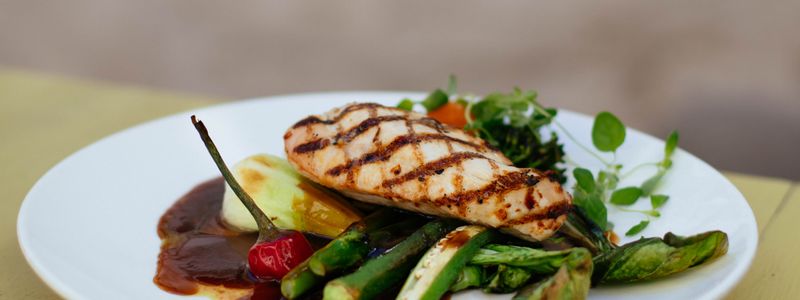
A palm-sized piece of chicken, fish, or lean meat lands near 25 grams. That is one meal's target on one plate.
4
The weak meal
Front-Load Breakfast, the Meal Everyone Skips
Most people back-load their protein. Breakfast is toast, cereal, or fruit, lunch is light, and nearly all the day's protein arrives at dinner, long after the muscle-building window would have opened. The morning meal is where the easiest 25 grams goes missing.
Cleveland Clinic points out that moving some protein from supper to breakfast can also curb hunger and cravings through the day, which helps with weight as well as muscle (Cleveland Clinic, 2024). Three eggs, a bowl of Greek yogurt, or cottage cheese turns the weakest meal of the day into one of the strongest.
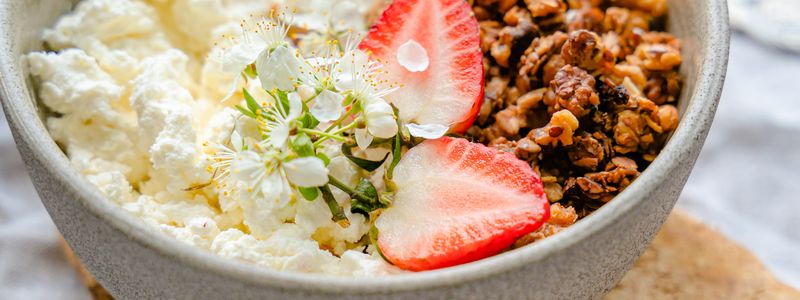
Cottage cheese and Greek yogurt carry 15 to 25 grams a serving, turning breakfast into a protein meal.
5
The sources
Where the Grams Come From, No Powder Required
You do not need a shaker bottle to hit these numbers. A three-ounce chicken breast carries about 25 grams, a can of tuna about 25, a cup of Greek yogurt around 20, three eggs about 18, and a cup of lentils or beans roughly 18. Stack two or three of those across the day and the target takes care of itself.
Powders are a convenience, not a requirement. Harvard Health is blunt that most people can get all the protein they need from food, and that whole foods bring fiber, vitamins, and minerals a scoop does not (Harvard Health, 2025). Start with the plate. Reach for the powder only if the plate genuinely comes up short.
Variety does the rest of the work. Rotating eggs, dairy, fish, poultry, beans, and lentils across the week covers the full range of amino acids muscle is built from, and the plant sources bring fiber and minerals that support the rest of your health in the same bite.
Take the protein playbook with you
Your free 2-page plan: your daily protein target, the 25-gram foods that hit it, and a simple three-meal template.
One email. No spam. Unsubscribe anytime.
Free Lifestyle Assessment
How Healthy Is Your Current Lifestyle?
Answer honestly for five minutes and walk away with your personal scorecard: all six areas of your health rated, the one that needs your attention first, and a 30-day plan built from your answers. It shows up the second you finish.
Free. About 5 minutes. Your results appear instantly.
📋 Your Coach's Recommendations
1
Hit 25 to 30 Grams at Every Meal
Three protein-anchored meals clears the higher target older adults need. A palm of meat or fish, a cup of Greek yogurt, or a cup of beans each lands you in range. No math, no tracking.
2
Rebuild Breakfast Around Protein
Make the morning meal carry 25 grams: eggs, Greek yogurt, or cottage cheese. It is the easiest protein most people leave on the table, and it steadies hunger for the rest of the day.
3
Lift Something Twice a Week
Protein only protects muscle if you use the muscle. Two short resistance sessions a week, even with bands or bodyweight, give the protein a reason to rebuild instead of pass through.
?
How it works. Just a quiet check-in, not an alert and not a recurring nag. The event lands as a 30-minute slot at 9am two weeks from today, with your plan in the notes and a link back to this article. Works with Apple Calendar, Google Calendar, and Outlook. Yours to move, snooze, or delete whenever.
Keep this plan
Get the one-page protein plan: your daily target, the 25-gram foods, and a three-meal template that hits it.
One email. No spam. Unsubscribe anytime.
Where should we send it?
Your 1-page protein plan, straight to your inbox.
We send the plan plus one short evidence brief each week. Unsubscribe anytime.
✓
It's on the way
Check your inbox in the next minute. Want it right now?
Your first Ageless Brief arrives this week: one study, translated, no hype.
To your health,
Frequently Asked Questions
How much protein do I actually need after 50?
The RDA is 0.8 grams per kilogram of body weight, but that is a minimum to prevent deficiency. A growing body of research and expert panels put the target for older adults closer to 1.0 to 1.2 grams per kilogram to help preserve muscle, which is roughly 68 to 82 grams a day for a 150-pound adult.
Is the 0.8 gram RDA enough for older adults?
It is enough to avoid a deficiency, but many experts argue it is too low to protect muscle as you age. Harvard Health reports that older adults eating more protein hold on to more lean mass and may delay disability.
How much protein can my body use at one meal?
Roughly 25 to 40 grams per sitting, according to Cleveland Clinic. Mayo Clinic adds that more than about 40 grams at once is no more useful than 15 to 30. Spreading protein across three meals beats loading it all into dinner.
What are the best high-protein foods after 50?
Eggs, Greek yogurt, cottage cheese, chicken, turkey, fish and canned tuna, and beans or lentils. A three-ounce serving of meat or fish lands near 25 grams, and a cup of Greek yogurt adds about 20.
Do I need protein powder to hit these numbers?
No. Harvard Health says most people can meet their needs from food, which also brings fiber, vitamins, and minerals a scoop does not. Treat powder as an occasional convenience, not a daily requirement.
Does eating more protein alone rebuild muscle?
No. Protein supplies the raw material, but muscle only rebuilds when you use it, so pair the higher intake with two short resistance sessions a week. This article is educational and not medical advice; if you have kidney disease or another condition, ask your doctor before raising your protein intake.
Curious where you stand? Take the free 5-minute lifestyle assessment and your personal scorecard appears the second you finish.
By the Ageless Coach Editorial Team · Published May 21, 2026 · Last updated July 14, 2026
<style>
:root{--dark-base:#0D1B2A;--dark-mid:#1B3A4B;--teal:#0EA5A0;--teal-dark:#0C8C88;--teal-bright:#14D4CD;--fog:#D8E8E8;--deep-fog:#C8DCDC;--fog-border:#A8C4C4;--ink:#313743;--ink-soft:#49505f;--muted:#6b7280;--warm:#9A6841;--warm-light:#be7b4c;--serif:"Source Serif 4",Georgia,serif;--sans:Inter,-apple-system,BlinkMacSystemFont,"Segoe UI",sans-serif}
.w-richtext p,.w-richtext li,.w-richtext td{font-size:20.5px;line-height:1.7;color:var(--ink-soft)}
.w-richtext ul{list-style-type:disc;padding-left:24px;margin:12px 0}
.w-richtext ul li{margin-bottom:8px}
.ac-answer{background:#fff;border:1px solid #D4E4E4;border-top:5px solid var(--teal);border-radius:16px;padding:22px 24px 18px;margin:16px 0 28px;box-shadow:0 6px 22px rgba(13,27,42,.07)}
.ac-answer .aa-eyebrow{font:800 12px/1 var(--sans);letter-spacing:2.5px;text-transform:uppercase;color:var(--teal-dark);margin-bottom:8px}
.ac-answer .aa-head{font-family:var(--serif);font-size:24px;line-height:1.2;font-weight:800;color:var(--dark-base);margin:0 0 16px}
.ac-answer .aa-list{list-style:none;margin:0;padding:0}
.ac-answer .aa-list li{display:flex;gap:12px;align-items:baseline;padding:11px 0;border-bottom:1px solid #EDF3F3;font:700 16.5px/1.4 var(--sans);color:var(--ink)}
.ac-answer .aa-list li:last-child{border-bottom:none}
.ac-answer .aa-n{flex-shrink:0;width:24px;height:24px;border-radius:50%;background:var(--teal-dark);color:#fff;font:800 12px/24px var(--sans);text-align:center}
.ac-answer .aa-food{color:var(--teal-dark);font-weight:800}
.ac-answer .aa-cue{margin-top:18px;text-align:center}
.ac-answer .aa-cta{display:inline-flex;align-items:center;gap:10px;background:var(--teal-dark);color:#fff;font:800 14px/1 var(--sans);letter-spacing:.2px;padding:14px 26px;border-radius:50px;text-decoration:none;box-shadow:0 6px 16px rgba(12,140,136,.30)}
.ac-answer .aa-cta:hover{background:#0A7A76}
.ac-answer .aa-arw{display:inline-block;animation:aa-nudge 1.4s ease-in-out infinite}
@keyframes aa-nudge{0%,100%{transform:translateY(0)}50%{transform:translateY(4px)}}
@media(max-width:560px){.ac-answer{padding:20px 18px 16px}.ac-answer .aa-head{font-size:21px}.ac-answer .aa-list li{font-size:15px}}
.ac-band{margin:56px 0 24px;padding:26px 24px 12px;background:linear-gradient(180deg,#F0F7F7,#fff);border-radius:16px}
.ac-band.hype{background:linear-gradient(180deg,#FAF3EB,#fff)}
.ac-band .inner{display:flex;gap:20px;align-items:center}
.ac-band .big{font:900 72px/1 var(--sans);color:var(--deep-fog);flex-shrink:0}
.ac-band.hype .big{color:#EAD9C6}
.ac-band .q{font:700 13px/1.4 var(--sans);letter-spacing:2px;text-transform:uppercase;color:var(--teal-dark)}
.ac-band.hype .q{color:var(--warm)}
.ac-band h3{font-family:var(--serif);font-size:30px;line-height:1.2;font-weight:800;color:var(--ink);margin:0}
.ac-callout{border-left:4px solid var(--teal);background:#F4FAFA;border-radius:0 12px 12px 0;padding:18px 22px;margin:28px 0}
.ac-callout .n{font:800 20px/1.35 var(--sans);color:var(--dark-mid);margin-bottom:6px}
.ac-callout .d{font:500 15px/1.55 var(--sans);color:var(--ink-soft)}
.ac-callout .c{font:600 11.5px/1 var(--sans);letter-spacing:1.5px;text-transform:uppercase;color:var(--muted);margin-top:10px}
.ac-plan{background:linear-gradient(135deg,#F4FAFA 0%,#fff 100%);border-left:5px solid var(--teal-dark);border-radius:14px;padding:30px 26px;margin:40px 0 0;box-shadow:0 2px 12px rgba(0,0,0,.06);scroll-margin-top:100px}
.ac-plan .ptitle{font-family:var(--serif);font-size:24px;font-weight:800;color:var(--ink);margin-bottom:22px}
.ac-plan .step{display:flex;gap:16px;margin-bottom:18px;align-items:flex-start}
.ac-plan .step .n{min-width:38px;width:38px;height:38px;background:var(--teal-dark);border-radius:50%;color:#fff;font:800 17px/38px var(--sans);text-align:center;flex-shrink:0}
.ac-plan .sh{font:800 16.5px/1.4 var(--sans);color:var(--ink);margin-bottom:3px}
.ac-plan .sd{font:400 15px/1.6 var(--sans);color:var(--muted)}
.ac-plan .actions{border-top:1px solid #D8E8E8;margin-top:16px;padding-top:20px}
.ac-primary-row{display:flex;align-items:center;gap:10px;padding:0 4px}
.ac-btn-primary-wide{flex:1;background:var(--teal);color:#fff;border:1.5px solid var(--teal);border-radius:14px;padding:12px 22px;box-shadow:0 4px 14px rgba(14,165,160,.22);font-family:var(--sans);cursor:pointer;display:grid;grid-template-columns:auto 1fr;gap:14px;align-items:center;transition:all .18s ease}
.ac-btn-primary-wide:hover{background:var(--teal-dark);border-color:var(--teal-dark)}
.ac-btn-primary-wide .icon svg{width:22px;height:22px;color:#fff;display:block}
.ac-btn-primary-wide .label{text-align:left;line-height:1.25}
.ac-btn-primary-wide .label .top{display:block;font-weight:700;font-size:15.5px;color:#fff}
.ac-btn-primary-wide .label .top em{font-style:italic;font-weight:700}
.ac-cal-help{position:relative;flex-shrink:0}
.ac-cal-help summary{list-style:none;width:24px;height:24px;border-radius:50%;background:#E4F1F1;border:1px solid var(--fog-border);color:var(--dark-mid);font:700 13px/22px var(--sans);text-align:center;cursor:pointer;display:block}
.ac-cal-help summary::-webkit-details-marker{display:none}
.ac-cal-help .tip{position:absolute;right:0;top:32px;z-index:50;width:290px;background:var(--dark-base);color:var(--fog);border-radius:12px;padding:14px 16px;font:500 12.5px/1.55 var(--sans);box-shadow:0 10px 30px rgba(13,27,42,.35)}
.ac-cal-help .tip strong{color:#fff}
.ac-btn-share-wide{display:flex;width:100%;align-items:center;justify-content:center;gap:10px;background:#fff;color:var(--teal-dark);border:1.5px solid var(--teal-dark);border-radius:14px;padding:12px 22px;margin-top:10px;font:800 15px/1 var(--sans);cursor:pointer}
.ac-btn-share-wide svg{width:18px;height:18px}
.ac-midcap{background:linear-gradient(180deg,#F0F7F7,#fff);border:1.5px solid var(--fog-border);border-radius:16px;padding:24px 22px;margin:34px 0;text-align:center}
.ac-midcap h4{font-family:var(--serif);font-size:22px;font-weight:800;color:var(--ink);margin:0 0 6px}
.ac-midcap .sub{font:500 14px/1.55 var(--sans);color:var(--ink-soft);margin:0 auto 14px;max-width:400px}
.ac-midcap .mcform{display:flex;gap:8px;max-width:400px;margin:0 auto}
.ac-midcap .mcform input{flex:1;border:1.5px solid var(--fog-border);border-radius:50px;padding:12px 18px;font:500 14px/1 var(--sans);min-width:0}
.ac-midcap .mcform button{background:var(--teal-dark);color:#fff;border:none;border-radius:50px;padding:12px 20px;font:800 13.5px/1 var(--sans);cursor:pointer;white-space:nowrap}
.ac-midcap .fine{font:500 11.5px/1.5 var(--sans);color:var(--muted);margin-top:10px}
@media (max-width:520px){.ac-midcap .mcform{flex-direction:column}}
.ac-assess-promo{background:linear-gradient(135deg,#D8E8E8,#C8DCDC);border:1px solid var(--fog-border);border-radius:16px;padding:34px 30px;margin:44px 0;text-align:center}
.ac-assess-promo .eyebrow{color:var(--teal-dark);font:800 12px/1 var(--sans);letter-spacing:2.5px;text-transform:uppercase;margin:0 0 10px}
.ac-assess-promo h4{font-family:var(--serif);color:var(--dark-base);font-size:26px;font-weight:800;margin:0 0 12px}
.w-embed .ac-assess-promo p.ap-body,.ac-assess-promo p.ap-body{font-family:Georgia,serif;color:#3A5555;font-size:15.5px;font-weight:500;line-height:1.65;max-width:540px;margin:0 auto 22px}
.ac-assess-promo .ap-cta{display:inline-block;background:var(--teal-bright);color:var(--dark-base);font:800 15px/1 var(--sans);padding:15px 30px;border-radius:50px;text-decoration:none}
.ac-assess-promo .ap-fine{color:#4E6B6B;font:500 13px/1.5 var(--sans);margin:14px 0 0}
.ac-assess-line{border-top:1px solid #E2ECEC;margin-top:30px;padding:22px 10px 0;text-align:center;font:500 15.5px/1.6 var(--sans);color:#3A5555}
.w-embed .ac-assess-line a,.ac-assess-line a{color:var(--teal-dark);font-weight:700;text-decoration:underline;text-underline-offset:3px}
.ac-articlemeta{font:500 12.5px/1.6 var(--sans);color:#98a0a6;text-align:center;margin:24px 0 0}
.ac-capture{background:linear-gradient(180deg,#F0F7F7,#fff);border:1.5px solid var(--fog-border);border-radius:16px;padding:30px 28px;margin:26px 0 44px;text-align:center}
.ac-capture .cap-state{display:none}
.ac-capture[data-state="trigger"] .st-trigger{display:block}
.ac-capture[data-state="form"] .st-form{display:block}
.ac-capture[data-state="sent"] .st-sent{display:block}
.ac-capture h4{font-family:var(--serif);font-size:24px;font-weight:800;color:var(--ink);margin:0 0 8px}
.ac-capture .sub{font:500 15px/1.55 var(--sans);color:var(--ink-soft);margin:0 auto 18px;max-width:430px}
.ac-capture .bigbtn{display:inline-flex;align-items:center;gap:10px;background:var(--teal-dark);color:#fff;border:none;border-radius:50px;padding:16px 30px;font:800 16px/1 var(--sans);cursor:pointer;box-shadow:0 6px 18px rgba(12,140,136,.28)}
.ac-capture .capform{display:flex;gap:10px;max-width:430px;margin:0 auto}
.ac-capture .capform input{flex:1;border:1.5px solid var(--fog-border);border-radius:50px;padding:14px 20px;font:500 15px/1 var(--sans)}
.ac-capture .capform button{background:var(--teal-dark);color:#fff;border:none;border-radius:50px;padding:14px 24px;font:800 14px/1 var(--sans);cursor:pointer}
.ac-capture .sent-check{width:52px;height:52px;border-radius:50%;background:var(--teal);color:#fff;font:800 26px/52px var(--sans);margin:0 auto 12px}
.ac-capture .dl{display:inline-block;margin-top:6px;color:var(--teal-dark);font:700 15px/1 var(--sans);text-decoration:underline;cursor:pointer}
.ac-capture .fine{font:500 12px/1.5 var(--sans);color:var(--muted);margin-top:12px}
.ac-sig{margin-top:36px}
.ac-sig .rule{width:60px;height:2px;background:linear-gradient(90deg,var(--teal-dark),var(--teal-bright));margin-bottom:18px;border-radius:2px}
.ac-sig .toyour{font-family:var(--serif);font-size:16px;font-style:italic;color:#777;margin:0 0 10px;padding-left:2px}
.ac-faq{margin-top:40px;border-top:1px solid #e5e7eb;padding-top:30px;margin-bottom:40px}
.ac-faq h2{font-family:var(--serif);font-size:23px;font-weight:800;color:var(--ink);margin:0 0 18px}
.ac-faq details{border:1px solid #e5e7eb;border-radius:10px;margin-bottom:10px}
.ac-faq summary{padding:15px 18px;font:700 16px/1.4 var(--sans);color:var(--ink);cursor:pointer;display:flex;justify-content:space-between;align-items:center;list-style:none}
.ac-faq summary:after{content:"\25BE";color:var(--warm)}
.ac-faq .a{padding:0 18px 16px;font-size:17px;line-height:1.65;color:#555}
.article-header-section .article-container{max-width:1080px !important;margin:0 auto !important;padding:0 20px !important}
.article-header-section .article-hero-image{display:block;width:100%;max-width:660px;margin:0}
.article-header-section .article-title{display:block !important;font-family:var(--serif);font-size:32px;line-height:1.25;font-weight:700;color:#313743;margin:20px 0 12px 0;text-align:left;max-width:660px}
@media (max-width:767px){.article-header-section .article-title{font-size:26px}.article-header-section .article-hero-image{max-width:100%}}
@media (max-width:640px){.ac-band .big{font-size:52px}}
@media (max-width:520px){.ac-capture .capform{flex-direction:column}}
.ac-figure{margin:30px 0}.ac-figure img{display:block;width:100%;border-radius:14px;height:auto;aspect-ratio:800/300}.ac-figure figcaption{font:500 13px/1.5 var(--sans);color:var(--muted);margin-top:9px}</style>
<div class="ac-answer">
<div class="aa-eyebrow">The number most people get wrong</div>
<h2 class="aa-head">The RDA is a floor, not a goal. After 50, protein is what keeps muscle on your frame.</h2>
<ol class="aa-list">
<li><span class="aa-n">1</span><span><span class="aa-food">The 0.8 rule</span> · what the RDA actually promises, and why it is only the minimum</span></li>
<li><span class="aa-n">2</span><span><span class="aa-food">The real target</span> · why experts put older adults closer to 1.0 to 1.2 grams per kilo</span></li>
<li><span class="aa-n">3</span><span><span class="aa-food">25 to 30 grams a meal</span> · the per-meal dose your body can actually use</span></li>
<li><span class="aa-n">4</span><span><span class="aa-food">Front-load breakfast</span> · the meal most people leave almost protein-free</span></li>
<li><span class="aa-n">5</span><span><span class="aa-food">Where it comes from</span> · the everyday foods that hit the number without powders</span></li>
</ol>
<div class="aa-cue"><a class="aa-cta" href="#coach-recommendations">Get Your Coach's 3-Step Plan <span class="aa-arw">↓</span></a></div>
</div>
<p>Muscle does not leave with a bang. It slips away quietly, a little each year, in a process doctors call sarcopenia. It starts as early as your 30s and speeds up after 50, and Harvard Health lists too little dietary protein among its direct causes, alongside too little activity (<a href="https://www.health.harvard.edu/healthy-aging-and-longevity/a-guide-to-combatting-sarcopenia-and-preserving-muscle-mass-as-you-get-older" target="_blank" rel="noopener">Harvard Health, 2025</a>). Less muscle means less strength, a slower metabolism, and a higher risk of the falls and frailty that steal independence later on.</p>
<p>Here is the mistake almost nobody knows they are making: they eat enough protein to avoid a deficiency, but not enough to protect their muscle. The gap hides inside a single number most people have never questioned. Fix the number and you change the trajectory.</p>
<div class="ac-band"><div class="inner"><div class="big">1</div><div><div class="q">The floor</div><h3>The 0.8 Rule Is a Minimum, Not a Goal</h3></div></div></div>
<p>The official Recommended Dietary Allowance for protein is 0.8 grams per kilogram of body weight per day, which works out to about 54 grams for a 150-pound adult (<a href="https://www.health.harvard.edu/nutrition/are-you-eating-enough-protein" target="_blank" rel="noopener">Harvard Health, 2025</a>). That sounds precise, and it is widely treated as the target.</p>
<p>But the RDA was set to prevent deficiency in the average healthy adult, not to preserve muscle in an aging one. It is the amount that keeps you from running short, the floor beneath which problems appear. Reading it as your goal is like treating the speed limit as the slowest you are allowed to drive. After 50, the floor and the goal are not the same number.</p>
<div class="ac-callout"><div class="n">The 0.8 gram RDA prevents deficiency. It was never set to preserve muscle in older adults.</div><div class="d">Treating the minimum as your target is the quiet mistake behind years of slow muscle loss.</div><div class="c">Harvard Health, 2025</div></div>
<div class="ac-band"><div class="inner"><div class="big">2</div><div><div class="q">The real target</div><h3>After 50, the Evidence Points Higher</h3></div></div></div>
<p>A growing body of research and several expert panels now put the target for older adults closer to 1.0 to 1.2 grams per kilogram per day, meaningfully above the standard RDA, to help maintain muscle as we age. For that same 150-pound adult, that is roughly 68 to 82 grams a day rather than 54.</p>
<p>The payoff is not vanity. Harvard Health reports that older adults who eat more protein hold on to more lean mass and may delay the disability that comes with muscle loss (<a href="https://www.health.harvard.edu/healthy-aging-and-longevity/eating-enough-daily-protein-may-delay-disability" target="_blank" rel="noopener">Harvard Health, 2024</a>). More protein on the plate today buys more strength and independence later.</p>
<p>Muscle is about more than strength. It anchors your metabolism, steadies your balance, and is the very tissue that protects you from the falls and fractures that end independence. Harvard and the National Institute on Aging make the same point in tandem: protein and resistance exercise work together, the food supplying the raw material and the training giving your body a reason to build with it rather than let it pass through (<a href="https://www.health.harvard.edu/healthy-aging-and-longevity/a-guide-to-combatting-sarcopenia-and-preserving-muscle-mass-as-you-get-older" target="_blank" rel="noopener">Harvard Health, 2025</a>).</p>
<div class="ac-band"><div class="inner"><div class="big">3</div><div><div class="q">The timing</div><h3>Spread It Out, About 25 to 30 Grams a Meal</h3></div></div></div>
<p>Total protein matters, but so does how you space it. Cleveland Clinic notes the body can only use roughly 25 to 40 grams of protein at one sitting, so it is better to spread intake across the day than to load it all into one meal (<a href="https://health.clevelandclinic.org/how-much-protein-you-need" target="_blank" rel="noopener">Cleveland Clinic, 2024</a>).</p>
<p>Mayo Clinic makes the same point from the other side: eating more than about 40 grams in a single sitting is no more useful than the recommended 15 to 30 grams (<a href="https://newsnetwork.mayoclinic.org/discussion/are-you-getting-enough-protein/" target="_blank" rel="noopener">Mayo Clinic, 2024</a>). The practical target is simple. Aim for 25 to 30 grams at each of three meals, and you clear the higher bar without thinking in decimals.</p>
<figure class="ac-figure"><img src="https://images.pexels.com/photos/1247677/pexels-photo-1247677.jpeg?auto=compress&cs=tinysrgb&w=800&h=300&fit=crop" alt="Grilled chicken breast with grilled vegetables on a white plate" width="800" height="300" loading="lazy" decoding="async"><figcaption>A palm-sized piece of chicken, fish, or lean meat lands near 25 grams. That is one meal's target on one plate.</figcaption></figure>
<div class="ac-band"><div class="inner"><div class="big">4</div><div><div class="q">The weak meal</div><h3>Front-Load Breakfast, the Meal Everyone Skips</h3></div></div></div>
<p>Most people back-load their protein. Breakfast is toast, cereal, or fruit, lunch is light, and nearly all the day's protein arrives at dinner, long after the muscle-building window would have opened. The morning meal is where the easiest 25 grams goes missing.</p>
<p>Cleveland Clinic points out that moving some protein from supper to breakfast can also curb hunger and cravings through the day, which helps with weight as well as muscle (<a href="https://health.clevelandclinic.org/how-much-protein-you-need" target="_blank" rel="noopener">Cleveland Clinic, 2024</a>). Three eggs, a bowl of Greek yogurt, or cottage cheese turns the weakest meal of the day into one of the strongest.</p>
<figure class="ac-figure"><img src="https://images.pexels.com/photos/4397312/pexels-photo-4397312.jpeg?auto=compress&cs=tinysrgb&w=800&h=300&fit=crop" alt="Bowl of cottage cheese with granola and sliced strawberries" width="800" height="300" loading="lazy" decoding="async"><figcaption>Cottage cheese and Greek yogurt carry 15 to 25 grams a serving, turning breakfast into a protein meal.</figcaption></figure>
<div class="ac-band"><div class="inner"><div class="big">5</div><div><div class="q">The sources</div><h3>Where the Grams Come From, No Powder Required</h3></div></div></div>
<p>You do not need a shaker bottle to hit these numbers. A three-ounce chicken breast carries about 25 grams, a can of tuna about 25, a cup of Greek yogurt around 20, three eggs about 18, and a cup of lentils or beans roughly 18. Stack two or three of those across the day and the target takes care of itself.</p>
<p>Powders are a convenience, not a requirement. Harvard Health is blunt that most people can get all the protein they need from food, and that whole foods bring fiber, vitamins, and minerals a scoop does not (<a href="https://www.health.harvard.edu/nutrition/are-you-eating-enough-protein" target="_blank" rel="noopener">Harvard Health, 2025</a>). Start with the plate. Reach for the powder only if the plate genuinely comes up short.</p>
<p>Variety does the rest of the work. Rotating eggs, dairy, fish, poultry, beans, and lentils across the week covers the full range of amino acids muscle is built from, and the plant sources bring fiber and minerals that support the rest of your health in the same bite.</p>
<div class="ac-midcap">
<h4>Take the protein playbook with you</h4>
<p class="sub">Your free 2-page plan: your daily protein target, the 25-gram foods that hit it, and a simple three-meal template.</p>
<div class="mcform"><input type="email" placeholder="Your email address" aria-label="Email address"><button type="button">Send My Plan (Free)</button></div>
<div class="fine">One email. No spam. Unsubscribe anytime.</div>
</div>
<div class="ac-assess-promo">
<p class="eyebrow">Free Lifestyle Assessment</p>
<h4>How Healthy Is Your Current Lifestyle?</h4>
<p class="ap-body">Answer honestly for five minutes and walk away with your personal scorecard: all six areas of your health rated, the one that needs your attention first, and a 30-day plan built from your answers. It shows up the second you finish.</p>
<a class="ap-cta" href="/#assessment">See How the Assessment Works →</a>
<p class="ap-fine">Free. About 5 minutes. Your results appear instantly.</p>
</div>
<div class="ac-plan" id="coach-recommendations"><div class="ptitle">📋 Your Coach's Recommendations</div>
<div class="step"><div class="n">1</div><div><div class="sh">Hit 25 to 30 Grams at Every Meal</div><div class="sd">Three protein-anchored meals clears the higher target older adults need. A palm of meat or fish, a cup of Greek yogurt, or a cup of beans each lands you in range. No math, no tracking.</div></div></div>
<div class="step"><div class="n">2</div><div><div class="sh">Rebuild Breakfast Around Protein</div><div class="sd">Make the morning meal carry 25 grams: eggs, Greek yogurt, or cottage cheese. It is the easiest protein most people leave on the table, and it steadies hunger for the rest of the day.</div></div></div>
<div class="step"><div class="n">3</div><div><div class="sh">Lift Something Twice a Week</div><div class="sd">Protein only protects muscle if you use the muscle. Two short resistance sessions a week, even with bands or bodyweight, give the protein a reason to rebuild instead of pass through.</div></div></div>
<div class="actions">
<div class="ac-primary-row">
<button type="button" class="ac-btn-primary-wide" data-ac-cal>
<span class="icon"><svg viewBox="0 0 24 24" fill="none" stroke="currentColor" stroke-width="2" stroke-linecap="round" stroke-linejoin="round"><rect x="3" y="4" width="18" height="18" rx="2"></rect><path d="M16 2v4M8 2v4M3 10h18"></path></svg></span>
<span class="label"><span class="top">Add <em>Your Coach's Recommendations to Your Calendar</em></span></span>
</button>
<details class="ac-cal-help">
<summary aria-label="What does this do?">?</summary>
<div class="tip"><strong>How it works.</strong> Just a quiet check-in, not an alert and not a recurring nag. The event lands as a 30-minute slot at 9am two weeks from today, with your plan in the notes and a link back to this article. Works with Apple Calendar, Google Calendar, and Outlook. Yours to move, snooze, or delete whenever.</div>
</details>
</div>
<button type="button" class="ac-btn-share-wide" data-ac-share>
<svg viewBox="0 0 24 24" fill="none" stroke="currentColor" stroke-width="2" stroke-linecap="round" stroke-linejoin="round"><path d="M4 12v8a2 2 0 002 2h12a2 2 0 002-2v-8"></path><polyline points="16 6 12 2 8 6"></polyline><line x1="12" y1="2" x2="12" y2="15"></line></svg>
Share this article
</button>
</div>
</div>
<div class="ac-capture" data-state="trigger" data-article-slug="how-much-protein-after-50-and-why-the-rda-is-probably-too-low" data-pdf-url="https://cdn.prod.website-files.com/69be1026a027224999b7936b/6a561e8f99629e44a8d0d00b_protein-after-50-plan.pdf" data-plan-title="The Protein After 50 Plan" data-plan-desc="Your free 2-page plan: your daily protein target, the everyday foods that hit it, and a simple three-meal template. Checked against Harvard Health, Cleveland Clinic, and Mayo Clinic.">
<div class="st-trigger cap-state"><h4>Keep this plan</h4>
<p class="sub">Get the one-page protein plan: your daily target, the 25-gram foods, and a three-meal template that hits it.</p>
<button class="bigbtn" type="button" data-cap="form">📩 Email Me This Plan (Free PDF)</button>
<div class="fine">One email. No spam. Unsubscribe anytime.</div></div>
<div class="st-form cap-state"><h4>Where should we send it?</h4>
<p class="sub">Your 1-page protein plan, straight to your inbox.</p>
<form class="capform"><input type="email" name="email" required placeholder="Your email address" aria-label="Email address"><button type="submit">Send My Plan</button></form>
<div class="fine">We send the plan plus one short evidence brief each week. Unsubscribe anytime.</div></div>
<div class="st-sent cap-state"><div class="sent-check">✓</div><h4>It's on the way</h4>
<p class="sub">Check your inbox in the next minute. Want it right now?</p>
<a class="dl" href="https://cdn.prod.website-files.com/69be1026a027224999b7936b/6a561e8f99629e44a8d0d00b_protein-after-50-plan.pdf" download>⬇ Download your plan (PDF)</a>
<div class="fine">Your first Ageless Brief arrives this week: one study, translated, no hype.</div></div>
</div>
<div class="ac-sig">
<div class="rule"></div>
<p class="toyour">To your health,</p>
<svg width="320" height="72" viewBox="0 0 320 72" role="img" aria-label="Ageless Coach. Age Strong. Live Long." xmlns="http://www.w3.org/2000/svg" xmlns:xlink="http://www.w3.org/1999/xlink">
<defs><clipPath id="acSigIconClip"><rect x="0" y="6" width="60" height="60" rx="12" ry="12"/></clipPath></defs>
<image x="0" y="6" width="60" height="60" clip-path="url(#acSigIconClip)" preserveAspectRatio="xMidYMid slice" href="https://cdn.prod.website-files.com/69be1026a027224999b7936b/6a0b22c6afd5d6fd115b9c1a_ac-closing-brand-icon.webp" xlink:href="https://cdn.prod.website-files.com/69be1026a027224999b7936b/6a0b22c6afd5d6fd115b9c1a_ac-closing-brand-icon.webp"/>
<text x="76" y="42" style="font-family:Inter,system-ui,-apple-system,'Helvetica Neue',Arial,sans-serif;font-size:27px;letter-spacing:-0.3px">
<tspan style="font-weight:800;fill:#0D1B2A">Ageless</tspan><tspan style="font-weight:300;fill:rgba(13,27,42,0.6)">Coach</tspan><tspan dy="-12" style="font-size:16px;font-weight:600;fill:rgba(13,27,42,0.6)">™</tspan>
</text>
<text x="76" y="60" style="font-family:Inter,system-ui,-apple-system,'Helvetica Neue',Arial,sans-serif;font-size:10.5px;letter-spacing:2.5px;font-weight:500;fill:#0C8C88;text-transform:uppercase">AGE STRONG. LIVE LONG.</text>
</svg>
</div>
<div class="ac-faq"><h2>Frequently Asked Questions</h2>
<details><summary>How much protein do I actually need after 50?</summary><div class="a">The RDA is 0.8 grams per kilogram of body weight, but that is a minimum to prevent deficiency. A growing body of research and expert panels put the target for older adults closer to 1.0 to 1.2 grams per kilogram to help preserve muscle, which is roughly 68 to 82 grams a day for a 150-pound adult.</div></details>
<details><summary>Is the 0.8 gram RDA enough for older adults?</summary><div class="a">It is enough to avoid a deficiency, but many experts argue it is too low to protect muscle as you age. Harvard Health reports that older adults eating more protein hold on to more lean mass and may delay disability.</div></details>
<details><summary>How much protein can my body use at one meal?</summary><div class="a">Roughly 25 to 40 grams per sitting, according to Cleveland Clinic. Mayo Clinic adds that more than about 40 grams at once is no more useful than 15 to 30. Spreading protein across three meals beats loading it all into dinner.</div></details>
<details><summary>What are the best high-protein foods after 50?</summary><div class="a">Eggs, Greek yogurt, cottage cheese, chicken, turkey, fish and canned tuna, and beans or lentils. A three-ounce serving of meat or fish lands near 25 grams, and a cup of Greek yogurt adds about 20.</div></details>
<details><summary>Do I need protein powder to hit these numbers?</summary><div class="a">No. Harvard Health says most people can meet their needs from food, which also brings fiber, vitamins, and minerals a scoop does not. Treat powder as an occasional convenience, not a daily requirement.</div></details>
<details><summary>Does eating more protein alone rebuild muscle?</summary><div class="a">No. Protein supplies the raw material, but muscle only rebuilds when you use it, so pair the higher intake with two short resistance sessions a week. This article is educational and not medical advice; if you have kidney disease or another condition, ask your doctor before raising your protein intake.</div></details>
</div>
<div class="ac-assess-line">Curious where you stand? Take the free <a href="/#assessment">5-minute lifestyle assessment</a> and your personal scorecard appears the second you finish.</div>
<p class="ac-articlemeta">By the Ageless Coach Editorial Team · Published May 21, 2026 · Last updated July 14, 2026</p>
Subscribe to the Free Newsletter
One article a week. Trusted research made simple. Start making smarter health decisions today.