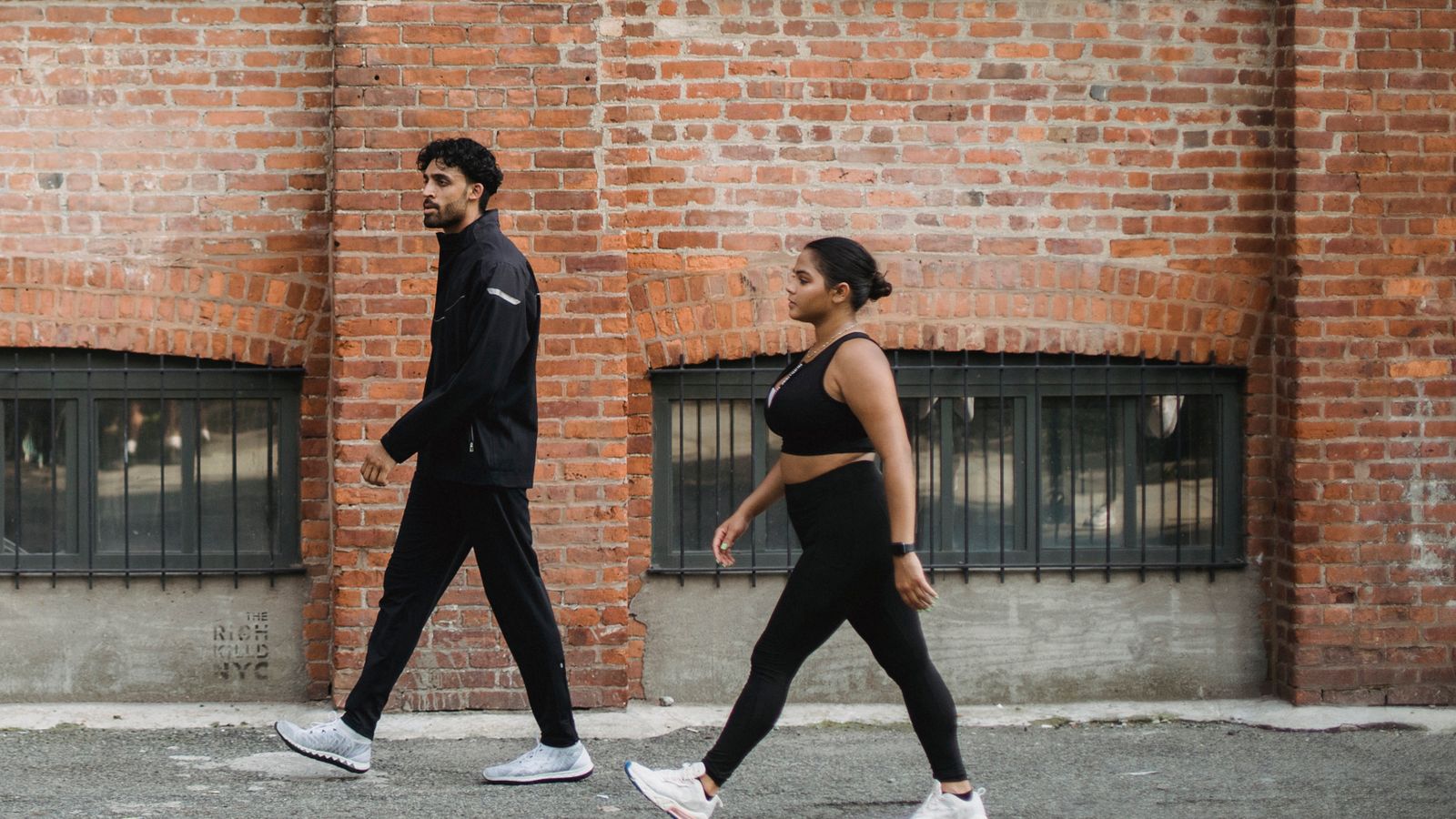
How fast you walk is one of the simplest read-outs of how well you are aging. In a study of nearly 85,000 adults, people who walked briskly for even 15 minutes a day were about 20 percent less likely to die over the next 17 years, and an everyday pace that quietly slows can flag a problem years before you feel it.
1Nearly 20 percent · brisk walkers in a large study were about that much less likely to die over 17 years than slow walkers
2A daily stress test · a cardiologist says your walk is a check you can run every day, and a slipping pace may tip off a hidden problem
315 minutes · the small daily dose of faster walking tied to a longer life, with no gym required
465 to 75 percent · the share of your maximum heart rate that marks a real, moderate-intensity walk
51 in 5 · how few adults actually hit the recommended 150 minutes of moderate activity each week
You do not need a lab, a treadmill or a wearable to get a reading on how well you are aging. You already run the test several times a day, every time you cross a parking lot, catch a light or climb a flight of stairs. It is your walking speed, and it quietly says more than it seems to.
The reason is not mystical. Faster walking is a sign of fitness and healthy muscle, so a Cleveland Clinic cardiologist calls your daily walk a kind of stress test you can run every day. When your usual pace starts to slip, that change can flag a problem years before anything actually hurts.
1
The signal
What Your Everyday Pace Reveals
The link is straightforward. The ability to walk faster reflects strength, healthy muscle mass and solid cardiorespiratory fitness, cardiologist Ashish Sarraju explains at Cleveland Clinic, which turns your pace into a rough barometer for the whole body. When your fitness and activity levels are high, he notes, your heart health tends to be better too.
That makes an ordinary walk quietly informative. If a distance that once felt easy now leaves you winded, or you catch yourself dawdling where you used to stride, that shift is worth paying real attention to rather than shrugging off as just getting older. It is your body sending an early, honest signal.
2
The evidence
The Study That Followed 85,000 People
The longevity link is not a hunch either. Harvard Health reported on an analysis of nearly 85,000 adults aged 40 to 79, whose exercise habits and walking speed were logged and then tracked for the next 17 years. The people involved were ordinary adults across a dozen states, not elite athletes, which is part of what makes the finding hard to wave away.
The result was striking. People who walked fast for as little as 15 minutes a day were nearly 20 percent less likely to have died than those who did not, while people who strolled slowly for more than three hours a day gained only about 4 percent. It was the intensity of the walking, not the sheer hours, that moved the needle.
A brisk, heel-to-toe stride is exactly the kind of moderate exercise the research links to a longer, healthier life.
3
The catch
What Actually Counts as Fast
So how fast is fast enough? You do not need to race anyone. Harvard Health suggests judging your intensity by heart rate, aiming for roughly 65 to 75 percent of your estimated maximum, which is simply 220 minus your age. A smartwatch or a quick pulse check will tell you where you land.
There is an easier gauge if numbers are not your thing. At a moderate, health-building pace your breathing turns noticeably heavier and holding a full conversation gets a little harder, though you are not gasping for air. If you can still comfortably belt out a song, you are strolling rather than exercising, and there is room to push. This simple talk test needs no watch and works on any street or hallway.
4
The honest part
One Number, Not the Whole Story
A fair caution belongs here. Your walking speed reflects your health more than it single-handedly creates it, and Dr. Sarraju is candid that the cause and effect run in both directions and are genuinely hard to fully separate. A fast pace is a symptom of fitness as much as a cause of it.
The takeaway is encouraging anyway. Building your fitness still helps your heart, and diet, not smoking and daily movement all feed the same engine that sets your pace. Treat walking speed as a useful dashboard light on that engine, worth watching and worth improving, rather than as the entire car.
Bending your arms and taking shorter, quicker steps are two simple ways to lift a gentle stroll into a genuine, heart-working walk.
People who walked fast for even 15 minutes a day were nearly 20 percent less likely to die over 17 years than those who did not.
That is why a slowing everyday pace is worth noticing, and why picking the pace back up is worth the effort.
Harvard Health
If your pace has slipped, the good news is that it is one of the most fixable numbers you own. You do not need equipment, a class or a membership, only a simple plan to walk a little faster and a little more often, starting this week. The rest of this guide is that plan.
5
What to do
How to Put Some Speed Back In
Start with form, because it often does more than raw effort. Harvard Health advises standing tall, bending your arms to about 90 degrees, and taking shorter, quicker steps rather than longer strides, all of which naturally lift your speed while easing the strain on your knees and hips. Land on your heel, roll smoothly through the foot, and push off from your toes to carry yourself forward with less effort. Small tweaks add up fast.
Then build the dose gradually. Aim toward the 150 minutes of moderate activity a week that the American Heart Association recommends, a target only about 1 in 5 adults currently hit, and sprinkle in short bursts of faster walking to nudge your pace upward over time. Moving more is always better than moving less.
Take the walking speed cheat sheet with you
Your free 2-page guide: what your pace reveals about aging, what actually counts as a fast walk, and the simple form fixes that lift your speed.
One email. No spam. Unsubscribe anytime.
Free Lifestyle Assessment
How Healthy Is Your Current Lifestyle?
Answer honestly for five minutes and walk away with your personal scorecard: all six areas of your health rated, the one that needs your attention first, and a 30-day plan built from your answers. It shows up the second you finish.
Free. About 5 minutes. Your results appear instantly.
📋 Your Coach's Recommendations
1
Time a Faster 15-Minute Walk, Three Days This Week
Pick 15 minutes, walk briskly enough that talking gets a little harder, and repeat it on three separate days. Harvard-reported research tied that small daily dose of faster walking to a longer life.
2
Fix Your Form Before Your Effort
Stand tall, bend your arms to about 90 degrees, and take shorter, quicker steps instead of long strides. Harvard Health notes better form raises your speed with less strain on your joints.
3
Treat a Slowing Pace as Information
If your everyday walking speed drops or once-easy distances leave you winded, mention it to your doctor. A Cleveland Clinic cardiologist calls your daily walk a stress test worth watching.
?
How it works. Just a quiet check-in, not an alert and not a recurring nag. The event lands as a 30-minute slot at 9am two weeks from today, with your plan in the notes and a link back to this article. Works with Apple Calendar, Google Calendar, and Outlook. Yours to move, snooze, or delete whenever.
Keep this plan
Get the 2-page guide: what your pace reveals about aging, what counts as a fast walk, and the form fixes that speed you up.
One email. No spam. Unsubscribe anytime.
Where should we send it?
Your walking speed cheat sheet, straight to your inbox.
We send the plan plus one short evidence brief each week. Unsubscribe anytime.
✓
It is on the way
Check your inbox in the next minute. Your first Ageless Brief arrives this week: one study, translated, no hype.
Can walking speed really predict how long you will live?
It is a strong signal, not a crystal ball. Harvard Health reported that adults who walked fast for even 15 minutes a day were nearly 20 percent less likely to die over 17 years than those who did not.
How fast is a healthy walking pace?
Harvard Health suggests aiming for about 65 to 75 percent of your maximum heart rate, which is 220 minus your age. As a simpler test, your breathing should be heavier and talking a little harder, but not impossible.
Why does a cardiologist call walking a daily stress test?
Cleveland Clinic cardiologist Ashish Sarraju says faster walking reflects fitness and healthy muscle, so a pace that quietly slows or a distance that suddenly feels hard may tip you off to a health issue worth checking.
How can I actually walk faster?
Harvard Health advises standing tall, bending your arms to about 90 degrees, and taking shorter, quicker steps rather than longer strides. Better form lifts your speed while easing strain on your knees and hips.
How much brisk walking should I aim for?
The American Heart Association recommends at least 150 minutes of moderate activity a week, which a brisk walk qualifies as. Only about 1 in 5 adults currently hit that target, so any increase helps.
Is this medical advice?
No. This article is educational and is not a substitute for advice from your own clinician, who can factor in your history, joints and heart before you ramp up your pace.
Curious where you stand? Take the free 5-minute lifestyle assessment and your personal scorecard appears the second you finish.
By the Ageless Coach Editorial Team · Published August 2, 2026 · Last updated August 2, 2026
<style>
:root{--dark-base:#0D1B2A;--dark-mid:#1B3A4B;--teal:#0EA5A0;--teal-dark:#0C8C88;--teal-bright:#14D4CD;--fog:#D8E8E8;--deep-fog:#C8DCDC;--fog-border:#A8C4C4;--ink:#313743;--ink-soft:#49505f;--muted:#6b7280;--warm:#9A6841;--warm-light:#be7b4c;--serif:"Source Serif 4",Georgia,serif;--sans:Inter,-apple-system,BlinkMacSystemFont,"Segoe UI",sans-serif}
.w-richtext p,.w-richtext li,.w-richtext td{font-size:20.5px;line-height:1.7;color:var(--ink-soft)}
.w-richtext ul{list-style-type:disc;padding-left:24px;margin:12px 0}
.w-richtext ul li{margin-bottom:8px}
.ac-answer{background:#fff;border:1px solid #D4E4E4;border-top:5px solid var(--teal);border-radius:16px;padding:22px 24px 18px;margin:16px 0 28px;box-shadow:0 6px 22px rgba(13,27,42,.07)}
.ac-answer .aa-eyebrow{font:800 12px/1 var(--sans);letter-spacing:2.5px;text-transform:uppercase;color:var(--teal-dark);margin-bottom:8px}
.ac-answer .aa-head{font-family:var(--serif);font-size:24px;line-height:1.2;font-weight:800;color:var(--dark-base);margin:0 0 16px}
.ac-answer .aa-list{list-style:none;margin:0;padding:0}
.ac-answer .aa-list li{display:flex;gap:12px;align-items:baseline;padding:11px 0;border-bottom:1px solid #EDF3F3;font:700 16.5px/1.4 var(--sans);color:var(--ink)}
.ac-answer .aa-list li:last-child{border-bottom:none}
.ac-answer .aa-n{flex-shrink:0;width:24px;height:24px;border-radius:50%;background:var(--teal-dark);color:#fff;font:800 12px/24px var(--sans);text-align:center}
.ac-answer .aa-food{color:var(--teal-dark);font-weight:800}
.ac-answer .aa-cue{margin-top:18px;text-align:center}
.ac-answer .aa-cta{display:inline-flex;align-items:center;gap:10px;background:var(--teal-dark);color:#fff;font:800 14px/1 var(--sans);letter-spacing:.2px;padding:14px 26px;border-radius:50px;text-decoration:none;box-shadow:0 6px 16px rgba(12,140,136,.30)}
.ac-answer .aa-cta:hover{background:#0A7A76}
.ac-answer .aa-arw{display:inline-block;animation:aa-nudge 1.4s ease-in-out infinite}
@keyframes aa-nudge{0%,100%{transform:translateY(0)}50%{transform:translateY(4px)}}
@media(max-width:560px){.ac-answer{padding:20px 18px 16px}.ac-answer .aa-head{font-size:21px}.ac-answer .aa-list li{font-size:15px}}
.ac-band{margin:56px 0 24px;padding:26px 24px 12px;background:linear-gradient(180deg,#F0F7F7,#fff);border-radius:16px}
.ac-band.hype{background:linear-gradient(180deg,#FAF3EB,#fff)}
.ac-band .inner{display:flex;gap:20px;align-items:center}
.ac-band .big{font:900 72px/1 var(--sans);color:var(--deep-fog);flex-shrink:0}
.ac-band.hype .big{color:#EAD9C6}
.ac-band .q{font:700 13px/1.4 var(--sans);letter-spacing:2px;text-transform:uppercase;color:var(--teal-dark)}
.ac-band.hype .q{color:var(--warm)}
.ac-band h3{font-family:var(--serif);font-size:30px;line-height:1.2;font-weight:800;color:var(--ink);margin:0}
.ac-callout{border-left:4px solid var(--teal);background:#F4FAFA;border-radius:0 12px 12px 0;padding:18px 22px;margin:28px 0}
.ac-callout .n{font:800 20px/1.35 var(--sans);color:var(--dark-mid);margin-bottom:6px}
.ac-callout .d{font:500 15px/1.55 var(--sans);color:var(--ink-soft)}
.ac-callout .c{font:600 11.5px/1 var(--sans);letter-spacing:1.5px;text-transform:uppercase;color:var(--muted);margin-top:10px}
.ac-plan{background:linear-gradient(135deg,#F4FAFA 0%,#fff 100%);border-left:5px solid var(--teal-dark);border-radius:14px;padding:30px 26px;margin:40px 0 0;box-shadow:0 2px 12px rgba(0,0,0,.06);scroll-margin-top:100px}
.ac-plan .ptitle{font-family:var(--serif);font-size:24px;font-weight:800;color:var(--ink);margin-bottom:22px}
.ac-plan .step{display:flex;gap:16px;margin-bottom:18px;align-items:flex-start}
.ac-plan .step .n{min-width:38px;width:38px;height:38px;background:var(--teal-dark);border-radius:50%;color:#fff;font:800 17px/38px var(--sans);text-align:center;flex-shrink:0}
.ac-plan .sh{font:800 16.5px/1.4 var(--sans);color:var(--ink);margin-bottom:3px}
.ac-plan .sd{font:400 15px/1.6 var(--sans);color:var(--muted)}
.ac-plan .actions{border-top:1px solid #D8E8E8;margin-top:16px;padding-top:20px}
.ac-primary-row{display:flex;align-items:center;gap:10px;padding:0 4px}
.ac-btn-primary-wide{flex:1;background:var(--teal);color:#fff;border:1.5px solid var(--teal);border-radius:14px;padding:12px 22px;box-shadow:0 4px 14px rgba(14,165,160,.22);font-family:var(--sans);cursor:pointer;display:grid;grid-template-columns:auto 1fr;gap:14px;align-items:center;transition:all .18s ease}
.ac-btn-primary-wide:hover{background:var(--teal-dark);border-color:var(--teal-dark)}
.ac-btn-primary-wide .icon svg{width:22px;height:22px;color:#fff;display:block}
.ac-btn-primary-wide .label{text-align:left;line-height:1.25}
.ac-btn-primary-wide .label .top{display:block;font-weight:700;font-size:15.5px;color:#fff}
.ac-btn-primary-wide .label .top em{font-style:italic;font-weight:700}
.ac-cal-help{position:relative;flex-shrink:0}
.ac-cal-help summary{list-style:none;width:24px;height:24px;border-radius:50%;background:#E4F1F1;border:1px solid var(--fog-border);color:var(--dark-mid);font:700 13px/22px var(--sans);text-align:center;cursor:pointer;display:block}
.ac-cal-help summary::-webkit-details-marker{display:none}
.ac-cal-help .tip{position:absolute;right:0;top:32px;z-index:50;width:290px;background:var(--dark-base);color:var(--fog);border-radius:12px;padding:14px 16px;font:500 12.5px/1.55 var(--sans);box-shadow:0 10px 30px rgba(13,27,42,.35)}
.ac-cal-help .tip strong{color:#fff}
.ac-btn-share-wide{display:flex;width:100%;align-items:center;justify-content:center;gap:10px;background:#fff;color:var(--teal-dark);border:1.5px solid var(--teal-dark);border-radius:14px;padding:12px 22px;margin-top:10px;font:800 15px/1 var(--sans);cursor:pointer}
.ac-btn-share-wide svg{width:18px;height:18px}
.ac-midcap{background:linear-gradient(180deg,#F0F7F7,#fff);border:1.5px solid var(--fog-border);border-radius:16px;padding:24px 22px;margin:34px 0;text-align:center}
.ac-midcap h4{font-family:var(--serif);font-size:22px;font-weight:800;color:var(--ink);margin:0 0 6px}
.ac-midcap .sub{font:500 14px/1.55 var(--sans);color:var(--ink-soft);margin:0 auto 14px;max-width:400px}
.ac-midcap .mcform{display:flex;gap:8px;max-width:400px;margin:0 auto}
.ac-midcap .mcform input{flex:1;border:1.5px solid var(--fog-border);border-radius:50px;padding:12px 18px;font:500 14px/1 var(--sans);min-width:0}
.ac-midcap .mcform button{background:var(--teal-dark);color:#fff;border:none;border-radius:50px;padding:12px 20px;font:800 13.5px/1 var(--sans);cursor:pointer;white-space:nowrap}
.ac-midcap .fine{font:500 11.5px/1.5 var(--sans);color:var(--muted);margin-top:10px}
@media (max-width:520px){.ac-midcap .mcform{flex-direction:column}}
.ac-assess-promo{background:linear-gradient(135deg,#D8E8E8,#C8DCDC);border:1px solid var(--fog-border);border-radius:16px;padding:34px 30px;margin:44px 0;text-align:center}
.ac-assess-promo .eyebrow{color:var(--teal-dark);font:800 12px/1 var(--sans);letter-spacing:2.5px;text-transform:uppercase;margin:0 0 10px}
.ac-assess-promo h4{font-family:var(--serif);color:var(--dark-base);font-size:26px;font-weight:800;margin:0 0 12px}
.w-embed .ac-assess-promo p.ap-body,.ac-assess-promo p.ap-body{font-family:Georgia,serif;color:#3A5555;font-size:15.5px;font-weight:500;line-height:1.65;max-width:540px;margin:0 auto 22px}
.ac-assess-promo .ap-cta{display:inline-block;background:var(--teal-bright);color:var(--dark-base);font:800 15px/1 var(--sans);padding:15px 30px;border-radius:50px;text-decoration:none}
.ac-assess-promo .ap-fine{color:#4E6B6B;font:500 13px/1.5 var(--sans);margin:14px 0 0}
.ac-assess-line{border-top:1px solid #E2ECEC;margin-top:30px;padding:22px 10px 0;text-align:center;font:500 15.5px/1.6 var(--sans);color:#3A5555}
.w-embed .ac-assess-line a,.ac-assess-line a{color:var(--teal-dark);font-weight:700;text-decoration:underline;text-underline-offset:3px}
.ac-articlemeta{font:500 12.5px/1.6 var(--sans);color:#98a0a6;text-align:center;margin:24px 0 0}
.ac-capture{background:linear-gradient(180deg,#F0F7F7,#fff);border:1.5px solid var(--fog-border);border-radius:16px;padding:30px 28px;margin:26px 0 44px;text-align:center}
.ac-capture .cap-state{display:none}
.ac-capture[data-state="trigger"] .st-trigger{display:block}
.ac-capture[data-state="form"] .st-form{display:block}
.ac-capture[data-state="sent"] .st-sent{display:block}
.ac-capture h4{font-family:var(--serif);font-size:24px;font-weight:800;color:var(--ink);margin:0 0 8px}
.ac-capture .sub{font:500 15px/1.55 var(--sans);color:var(--ink-soft);margin:0 auto 18px;max-width:430px}
.ac-capture .bigbtn{display:inline-flex;align-items:center;gap:10px;background:var(--teal-dark);color:#fff;border:none;border-radius:50px;padding:16px 30px;font:800 16px/1 var(--sans);cursor:pointer;box-shadow:0 6px 18px rgba(12,140,136,.28)}
.ac-capture .capform{display:flex;gap:10px;max-width:430px;margin:0 auto}
.ac-capture .capform input{flex:1;border:1.5px solid var(--fog-border);border-radius:50px;padding:14px 20px;font:500 15px/1 var(--sans)}
.ac-capture .capform button{background:var(--teal-dark);color:#fff;border:none;border-radius:50px;padding:14px 24px;font:800 14px/1 var(--sans);cursor:pointer}
.ac-capture .sent-check{width:52px;height:52px;border-radius:50%;background:var(--teal);color:#fff;font:800 26px/52px var(--sans);margin:0 auto 12px}
.ac-capture .dl{display:inline-block;margin-top:6px;color:var(--teal-dark);font:700 15px/1 var(--sans);text-decoration:underline;cursor:pointer}
.ac-capture .fine{font:500 12px/1.5 var(--sans);color:var(--muted);margin-top:12px}
.ac-sig{margin-top:36px}
.ac-sig .rule{width:60px;height:2px;background:linear-gradient(90deg,var(--teal-dark),var(--teal-bright));margin-bottom:18px;border-radius:2px}
.ac-sig .toyour{font-family:var(--serif);font-size:16px;font-style:italic;color:#777;margin:0 0 10px;padding-left:2px}
.ac-faq{margin-top:40px;border-top:1px solid #e5e7eb;padding-top:30px;margin-bottom:40px}
.ac-faq h2{font-family:var(--serif);font-size:23px;font-weight:800;color:var(--ink);margin:0 0 18px}
.ac-faq details{border:1px solid #e5e7eb;border-radius:10px;margin-bottom:10px}
.ac-faq summary{padding:15px 18px;font:700 16px/1.4 var(--sans);color:var(--ink);cursor:pointer;display:flex;justify-content:space-between;align-items:center;list-style:none}
.ac-faq summary:after{content:"\25BE";color:var(--warm)}
.ac-faq .a{padding:0 18px 16px;font-size:17px;line-height:1.65;color:#555}
.article-header-section .article-container{max-width:1080px !important;margin:0 auto !important;padding:0 20px !important}
.article-header-section .article-hero-image{display:block;width:100%;max-width:660px;margin:0}
.article-header-section .article-title{display:block !important;font-family:var(--serif);font-size:32px;line-height:1.25;font-weight:700;color:#313743;margin:20px 0 12px 0;text-align:left;max-width:660px}
@media (max-width:767px){.article-header-section .article-title{font-size:26px}.article-header-section .article-hero-image{max-width:100%}}
@media (max-width:640px){.ac-band .big{font-size:52px}}
@media (max-width:520px){.ac-capture .capform{flex-direction:column}}
.ac-figure{margin:30px 0}.ac-figure img{display:block;width:100%;border-radius:14px;height:auto;aspect-ratio:800/300}.ac-figure figcaption{font:500 13px/1.5 var(--sans);color:var(--muted);margin-top:9px}</style>
<div class="ac-answer">
<div class="aa-eyebrow">What the evidence actually says</div>
<h2 class="aa-head">How fast you walk is one of the simplest read-outs of how well you are aging. In a study of nearly 85,000 adults, people who walked briskly for even 15 minutes a day were about 20 percent less likely to die over the next 17 years, and an everyday pace that quietly slows can flag a problem years before you feel it.</h2>
<ol class="aa-list">
<li><span class="aa-n">1</span><span><span class="aa-food">Nearly 20 percent</span> · brisk walkers in a large study were about that much less likely to die over 17 years than slow walkers</span></li><li><span class="aa-n">2</span><span><span class="aa-food">A daily stress test</span> · a cardiologist says your walk is a check you can run every day, and a slipping pace may tip off a hidden problem</span></li><li><span class="aa-n">3</span><span><span class="aa-food">15 minutes</span> · the small daily dose of faster walking tied to a longer life, with no gym required</span></li><li><span class="aa-n">4</span><span><span class="aa-food">65 to 75 percent</span> · the share of your maximum heart rate that marks a real, moderate-intensity walk</span></li><li><span class="aa-n">5</span><span><span class="aa-food">1 in 5</span> · how few adults actually hit the recommended 150 minutes of moderate activity each week</span></li>
</ol>
<div class="aa-cue"><a class="aa-cta" href="#coach-recommendations">Get Your Coach's 3-Step Plan <span class="aa-arw">↓</span></a></div>
</div>
<p>You do not need a lab, a treadmill or a wearable to get a reading on how well you are aging. You already run the test several times a day, every time you cross a parking lot, catch a light or climb a flight of stairs. It is your walking speed, and it quietly says more than it seems to.</p>
<p>The reason is not mystical. Faster walking is a sign of fitness and healthy muscle, so a Cleveland Clinic cardiologist calls your daily walk a kind of <a href="https://health.clevelandclinic.org/your-walking-speed-may-be-linked-to-risk-of-heart-disease" target="_blank" rel="noopener">stress test you can run every day</a>. When your usual pace starts to slip, that change can flag a problem years before anything actually hurts.</p>
<div class="ac-band"><div class="inner"><div class="big">1</div><div><div class="q">The signal</div><h3>What Your Everyday Pace Reveals</h3></div></div></div>
<p>The link is straightforward. The ability to walk faster reflects strength, healthy muscle mass and solid cardiorespiratory fitness, cardiologist Ashish Sarraju explains at Cleveland Clinic, which turns your pace into a rough barometer for the whole body. When your fitness and activity levels are high, he notes, your heart health tends to be better too.</p>
<p>That makes an ordinary walk quietly informative. If a distance that once felt easy now leaves you winded, or you catch yourself dawdling where you used to stride, that shift is worth paying real attention to rather than shrugging off as just getting older. It is your body sending an early, honest signal.</p>
<div class="ac-band"><div class="inner"><div class="big">2</div><div><div class="q">The evidence</div><h3>The Study That Followed 85,000 People</h3></div></div></div>
<p>The longevity link is not a hunch either. Harvard Health reported on <a href="https://www.health.harvard.edu/healthy-aging-and-longevity/fast-walking-may-lengthen-your-life" target="_blank" rel="noopener">an analysis of nearly 85,000 adults</a> aged 40 to 79, whose exercise habits and walking speed were logged and then tracked for the next 17 years. The people involved were ordinary adults across a dozen states, not elite athletes, which is part of what makes the finding hard to wave away.</p>
<p>The result was striking. People who walked fast for as little as 15 minutes a day were nearly 20 percent less likely to have died than those who did not, while people who strolled slowly for more than three hours a day gained only about 4 percent. It was the intensity of the walking, not the sheer hours, that moved the needle.</p>
<figure class="ac-figure"><img src="https://cdn.prod.website-files.com/69be1026a027224999b7936b/6a6f0a030d3d78e16af896dc_ac-walkspeed-fig-1556710.jpg" alt="Close-up of a person's feet in running shoes taking a heel-to-toe stride on a paved path" width="800" height="300" loading="lazy" decoding="async"><figcaption>A brisk, heel-to-toe stride is exactly the kind of moderate exercise the research links to a longer, healthier life.</figcaption></figure>
<div class="ac-band"><div class="inner"><div class="big">3</div><div><div class="q">The catch</div><h3>What Actually Counts as Fast</h3></div></div></div>
<p>So how fast is fast enough? You do not need to race anyone. Harvard Health suggests <a href="https://www.health.harvard.edu/exercise-and-fitness/is-your-walking-up-to-speed" target="_blank" rel="noopener">judging your intensity by heart rate</a>, aiming for roughly 65 to 75 percent of your estimated maximum, which is simply 220 minus your age. A smartwatch or a quick pulse check will tell you where you land.</p>
<p>There is an easier gauge if numbers are not your thing. At a moderate, health-building pace your breathing turns noticeably heavier and holding a full conversation gets a little harder, though you are not gasping for air. If you can still comfortably belt out a song, you are strolling rather than exercising, and there is room to push. This simple talk test needs no watch and works on any street or hallway.</p>
<div class="ac-band"><div class="inner"><div class="big">4</div><div><div class="q">The honest part</div><h3>One Number, Not the Whole Story</h3></div></div></div>
<p>A fair caution belongs here. Your walking speed reflects your health more than it single-handedly creates it, and Dr. Sarraju is candid that the cause and effect run in both directions and are genuinely hard to fully separate. A fast pace is a symptom of fitness as much as a cause of it.</p>
<p>The takeaway is encouraging anyway. Building your fitness still helps your heart, and diet, not smoking and daily movement all feed the same engine that sets your pace. Treat walking speed as a useful dashboard light on that engine, worth watching and worth improving, rather than as the entire car.</p>
<figure class="ac-figure"><img src="https://cdn.prod.website-files.com/69be1026a027224999b7936b/6a6f0a040d3d78e16af8972d_ac-walkspeed-fig-8539234.jpg" alt="Two women walking briskly along a park path with their arms bent, working up a moderate pace" width="800" height="300" loading="lazy" decoding="async"><figcaption>Bending your arms and taking shorter, quicker steps are two simple ways to lift a gentle stroll into a genuine, heart-working walk.</figcaption></figure>
<div class="ac-callout"><div class="n">People who walked fast for even 15 minutes a day were nearly 20 percent less likely to die over 17 years than those who did not.</div><div class="d">That is why a slowing everyday pace is worth noticing, and why picking the pace back up is worth the effort.</div><div class="c">Harvard Health</div></div>
<p>If your pace has slipped, the good news is that it is one of the most fixable numbers you own. You do not need equipment, a class or a membership, only a simple plan to walk a little faster and a little more often, starting this week. The rest of this guide is that plan.</p>
<div class="ac-band"><div class="inner"><div class="big">5</div><div><div class="q">What to do</div><h3>How to Put Some Speed Back In</h3></div></div></div>
<p>Start with form, because it often does more than raw effort. Harvard Health advises standing tall, bending your arms to about 90 degrees, and taking shorter, quicker steps rather than longer strides, all of which naturally lift your speed while easing the strain on your knees and hips. Land on your heel, roll smoothly through the foot, and push off from your toes to carry yourself forward with less effort. Small tweaks add up fast.</p>
<p>Then build the dose gradually. Aim toward the 150 minutes of moderate activity a week that the American Heart Association recommends, a target only about 1 in 5 adults currently hit, and sprinkle in short bursts of faster walking to nudge your pace upward over time. Moving more is always better than moving less.</p>
<div class="ac-midcap"><h4>Take the walking speed cheat sheet with you</h4><p class="sub">Your free 2-page guide: what your pace reveals about aging, what actually counts as a fast walk, and the simple form fixes that lift your speed.</p><div class="mcform"><input type="email" placeholder="Your email address" aria-label="Email address"><button type="button">Send My Plan (Free)</button></div><div class="fine">One email. No spam. Unsubscribe anytime.</div></div>
<div class="ac-assess-promo"><p class="eyebrow">Free Lifestyle Assessment</p><h4>How Healthy Is Your Current Lifestyle?</h4><p class="ap-body">Answer honestly for five minutes and walk away with your personal scorecard: all six areas of your health rated, the one that needs your attention first, and a 30-day plan built from your answers. It shows up the second you finish.</p><a class="ap-cta" href="/#assessment">See How the Assessment Works →</a><p class="ap-fine">Free. About 5 minutes. Your results appear instantly.</p></div>
<div class="ac-plan" id="coach-recommendations">
<div class="ptitle">📋 Your Coach's Recommendations</div>
<div class="step"><div class="n">1</div><div><div class="sh">Time a Faster 15-Minute Walk, Three Days This Week</div><div class="sd">Pick 15 minutes, walk briskly enough that talking gets a little harder, and repeat it on three separate days. Harvard-reported research tied that small daily dose of faster walking to a longer life.</div></div></div><div class="step"><div class="n">2</div><div><div class="sh">Fix Your Form Before Your Effort</div><div class="sd">Stand tall, bend your arms to about 90 degrees, and take shorter, quicker steps instead of long strides. Harvard Health notes better form raises your speed with less strain on your joints.</div></div></div><div class="step"><div class="n">3</div><div><div class="sh">Treat a Slowing Pace as Information</div><div class="sd">If your everyday walking speed drops or once-easy distances leave you winded, mention it to your doctor. A Cleveland Clinic cardiologist calls your daily walk a stress test worth watching.</div></div></div>
<div class="actions">
<div class="ac-primary-row">
<button type="button" class="ac-btn-primary-wide" data-ac-cal>
<span class="icon"><svg viewBox="0 0 24 24" fill="none" stroke="currentColor" stroke-width="2" stroke-linecap="round" stroke-linejoin="round"><rect x="3" y="4" width="18" height="18" rx="2"></rect><path d="M16 2v4M8 2v4M3 10h18"></path></svg></span>
<span class="label"><span class="top">Add <em>Your Coach's Recommendations to Your Calendar</em></span></span>
</button>
<details class="ac-cal-help"><summary aria-label="What does this do?">?</summary><div class="tip"><strong>How it works.</strong> Just a quiet check-in, not an alert and not a recurring nag. The event lands as a 30-minute slot at 9am two weeks from today, with your plan in the notes and a link back to this article. Works with Apple Calendar, Google Calendar, and Outlook. Yours to move, snooze, or delete whenever.</div></details>
</div>
<button type="button" class="ac-btn-share-wide" data-ac-share><svg viewBox="0 0 24 24" fill="none" stroke="currentColor" stroke-width="2" stroke-linecap="round" stroke-linejoin="round"><path d="M4 12v8a2 2 0 002 2h12a2 2 0 002-2v-8"></path><polyline points="16 6 12 2 8 6"></polyline><line x1="12" y1="2" x2="12" y2="15"></line></svg> Share this article</button>
</div>
</div>
<div class="ac-capture" data-state="trigger" data-article-slug="the-walking-speed-that-warns-you-years-early" data-pdf-url="https://cdn.prod.website-files.com/69be1026a027224999b7936b/6a6f0c40b1391e54e83b265d_ac-walking-speed-cheat-sheet.pdf" data-plan-title="The Walking Speed Cheat Sheet" data-plan-desc="Your free 2-page guide to what your walking pace reveals and the simple fixes that lift your speed.">
<div class="st-trigger cap-state"><h4>Keep this plan</h4><p class="sub">Get the 2-page guide: what your pace reveals about aging, what counts as a fast walk, and the form fixes that speed you up.</p><button class="bigbtn" type="button" data-cap="form">📩 Email Me This Plan (Free PDF)</button><div class="fine">One email. No spam. Unsubscribe anytime.</div></div>
<div class="st-form cap-state"><h4>Where should we send it?</h4><p class="sub">Your walking speed cheat sheet, straight to your inbox.</p><form class="capform"><input type="email" name="email" required placeholder="Your email address" aria-label="Email address"><button type="submit">Send My Plan</button></form><div class="fine">We send the plan plus one short evidence brief each week. Unsubscribe anytime.</div></div>
<div class="st-sent cap-state"><div class="sent-check">✓</div><h4>It is on the way</h4><p class="sub">Check your inbox in the next minute. Your first Ageless Brief arrives this week: one study, translated, no hype.</p><a class="dl" href="https://cdn.prod.website-files.com/69be1026a027224999b7936b/6a6f0c40b1391e54e83b265d_ac-walking-speed-cheat-sheet.pdf" download>⬇ Download your plan (PDF)</a></div>
</div>
<style>
.ac-exlib{--ac-ex-fog:#F0F7F7;--ac-ex-border:#A8C4C4;--ac-ex-teal:#0C8C88;--ac-ex-ink-teal:#0A6F6C;--ac-ex-dark:#0D1B2A;--ac-ex-body:#49505f;--ac-ex-muted:#5F6773;--ac-ex-serif:"Source Serif 4",Georgia,serif;--ac-ex-sans:Inter,-apple-system,"Segoe UI",sans-serif;background:linear-gradient(180deg,var(--ac-ex-fog),#fff);border:1.5px solid var(--ac-ex-border);border-radius:16px;padding:24px 26px;margin:36px 0 0;box-sizing:border-box}
.ac-exlib *{box-sizing:border-box}
.ac-exlib .ac-ex-eb{font:800 11.5px/1 var(--ac-ex-sans);letter-spacing:2.4px;text-transform:uppercase;color:var(--ac-ex-ink-teal);margin:0 0 10px}
.ac-exlib .ac-ex-h{font-family:var(--ac-ex-serif);font-size:22px;line-height:1.25;font-weight:800;color:var(--ac-ex-dark);margin:0 0 10px}
.ac-exlib .ac-ex-p{font:500 16px/1.6 var(--ac-ex-sans);color:var(--ac-ex-body);margin:0 0 16px}
.ac-exlib .ac-ex-go{display:inline-flex;align-items:center;gap:8px;border:1.5px solid var(--ac-ex-teal);color:var(--ac-ex-ink-teal);background:#fff;font:800 14px/1 var(--ac-ex-sans);padding:15px 24px;border-radius:50px;text-decoration:none;min-height:44px}
.ac-exlib .ac-ex-go:hover,.ac-exlib .ac-ex-go:focus{background:var(--ac-ex-fog);color:var(--ac-ex-ink-teal)}
.ac-exlib .ac-ex-go:focus-visible{outline:2px solid var(--ac-ex-ink-teal);outline-offset:3px}
.ac-exlib .ac-ex-go svg{width:14px;height:14px;stroke:currentColor;fill:none;stroke-width:2.4;flex:none}
.ac-exlib .ac-ex-note{font:500 12px/1.6 var(--ac-ex-sans);color:var(--ac-ex-muted);margin:14px 0 0}
@media(max-width:560px){.ac-exlib{padding:20px 18px}.ac-exlib .ac-ex-h{font-size:20px}.ac-exlib .ac-ex-go{width:100%;justify-content:center}}
</style>
<aside class="ac-exlib" data-template="L-examine" aria-label="Further reading">
<p class="ac-ex-eb">Read the research yourself</p>
<h3 class="ac-ex-h">We read the studies. You can too.</h3>
<p class="ac-ex-p">Everything above is sourced and linked. If you want to go deeper than one article can go, Examine maintains independent, continuously updated research summaries on around a thousand supplements. They sell no supplements of their own. That is the reason we send people there rather than somewhere else.</p>
<a class="ac-ex-go" href="https://examine.com/refer/qed0mm2?utm_source=agelesscoach&utm_medium=article&utm_content=tmpl-L-examine" rel="noopener sponsored" target="_blank">
Read the research on Examine
<svg viewBox="0 0 24 24" aria-hidden="true"><path d="M5 12h14M13 6l6 6-6 6" stroke-linecap="round" stroke-linejoin="round"/></svg>
</a>
<p class="ac-ex-note">Ageless Coach may earn a commission if you subscribe, at no additional cost to you. We were not paid to write this and it does not affect what we recommend.</p>
</aside>
<div class="ac-sig"><div class="rule"></div><p class="toyour">To your health,</p><svg width="320" height="72" viewBox="0 0 320 72" role="img" aria-label="Ageless Coach. Age Strong. Live Long." xmlns="http://www.w3.org/2000/svg" xmlns:xlink="http://www.w3.org/1999/xlink"><defs><clipPath id="acSigIconClip"><rect x="0" y="6" width="60" height="60" rx="12" ry="12"/></clipPath></defs><image x="0" y="6" width="60" height="60" clip-path="url(#acSigIconClip)" preserveAspectRatio="xMidYMid slice" href="https://cdn.prod.website-files.com/69be1026a027224999b7936b/6a0b22c6afd5d6fd115b9c1a_ac-closing-brand-icon.webp" xlink:href="https://cdn.prod.website-files.com/69be1026a027224999b7936b/6a0b22c6afd5d6fd115b9c1a_ac-closing-brand-icon.webp"/><text x="76" y="42" style="font-family:Inter,system-ui,-apple-system,'Helvetica Neue',Arial,sans-serif;font-size:27px;letter-spacing:-0.3px"><tspan style="font-weight:800;fill:#0D1B2A">Ageless</tspan><tspan style="font-weight:300;fill:rgba(13,27,42,0.6)">Coach</tspan><tspan dy="-12" style="font-size:16px;font-weight:600;fill:rgba(13,27,42,0.6)">™</tspan></text><text x="76" y="60" style="font-family:Inter,system-ui,-apple-system,'Helvetica Neue',Arial,sans-serif;font-size:10.5px;letter-spacing:2.5px;font-weight:500;fill:#0C8C88;text-transform:uppercase">AGE STRONG. LIVE LONG.</text></svg></div>
<div class="ac-faq">
<h2>Frequently Asked Questions</h2>
<details><summary>Can walking speed really predict how long you will live?</summary><div class="a">It is a strong signal, not a crystal ball. Harvard Health reported that adults who walked fast for even 15 minutes a day were nearly 20 percent less likely to die over 17 years than those who did not.</div></details>
<details><summary>How fast is a healthy walking pace?</summary><div class="a">Harvard Health suggests aiming for about 65 to 75 percent of your maximum heart rate, which is 220 minus your age. As a simpler test, your breathing should be heavier and talking a little harder, but not impossible.</div></details>
<details><summary>Why does a cardiologist call walking a daily stress test?</summary><div class="a">Cleveland Clinic cardiologist Ashish Sarraju says faster walking reflects fitness and healthy muscle, so a pace that quietly slows or a distance that suddenly feels hard may tip you off to a health issue worth checking.</div></details>
<details><summary>How can I actually walk faster?</summary><div class="a">Harvard Health advises standing tall, bending your arms to about 90 degrees, and taking shorter, quicker steps rather than longer strides. Better form lifts your speed while easing strain on your knees and hips.</div></details>
<details><summary>How much brisk walking should I aim for?</summary><div class="a">The American Heart Association recommends at least 150 minutes of moderate activity a week, which a brisk walk qualifies as. Only about 1 in 5 adults currently hit that target, so any increase helps.</div></details>
<details><summary>Is this medical advice?</summary><div class="a">No. This article is educational and is not a substitute for advice from your own clinician, who can factor in your history, joints and heart before you ramp up your pace.</div></details>
</div>
<div class="ac-assess-line">Curious where you stand? Take the free <a href="/#assessment">5-minute lifestyle assessment</a> and your personal scorecard appears the second you finish.</div>
<p class="ac-articlemeta">By the Ageless Coach Editorial Team · Published August 2, 2026 · Last updated August 2, 2026</p>
Subscribe to the Free Newsletter
One article a week. Trusted research made simple. Start making smarter health decisions today.