<style>
.w-richtext p,.w-richtext li,.w-richtext td{font-size:18px;line-height:1.65}
.w-richtext h2{font-size:26px;line-height:1.35}
.w-richtext h3{font-size:22px;line-height:1.35}
.w-richtext ul{list-style-type:disc;padding-left:24px;margin:12px 0}
.w-richtext ul li{margin-bottom:8px;line-height:1.65}
.w-richtext .ac-action-plan{background:linear-gradient(135deg,#fffcf4 0%,#fff8ed 100%);border-left:5px solid #9a6841;border-radius:12px;padding:28px 24px;margin:32px 0;box-shadow:0 2px 12px rgba(0,0,0,0.06)}
.article-header-section .article-container{max-width:1080px !important;margin:0 auto !important;padding:0 20px !important}
.article-header-section .article-hero-image{display:block;width:100%;max-width:660px;margin:0}
.article-header-section .article-title{display:block !important;font-family:Georgia,serif;font-size:32px;line-height:1.25;font-weight:700;color:#313743;margin:20px 0 12px 0;text-align:left;max-width:660px}
@media (max-width:767px){.article-header-section .article-title{font-size:26px}.article-header-section .article-hero-image{max-width:100%}}
.ac-article-cta{margin-top:40px;text-align:center}
.ac-article-cta .ac-cta-lead{font-family:Georgia,serif;font-size:17px;color:#555;margin:0 0 16px 0;line-height:1.5}
.ac-article-cta a.ac-nav-cta{display:inline-flex;align-items:center;gap:10px;padding:10px 14px 10px 20px;background:#313743;color:#fff;border:1.5px solid #14D4CD;border-radius:82px;font-family:Inter,sans-serif;font-size:14px;font-weight:600;letter-spacing:0.3px;text-decoration:none;transition:transform 0.15s ease,box-shadow 0.15s ease}
.ac-article-cta a.ac-nav-cta:hover{transform:translateY(-1px);box-shadow:0 6px 18px rgba(20,212,205,0.25)}
.ac-article-cta .ac-nav-cta-arrow{width:28px;height:28px;background:#14D4CD;border-radius:50%;display:inline-flex;align-items:center;justify-content:center;flex-shrink:0}
.ac-article-cta .ac-nav-cta-arrow svg{width:14px;height:14px}
</style>
<p class="publish-date" style="font-size:13px; color:#999; margin-bottom:16px;">Published: May 13, 2026 · Last updated: May 13, 2026</p>
<div class="ac-glance" style="background-color: #ffffff; padding: 20px; border: 2px solid #b0bec5; border-radius: 8px; margin: 20px 0;"><strong>This week's brief at a glance:</strong><ul style="margin: 12px 0; padding-left: 24px;"><li style="margin-bottom:6px;">Adults lose about 3 to 8 percent of muscle mass per decade starting in their 30s, with the loss accelerating after 60. Untrained adults can lose half their peak strength by age 80 (Harvard Health, 2024)</li><li style="margin-bottom:6px;">Twelve weeks of structured strength training can deliver 25 to 40 percent strength gains in adults in their 70s and 80s, often larger percentage gains than the same protocol delivers to people in their 30s (NIA, 2024)</li><li style="margin-bottom:6px;">Strength training over 60 is associated with 10 to 17 percent lower all-cause mortality, better blood sugar control, sharper cognition, and dramatically lower fall and fracture risk (Harvard Health, 2024)</li></ul></div>
<p>The conventional wisdom says strength training is for the young. Build muscle in your 20s and 30s, the story goes, and maintain it from there. The conventional wisdom is wrong. The age when strength training delivers the largest functional payoff is not 30. It is 60 and beyond, because that is when the dose-response curve is steepest and the consequences of not training are most severe.</p>
<p>The math is simple. A 35-year-old who skips strength training has plenty of reserve muscle and stays mostly functional for decades. A 65-year-old who skips strength training loses muscle, loses balance, and loses the ability to recover from minor injuries. The same training program that gives the 35-year-old a marginal upgrade gives the 65-year-old back something approaching their 50-year-old self.</p>
<h3>The Sarcopenia Cliff</h3>
<p>Sarcopenia is the age-related loss of muscle mass and strength. (<a href="https://www.health.harvard.edu/healthy-aging-and-longevity/strength-training-builds-more-than-muscles" target="_blank" rel="noopener">Harvard Health, 2024</a>) summarizes the trajectory: roughly 3 to 8 percent loss per decade in the 30s, 40s, and 50s, then a steeper drop after 60. Untrained adults in their 80s typically have less than half the leg strength they had in their 30s. Strength training is the most effective treatment, and it works at every age. The percentage gains in older adults are often larger than in younger adults because there is more deficit to recover.</p>
<p>The clinical relevance is that muscle mass and strength predict independence in old age more reliably than age itself. The 75-year-old who can rise from a chair without using their hands almost always lives independently. The 75-year-old who cannot usually does not. Strength training is what moves people from the second group toward the first.</p>
<h3>The Mortality Numbers</h3>
<p>(<a href="https://www.health.harvard.edu/staying-healthy/want-to-live-longer-and-better-do-strength-training" target="_blank" rel="noopener">Harvard Health, 2024</a>) reviews the British Journal of Sports Medicine meta-analysis showing 10 to 17 percent lower all-cause mortality in adults who do strength training compared to those who do not. The mortality reduction is independent of aerobic exercise. The two stack. People who do both have meaningfully better survival than people who do only cardio.</p>
<p>The downstream effects are equally striking. Strength training lowers fasting blood glucose, improves insulin sensitivity, raises HDL cholesterol, lowers LDL particles, increases bone density, and modestly improves cognitive function. Few single interventions touch this many health markers at once.</p>
<h3>What "Strength Training" Actually Means at 60+</h3>
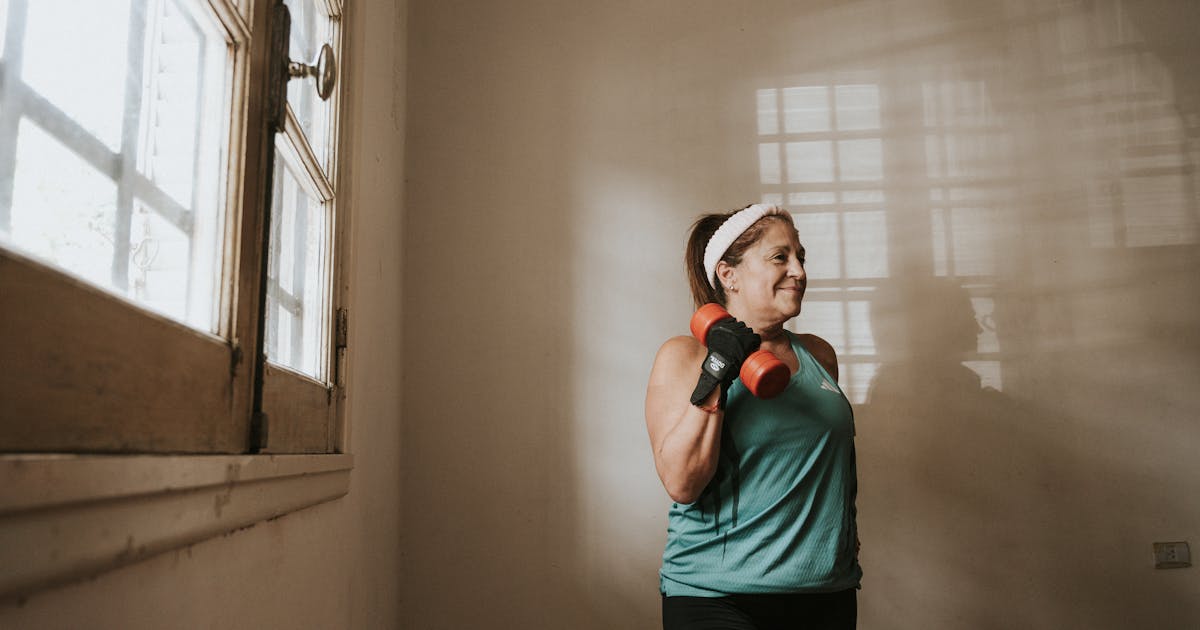
<p>The training that works for older adults is not the bodybuilder program. It is 2 to 3 weekly sessions covering the major movement patterns: squats (chair-to-stand), hinges (Romanian deadlifts), pushes (pushups or chest press), pulls (rows), and carries (walking with weights). 8 to 12 repetitions per set, 2 to 3 sets per movement. The (<a href="https://www.nia.nih.gov/health/exercise-and-physical-activity/four-types-exercise-can-improve-your-health-and" target="_blank" rel="noopener">NIA, 2024</a>) Four Types of Exercise framework groups strength as one of the four essentials alongside endurance, balance, and flexibility.</p>
<p>Weight should challenge the muscle. The last 2 repetitions of each set should feel difficult. Too-light training (a 5-pound dumbbell for 30 reps) builds endurance but not strength. The strength response requires effort. Done with good form and progressive loading, the injury risk is lower than walking on uneven pavement.</p>
<h3>The Hormonal and Bone Story</h3>
<p>Resistance training stimulates the release of growth hormone, IGF-1, and testosterone, all of which decline with age but respond to training. It also directly stimulates osteoblast activity in bone, which is why strength training is one of the few interventions that can build bone density rather than just slow the decline. The combination matters for fall risk: stronger muscles, better balance, and denser bones each reduce fracture risk, and they compound.</p>
<p>For more on companion interventions that pair well with strength training, see our piece on <a href="/articles/calcium-without-dairy-5-foods-that-build-bone-density-after-50">building bone density through nutrition</a>.</p>
<h3>Where to Start If You Have Never Lifted</h3>
<p>You do not need a gym membership. Bodyweight squats, wall pushups, glute bridges, and one-leg balance work cover most of the early gains. After 2 to 4 weeks, add weight. Adjustable dumbbells (5 to 25 pounds) or resistance bands cover most of what most adults will ever need. A session takes 30 to 45 minutes. The hardest part is starting and the second hardest is the first 6 weeks. After that, the gains feel like proof, and the habit becomes self-sustaining.</p>
<div class="ac-action-plan" style="background: linear-gradient(135deg, #fffcf4 0%, #fff8ed 100%); border-left: 5px solid #9A6841; border-radius: 12px; padding: 28px 24px; margin: 32px 0; box-shadow: 0 2px 12px rgba(0,0,0,0.06);"><div style="display: flex; align-items: center; gap: 10px; margin-bottom: 20px;"><svg width="24" height="24" viewBox="0 0 24 24" fill="none" stroke="#9A6841" stroke-width="2" stroke-linecap="round" stroke-linejoin="round"><path d="M9 5H7a2 2 0 00-2 2v12a2 2 0 002 2h10a2 2 0 002-2V7a2 2 0 00-2-2h-2"/><rect x="9" y="3" width="6" height="4" rx="1"/><path d="M9 14l2 2 4-4"/></svg><span style="font-family: Georgia, serif; font-size: 22px; font-weight: 700; color: #313743;">Your Coach's Recommendations</span></div><div style="display: flex; gap: 14px; margin-bottom: 16px; align-items: flex-start;"><div style="min-width: 36px; width: 36px; height: 36px; background: #9A6841; border-radius: 50%; display: flex; align-items: center; justify-content: center; color: #fff; font-weight: 700; font-size: 16px; flex-shrink: 0;">1</div><div><div style="font-weight: 700; color: #313743; font-size: 15px; margin-bottom: 2px;">Pick Two Days a Week and Block Them on Your Calendar.</div><div style="color: #6b7280; font-size: 13.5px; line-height: 1.5;">Tuesday and Friday, or any two non-consecutive days. 30 to 45 minutes each. Putting the time on the calendar before life fills it in is the single biggest predictor of who actually starts.</div></div></div><div style="display: flex; gap: 14px; margin-bottom: 16px; align-items: flex-start;"><div style="min-width: 36px; width: 36px; height: 36px; background: #9A6841; border-radius: 50%; display: flex; align-items: center; justify-content: center; color: #fff; font-weight: 700; font-size: 16px; flex-shrink: 0;">2</div><div><div style="font-weight: 700; color: #313743; font-size: 15px; margin-bottom: 2px;">Start With 5 Bodyweight Moves and Build From There.</div><div style="color: #6b7280; font-size: 13.5px; line-height: 1.5;">Chair-to-stand squats, wall pushups, glute bridges, rows with a resistance band, and one-leg balance. 2 sets of 10 each. Add adjustable dumbbells after 2 to 4 weeks. Progressive loading is what drives the gains.</div></div></div><div style="display: flex; gap: 14px; margin-bottom: 20px; align-items: flex-start;"><div style="min-width: 36px; width: 36px; height: 36px; background: #9A6841; border-radius: 50%; display: flex; align-items: center; justify-content: center; color: #fff; font-weight: 700; font-size: 16px; flex-shrink: 0;">3</div><div><div style="font-weight: 700; color: #313743; font-size: 15px; margin-bottom: 2px;">Eat Enough Protein on Training Days.</div><div style="color: #6b7280; font-size: 13.5px; line-height: 1.5;">Aim for 30 to 40 grams of protein at each main meal on training days. The combination of training plus adequate protein is what builds muscle. Training alone with low protein intake builds far less.</div></div></div><div style="border-top: 1px solid #e5ddd4; margin: 16px 0;"></div><div style="display: flex; justify-content: center; align-items: center; gap: 10px; flex-wrap: wrap;"><button onclick="acPrintPlan()" style="background: none; border: 1px solid #d3cabe; border-radius: 8px; padding: 10px 16px; font-size: 13px; color: #6b7280; cursor: pointer; display: flex; align-items: center; gap: 6px;"><svg width="14" height="14" viewBox="0 0 24 24" fill="none" stroke="currentColor" stroke-width="2" stroke-linecap="round" stroke-linejoin="round"><polyline points="6 9 6 2 18 2 18 9"/><path d="M6 18H4a2 2 0 01-2-2v-5a2 2 0 012-2h16a2 2 0 012 2v5a2 2 0 01-2 2h-2"/><rect x="6" y="14" width="12" height="8"/></svg>Print</button></div></div>
<div style="margin-top: 32px; padding-top: 0;">
<div style="width: 60px; height: 2px; background: linear-gradient(90deg, #9A6841, #be7b4c); border-radius: 2px; margin-bottom: 20px;"></div>
<p style="font-family: Georgia, serif; font-size: 16px; font-style: italic; color: #777; margin: 0 0 6px 0; letter-spacing: 0.3px; padding-left: 38px;">To your health,</p>
<div style="display: flex; align-items: center; gap: 4px; margin-bottom: 4px;">
<img src="https://cdn.prod.website-files.com/69be130d412f9c2c202307ef/69c539b9526b266e2cba5521_ageless-coach-logo-black.png" alt="AC" style="width: 34px; height: 34px; object-fit: contain;">
<p style="font-family: Georgia, serif; font-size: 22px; font-weight: 700; color: #313743; margin: 0; letter-spacing: 0.5px;">Ageless Coach</p>
</div>
<p style="font-family: -apple-system, BlinkMacSystemFont, Segoe UI, sans-serif; font-size: 11px; font-weight: 600; color: #be7b4c; letter-spacing: 2px; text-transform: uppercase; margin: 0 0 0 28px;">Age Strong. Live Long.</p>
</div>
<div style="margin-top: 28px; padding-top: 20px; border-top: 1px solid #e5e7eb; text-align: center;">
<p style="font-family: -apple-system, BlinkMacSystemFont, Segoe UI, sans-serif; font-size: 13px; font-weight: 700; color: #6b7280; letter-spacing: 2px; text-transform: uppercase; margin: 0 0 16px 0;">Trusted Sources Behind This Article</p>
<div style="display: flex; justify-content: center; gap: 10px; flex-wrap: wrap;">
<a href="https://www.health.harvard.edu/healthy-aging-and-longevity/strength-training-builds-more-than-muscles" target="_blank" rel="noopener" style="display: inline-block; background: #fff; border: 1.5px solid #9A6841; color: #9A6841; padding: 8px 20px; border-radius: 20px; font-size: 14px; font-weight: 600; letter-spacing: 0.3px; text-decoration: none; transition: background 0.2s ease, color 0.2s ease;">Harvard Health Aging</a>
<a href="https://www.health.harvard.edu/staying-healthy/want-to-live-longer-and-better-do-strength-training" target="_blank" rel="noopener" style="display: inline-block; background: #fff; border: 1.5px solid #9A6841; color: #9A6841; padding: 8px 20px; border-radius: 20px; font-size: 14px; font-weight: 600; letter-spacing: 0.3px; text-decoration: none; transition: background 0.2s ease, color 0.2s ease;">Harvard Health Live Longer</a>
<a href="https://www.nia.nih.gov/health/exercise-and-physical-activity/four-types-exercise-can-improve-your-health-and" target="_blank" rel="noopener" style="display: inline-block; background: #fff; border: 1.5px solid #9A6841; color: #9A6841; padding: 8px 20px; border-radius: 20px; font-size: 14px; font-weight: 600; letter-spacing: 0.3px; text-decoration: none; transition: background 0.2s ease, color 0.2s ease;">NIA</a>
</div>
</div>
<p style="font-size: 12px; color: #999; margin-top: 40px; line-height: 1.5;"><em>This content is for educational purposes only and is not a substitute for professional medical advice, diagnosis, or treatment. Reading this article does not create a provider-patient relationship. Always consult your physician or qualified healthcare provider before making changes to your diet, exercise, or health routine. Ageless Coach is not liable for any actions taken based on this information.</em></p>
<div class="ac-faq" style="margin-top:40px; border-top:1px solid #e5e7eb; padding-top:32px;">
<h2 style="font-family:Georgia,serif; font-size:20px; font-weight:700; color:#313743; margin:0 0 20px 0;">Frequently Asked Questions</h2>
<details style="border:1px solid #e5e7eb; border-radius:8px; margin-bottom:10px; overflow:hidden;">
<summary style="padding:14px 18px; font-weight:600; font-size:15px; color:#313743; cursor:pointer; list-style:none; display:flex; justify-content:space-between; align-items:center;">
How heavy should I lift if I am over 60?
<svg width="16" height="16" viewBox="0 0 24 24" fill="none" stroke="#9A6841" stroke-width="2" stroke-linecap="round" stroke-linejoin="round" aria-hidden="true"><polyline points="6 9 12 15 18 9"/></svg>
</summary>
<div style="padding:0 18px 16px; font-size:18px; color:#555; line-height:1.65;">Heavy enough that the last 2 repetitions of each set feel challenging. If you can do 15 repetitions easily, the weight is too light. Start where you are and add weight every 1 to 2 weeks. Most adults over 60 are surprised how quickly they progress in the first 2 months.</div>
</details>
<details style="border:1px solid #e5e7eb; border-radius:8px; margin-bottom:10px; overflow:hidden;">
<summary style="padding:14px 18px; font-weight:600; font-size:15px; color:#313743; cursor:pointer; list-style:none; display:flex; justify-content:space-between; align-items:center;">
Will I get bulky?
<svg width="16" height="16" viewBox="0 0 24 24" fill="none" stroke="#9A6841" stroke-width="2" stroke-linecap="round" stroke-linejoin="round" aria-hidden="true"><polyline points="6 9 12 15 18 9"/></svg>
</summary>
<div style="padding:0 18px 16px; font-size:18px; color:#555; line-height:1.65;">No. Building significant muscle bulk requires intense training, very high protein intake, and (in most cases) anabolic supplementation. Standard strength training over 60 builds enough muscle to restore function and improve appearance, not bodybuilder physique. Women especially do not bulk up from typical training because hormonal profiles do not support it.</div>
</details>
<details style="border:1px solid #e5e7eb; border-radius:8px; margin-bottom:10px; overflow:hidden;">
<summary style="padding:14px 18px; font-weight:600; font-size:15px; color:#313743; cursor:pointer; list-style:none; display:flex; justify-content:space-between; align-items:center;">
Is it safe if I have arthritis?
<svg width="16" height="16" viewBox="0 0 24 24" fill="none" stroke="#9A6841" stroke-width="2" stroke-linecap="round" stroke-linejoin="round" aria-hidden="true"><polyline points="6 9 12 15 18 9"/></svg>
</summary>
<div style="padding:0 18px 16px; font-size:18px; color:#555; line-height:1.65;">Yes, with reasonable precautions. Strength training reduces arthritis pain in most patients by strengthening the muscles around affected joints. Avoid loaded movements that fall into painful ranges of motion. Substitute the leg press for deep squats if knees flare. A physical therapist can design a program around specific joint limitations.</div>
</details>
<details style="border:1px solid #e5e7eb; border-radius:8px; margin-bottom:10px; overflow:hidden;">
<summary style="padding:14px 18px; font-weight:600; font-size:15px; color:#313743; cursor:pointer; list-style:none; display:flex; justify-content:space-between; align-items:center;">
How long until I see results?
<svg width="16" height="16" viewBox="0 0 24 24" fill="none" stroke="#9A6841" stroke-width="2" stroke-linecap="round" stroke-linejoin="round" aria-hidden="true"><polyline points="6 9 12 15 18 9"/></svg>
</summary>
<div style="padding:0 18px 16px; font-size:18px; color:#555; line-height:1.65;">Strength gains show up within 2 to 4 weeks (mostly neuromuscular efficiency). Visible muscle changes take 6 to 12 weeks. Functional gains like easier stair climbing, getting up from the floor, and carrying groceries show up between weeks 4 and 8 for most people who train consistently.</div>
</details>
<details style="border:1px solid #e5e7eb; border-radius:8px; margin-bottom:10px; overflow:hidden;">
<summary style="padding:14px 18px; font-weight:600; font-size:15px; color:#313743; cursor:pointer; list-style:none; display:flex; justify-content:space-between; align-items:center;">
Should I see a doctor before starting?
<svg width="16" height="16" viewBox="0 0 24 24" fill="none" stroke="#9A6841" stroke-width="2" stroke-linecap="round" stroke-linejoin="round" aria-hidden="true"><polyline points="6 9 12 15 18 9"/></svg>
</summary>
<div style="padding:0 18px 16px; font-size:18px; color:#555; line-height:1.65;">If you have known cardiovascular disease, uncontrolled hypertension, a recent injury, or new chest pain or shortness of breath, talk to your doctor first. Otherwise, bodyweight strength training is generally safe to start without medical clearance. Adding heavier loads is usually fine after a couple of weeks of building tolerance.</div>
</details>
<details style="border:1px solid #e5e7eb; border-radius:8px; margin-bottom:10px; overflow:hidden;">
<summary style="padding:14px 18px; font-weight:600; font-size:15px; color:#313743; cursor:pointer; list-style:none; display:flex; justify-content:space-between; align-items:center;">
Can I lose weight just by lifting?
<svg width="16" height="16" viewBox="0 0 24 24" fill="none" stroke="#9A6841" stroke-width="2" stroke-linecap="round" stroke-linejoin="round" aria-hidden="true"><polyline points="6 9 12 15 18 9"/></svg>
</summary>
<div style="padding:0 18px 16px; font-size:18px; color:#555; line-height:1.65;">Lifting alone is rarely the most efficient weight loss tool because muscle is denser than fat and the scale can stay flat while body composition changes. The combination of strength training, modest cardio, and a diet with adequate protein is what reliably reshapes the body. Strength training preserves muscle during weight loss, which is its biggest contribution.</div>
</details>
</div>
<div class="ac-article-cta">
<p class="ac-cta-lead">Want one verified-science article like this every week?</p>
<a href="/newsletter" class="ac-nav-cta">
Get Better Health, Weekly
<span class="ac-nav-cta-arrow">
<svg viewBox="0 0 18 18" fill="none" xmlns="http://www.w3.org/2000/svg" aria-hidden="true"><path d="M4.24 13.59L12.73 5.11" stroke="#0D1B2A" stroke-width="1.8"/><path d="M4.95 4.4H13.44V12.89" stroke="#0D1B2A" stroke-width="1.8"/></svg>
</span>
</a>
</div>