Collagen is the protein that keeps skin firm, but the collagen you swallow is broken down in your gut before any of it reaches your skin. A few small studies hint at a benefit, and nearly all of them were paid for by the companies selling the powder.
1Broken down first · your gut digests collagen into amino acids, so little of it arrives at your skin intact
2About 1% a year · the collagen your skin loses from your twenties on, sped up by sun, smoking and menopause
3Company funded · the small studies showing a skin benefit were nearly all run by the supplement makers
42.5 to 15 grams · the daily range sold, generally safe, but with no proven dose for your skin
53 to 6 months · how long makers say to wait, at real monthly cost, for effects the research has not confirmed
You stir a scoop of collagen powder into your morning coffee, the way the influencers do, and wait for firmer skin to follow. It is one of the most popular supplements on the shelf, and the pitch could not be simpler: drink the protein your skin is losing, and put back what the years have taken.
The trouble starts the moment you swallow it. A Cleveland Clinic dermatologist explains that collagen supplements are mostly absorbed by your gut, so not enough is left to reach your bloodstream and travel up to your skin. The powder in the tub is real collagen. It is the delivery, not the ingredient, that quietly falls apart.
1
The starting point
Why Your Skin Loses Collagen at All
Collagen is the main structural protein in skin, the scaffolding underneath that keeps it firm and springy. Cleveland Clinic notes that from your twenties onward you steadily lose it, and by the time you reach 40 you are shedding roughly 1% of it every year without doing anything at all.
Sun exposure, smoking and menopause all push that loss along faster. As the collagen thins, skin turns drier, looser and more lined, and the change is visible enough to send people looking for a fix. That is the real ache behind the supplement aisle, and it is exactly the worry the label on the tub is built to answer.
2
The pitch
What the Label Is Selling You
Most powders are collagen peptides, also called hydrolyzed collagen, which simply means the protein has been broken into small, easily digestible fragments. The marketing follows naturally from there. A daily scoop, the tub promises, will hydrate your skin, smooth out wrinkles, firm what has started to sag, and ease aching joints for good measure.
It is an appealing story because the starting fact is true: you really are losing collagen, and this really is collagen. Powders come from cows, pigs or fish and sell as capsules, gummies and loose scoops. Cleveland Clinic lists the same benefits fans hope for, from firmer skin to stronger joints, while making clear that hope and proof are not the same thing here.
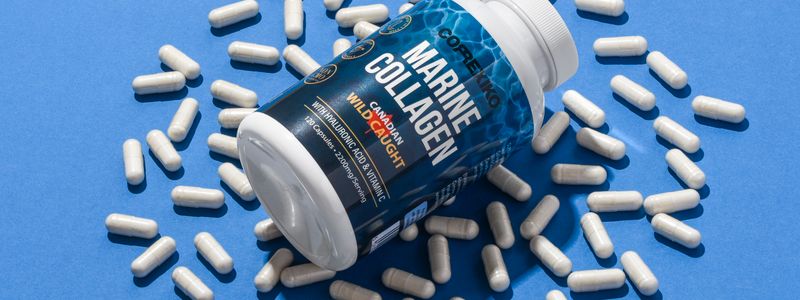
Most collagen sold for skin comes as capsules or hydrolyzed powder, and the pitch is that swallowing it puts back what your skin has lost.
3
The catch
What Happens After You Swallow It
Here is the part the tin skips over. The Cleveland Clinic dermatologist is blunt about it: collagen supplements are mostly absorbed by your GI tract, which means there is not enough collagen making it into your bloodstream to be delivered up to your hair, nails and skin in the first place. Digestion gets to it long before your face does.
There is a second snag layered on top. Most powders are made from animal collagen, and it is unclear whether that form is close enough to human collagen to do anything useful even if it did arrive. Your body treats the whole scoop as ordinary protein to dismantle for parts, not a spare piece of scaffolding to slot neatly back into your skin.
4
The evidence
The Studies Are Small and Sponsored
A handful of small studies have shown limited improvement in skin texture, which is where the confident marketing claims come from. The catch, the same dermatologist points out, is that they are nearly all manufacturer sponsored, and the supplement industry itself is loosely regulated, with a documented history of inaccurate labels and contamination.
None of that makes the powder harmful. Side effects are minimal, the odd headache or upset stomach aside, and for most people it is perfectly safe to try. It only means the case that a daily scoop firms your skin is thin, slow and costly to test on yourself over three to six months, and resting largely on research the sellers paid for.
The habits that actually protect skin collagen, like sun protection and not smoking, cost far less than a monthly tub of powder.
Collagen supplements are mostly broken down in your gut, so little reaches the bloodstream to be delivered to your skin.
That single fact is why the swallowed-collagen pitch runs ahead of the evidence, and why your money often does more elsewhere.
Cleveland Clinic
So if the powder mostly gets digested before it can help, the sensible question is not which brand to buy but where the same money and effort actually move the needle on your skin. The honest answer, from the same Cleveland Clinic experts, is less glamorous than a scoop in your coffee, and considerably more reliable.
5
What to do
Where Your Money Actually Helps
Start by protecting the collagen you still have. Daily sunscreen and not smoking slow the loss more than any capsule can, and cost close to nothing over a year. Topical vitamin C and E and staying genuinely well hydrated help your skin defend itself against the everyday sun and pollution that break collagen down.
If you want results with real evidence behind them, the dermatologist points to prescription retinoids such as tretinoin and to in-office microneedling, both shown to stimulate your own collagen. Food plays its part too, since a diet with enough protein and vitamin C gives your body the raw materials it needs to build fresh collagen on its own. Staying well hydrated, at least 64 ounces of fluid a day, rounds out the routine.
Take the collagen and skin cheat sheet with you
Your free 2-page guide: what really happens to swallowed collagen, why the studies are shaky, and the habits that protect your skin for far less money.
One email. No spam. Unsubscribe anytime.
Free Lifestyle Assessment
How Healthy Is Your Current Lifestyle?
Answer honestly for five minutes and walk away with your personal scorecard: all six areas of your health rated, the one that needs your attention first, and a 30-day plan built from your answers. It shows up the second you finish.
Free. About 5 minutes. Your results appear instantly.
📋 Your Coach's Recommendations
1
Protect the Collagen You Already Have
A Cleveland Clinic dermatologist says daily sunscreen and avoiding cigarettes slow collagen loss more than any supplement. Both are close to free and work every single day.
2
Feed Your Skin From the Plate
Protein and vitamin C rich foods give your body the raw materials to build its own collagen. A balanced plate does more for your skin than a scoop of powder in your coffee.
3
For Proven Results, Ask a Dermatologist
Prescription retinoids such as tretinoin and in-office microneedling have real evidence for stimulating your own collagen, unlike swallowed powder. A board-certified dermatologist can guide the choice.
?
How it works. Just a quiet check-in, not an alert and not a recurring nag. The event lands as a 30-minute slot at 9am two weeks from today, with your plan in the notes and a link back to this article. Works with Apple Calendar, Google Calendar, and Outlook. Yours to move, snooze, or delete whenever.
Keep this plan
Get the 2-page guide: what happens to swallowed collagen, why the studies are shaky, and the habits that protect your skin for less.
One email. No spam. Unsubscribe anytime.
Where should we send it?
Your collagen and skin cheat sheet, straight to your inbox.
We send the plan plus one short evidence brief each week. Unsubscribe anytime.
✓
It is on the way
Check your inbox in the next minute. Your first Ageless Brief arrives this week: one study, translated, no hype.
Mostly no. Cleveland Clinic explains that swallowed collagen is largely absorbed and broken down in your gut, so not enough reaches your bloodstream to be delivered to your skin, hair or nails.
What is collagen and why do we lose it?
Collagen is the main structural protein that keeps skin firm and elastic. Cleveland Clinic notes you start losing it in your twenties, shedding roughly 1% a year from 40, with sun, smoking and menopause speeding the decline.
Are collagen supplements safe?
Generally yes. Cleveland Clinic reports side effects are minimal, though some people notice headache, lightheadedness or diarrhea, and animal-derived products carry an allergy consideration.
How much collagen do people usually take?
A daily dose typically ranges from 2.5 to 15 grams, per Cleveland Clinic. There is no dose proven to firm your skin, and makers suggest waiting three to six months for any effect.
What works better than collagen pills for skin?
Cleveland Clinic dermatologists point to daily sun protection, not smoking, topical vitamin C, prescription retinoids like tretinoin, and in-office microneedling, all of which have stronger evidence than swallowed collagen.
Is this medical advice?
No. This article is educational and is not a substitute for advice from your own clinician or dermatologist, who can tailor a skin plan to your history and medications.
Curious where you stand? Take the free 5-minute lifestyle assessment and your personal scorecard appears the second you finish.
By the Ageless Coach Editorial Team · Published August 1, 2026 · Last updated August 1, 2026
<style>
:root{--dark-base:#0D1B2A;--dark-mid:#1B3A4B;--teal:#0EA5A0;--teal-dark:#0C8C88;--teal-bright:#14D4CD;--fog:#D8E8E8;--deep-fog:#C8DCDC;--fog-border:#A8C4C4;--ink:#313743;--ink-soft:#49505f;--muted:#6b7280;--warm:#9A6841;--warm-light:#be7b4c;--serif:"Source Serif 4",Georgia,serif;--sans:Inter,-apple-system,BlinkMacSystemFont,"Segoe UI",sans-serif}
.w-richtext p,.w-richtext li,.w-richtext td{font-size:20.5px;line-height:1.7;color:var(--ink-soft)}
.w-richtext ul{list-style-type:disc;padding-left:24px;margin:12px 0}
.w-richtext ul li{margin-bottom:8px}
.ac-answer{background:#fff;border:1px solid #D4E4E4;border-top:5px solid var(--teal);border-radius:16px;padding:22px 24px 18px;margin:16px 0 28px;box-shadow:0 6px 22px rgba(13,27,42,.07)}
.ac-answer .aa-eyebrow{font:800 12px/1 var(--sans);letter-spacing:2.5px;text-transform:uppercase;color:var(--teal-dark);margin-bottom:8px}
.ac-answer .aa-head{font-family:var(--serif);font-size:24px;line-height:1.2;font-weight:800;color:var(--dark-base);margin:0 0 16px}
.ac-answer .aa-list{list-style:none;margin:0;padding:0}
.ac-answer .aa-list li{display:flex;gap:12px;align-items:baseline;padding:11px 0;border-bottom:1px solid #EDF3F3;font:700 16.5px/1.4 var(--sans);color:var(--ink)}
.ac-answer .aa-list li:last-child{border-bottom:none}
.ac-answer .aa-n{flex-shrink:0;width:24px;height:24px;border-radius:50%;background:var(--teal-dark);color:#fff;font:800 12px/24px var(--sans);text-align:center}
.ac-answer .aa-food{color:var(--teal-dark);font-weight:800}
.ac-answer .aa-cue{margin-top:18px;text-align:center}
.ac-answer .aa-cta{display:inline-flex;align-items:center;gap:10px;background:var(--teal-dark);color:#fff;font:800 14px/1 var(--sans);letter-spacing:.2px;padding:14px 26px;border-radius:50px;text-decoration:none;box-shadow:0 6px 16px rgba(12,140,136,.30)}
.ac-answer .aa-cta:hover{background:#0A7A76}
.ac-answer .aa-arw{display:inline-block;animation:aa-nudge 1.4s ease-in-out infinite}
@keyframes aa-nudge{0%,100%{transform:translateY(0)}50%{transform:translateY(4px)}}
@media(max-width:560px){.ac-answer{padding:20px 18px 16px}.ac-answer .aa-head{font-size:21px}.ac-answer .aa-list li{font-size:15px}}
.ac-band{margin:56px 0 24px;padding:26px 24px 12px;background:linear-gradient(180deg,#F0F7F7,#fff);border-radius:16px}
.ac-band.hype{background:linear-gradient(180deg,#FAF3EB,#fff)}
.ac-band .inner{display:flex;gap:20px;align-items:center}
.ac-band .big{font:900 72px/1 var(--sans);color:var(--deep-fog);flex-shrink:0}
.ac-band.hype .big{color:#EAD9C6}
.ac-band .q{font:700 13px/1.4 var(--sans);letter-spacing:2px;text-transform:uppercase;color:var(--teal-dark)}
.ac-band.hype .q{color:var(--warm)}
.ac-band h3{font-family:var(--serif);font-size:30px;line-height:1.2;font-weight:800;color:var(--ink);margin:0}
.ac-callout{border-left:4px solid var(--teal);background:#F4FAFA;border-radius:0 12px 12px 0;padding:18px 22px;margin:28px 0}
.ac-callout .n{font:800 20px/1.35 var(--sans);color:var(--dark-mid);margin-bottom:6px}
.ac-callout .d{font:500 15px/1.55 var(--sans);color:var(--ink-soft)}
.ac-callout .c{font:600 11.5px/1 var(--sans);letter-spacing:1.5px;text-transform:uppercase;color:var(--muted);margin-top:10px}
.ac-plan{background:linear-gradient(135deg,#F4FAFA 0%,#fff 100%);border-left:5px solid var(--teal-dark);border-radius:14px;padding:30px 26px;margin:40px 0 0;box-shadow:0 2px 12px rgba(0,0,0,.06);scroll-margin-top:100px}
.ac-plan .ptitle{font-family:var(--serif);font-size:24px;font-weight:800;color:var(--ink);margin-bottom:22px}
.ac-plan .step{display:flex;gap:16px;margin-bottom:18px;align-items:flex-start}
.ac-plan .step .n{min-width:38px;width:38px;height:38px;background:var(--teal-dark);border-radius:50%;color:#fff;font:800 17px/38px var(--sans);text-align:center;flex-shrink:0}
.ac-plan .sh{font:800 16.5px/1.4 var(--sans);color:var(--ink);margin-bottom:3px}
.ac-plan .sd{font:400 15px/1.6 var(--sans);color:var(--muted)}
.ac-plan .actions{border-top:1px solid #D8E8E8;margin-top:16px;padding-top:20px}
.ac-primary-row{display:flex;align-items:center;gap:10px;padding:0 4px}
.ac-btn-primary-wide{flex:1;background:var(--teal);color:#fff;border:1.5px solid var(--teal);border-radius:14px;padding:12px 22px;box-shadow:0 4px 14px rgba(14,165,160,.22);font-family:var(--sans);cursor:pointer;display:grid;grid-template-columns:auto 1fr;gap:14px;align-items:center;transition:all .18s ease}
.ac-btn-primary-wide:hover{background:var(--teal-dark);border-color:var(--teal-dark)}
.ac-btn-primary-wide .icon svg{width:22px;height:22px;color:#fff;display:block}
.ac-btn-primary-wide .label{text-align:left;line-height:1.25}
.ac-btn-primary-wide .label .top{display:block;font-weight:700;font-size:15.5px;color:#fff}
.ac-btn-primary-wide .label .top em{font-style:italic;font-weight:700}
.ac-cal-help{position:relative;flex-shrink:0}
.ac-cal-help summary{list-style:none;width:24px;height:24px;border-radius:50%;background:#E4F1F1;border:1px solid var(--fog-border);color:var(--dark-mid);font:700 13px/22px var(--sans);text-align:center;cursor:pointer;display:block}
.ac-cal-help summary::-webkit-details-marker{display:none}
.ac-cal-help .tip{position:absolute;right:0;top:32px;z-index:50;width:290px;background:var(--dark-base);color:var(--fog);border-radius:12px;padding:14px 16px;font:500 12.5px/1.55 var(--sans);box-shadow:0 10px 30px rgba(13,27,42,.35)}
.ac-cal-help .tip strong{color:#fff}
.ac-btn-share-wide{display:flex;width:100%;align-items:center;justify-content:center;gap:10px;background:#fff;color:var(--teal-dark);border:1.5px solid var(--teal-dark);border-radius:14px;padding:12px 22px;margin-top:10px;font:800 15px/1 var(--sans);cursor:pointer}
.ac-btn-share-wide svg{width:18px;height:18px}
.ac-midcap{background:linear-gradient(180deg,#F0F7F7,#fff);border:1.5px solid var(--fog-border);border-radius:16px;padding:24px 22px;margin:34px 0;text-align:center}
.ac-midcap h4{font-family:var(--serif);font-size:22px;font-weight:800;color:var(--ink);margin:0 0 6px}
.ac-midcap .sub{font:500 14px/1.55 var(--sans);color:var(--ink-soft);margin:0 auto 14px;max-width:400px}
.ac-midcap .mcform{display:flex;gap:8px;max-width:400px;margin:0 auto}
.ac-midcap .mcform input{flex:1;border:1.5px solid var(--fog-border);border-radius:50px;padding:12px 18px;font:500 14px/1 var(--sans);min-width:0}
.ac-midcap .mcform button{background:var(--teal-dark);color:#fff;border:none;border-radius:50px;padding:12px 20px;font:800 13.5px/1 var(--sans);cursor:pointer;white-space:nowrap}
.ac-midcap .fine{font:500 11.5px/1.5 var(--sans);color:var(--muted);margin-top:10px}
@media (max-width:520px){.ac-midcap .mcform{flex-direction:column}}
.ac-assess-promo{background:linear-gradient(135deg,#D8E8E8,#C8DCDC);border:1px solid var(--fog-border);border-radius:16px;padding:34px 30px;margin:44px 0;text-align:center}
.ac-assess-promo .eyebrow{color:var(--teal-dark);font:800 12px/1 var(--sans);letter-spacing:2.5px;text-transform:uppercase;margin:0 0 10px}
.ac-assess-promo h4{font-family:var(--serif);color:var(--dark-base);font-size:26px;font-weight:800;margin:0 0 12px}
.w-embed .ac-assess-promo p.ap-body,.ac-assess-promo p.ap-body{font-family:Georgia,serif;color:#3A5555;font-size:15.5px;font-weight:500;line-height:1.65;max-width:540px;margin:0 auto 22px}
.ac-assess-promo .ap-cta{display:inline-block;background:var(--teal-bright);color:var(--dark-base);font:800 15px/1 var(--sans);padding:15px 30px;border-radius:50px;text-decoration:none}
.ac-assess-promo .ap-fine{color:#4E6B6B;font:500 13px/1.5 var(--sans);margin:14px 0 0}
.ac-assess-line{border-top:1px solid #E2ECEC;margin-top:30px;padding:22px 10px 0;text-align:center;font:500 15.5px/1.6 var(--sans);color:#3A5555}
.w-embed .ac-assess-line a,.ac-assess-line a{color:var(--teal-dark);font-weight:700;text-decoration:underline;text-underline-offset:3px}
.ac-articlemeta{font:500 12.5px/1.6 var(--sans);color:#98a0a6;text-align:center;margin:24px 0 0}
.ac-capture{background:linear-gradient(180deg,#F0F7F7,#fff);border:1.5px solid var(--fog-border);border-radius:16px;padding:30px 28px;margin:26px 0 44px;text-align:center}
.ac-capture .cap-state{display:none}
.ac-capture[data-state="trigger"] .st-trigger{display:block}
.ac-capture[data-state="form"] .st-form{display:block}
.ac-capture[data-state="sent"] .st-sent{display:block}
.ac-capture h4{font-family:var(--serif);font-size:24px;font-weight:800;color:var(--ink);margin:0 0 8px}
.ac-capture .sub{font:500 15px/1.55 var(--sans);color:var(--ink-soft);margin:0 auto 18px;max-width:430px}
.ac-capture .bigbtn{display:inline-flex;align-items:center;gap:10px;background:var(--teal-dark);color:#fff;border:none;border-radius:50px;padding:16px 30px;font:800 16px/1 var(--sans);cursor:pointer;box-shadow:0 6px 18px rgba(12,140,136,.28)}
.ac-capture .capform{display:flex;gap:10px;max-width:430px;margin:0 auto}
.ac-capture .capform input{flex:1;border:1.5px solid var(--fog-border);border-radius:50px;padding:14px 20px;font:500 15px/1 var(--sans)}
.ac-capture .capform button{background:var(--teal-dark);color:#fff;border:none;border-radius:50px;padding:14px 24px;font:800 14px/1 var(--sans);cursor:pointer}
.ac-capture .sent-check{width:52px;height:52px;border-radius:50%;background:var(--teal);color:#fff;font:800 26px/52px var(--sans);margin:0 auto 12px}
.ac-capture .dl{display:inline-block;margin-top:6px;color:var(--teal-dark);font:700 15px/1 var(--sans);text-decoration:underline;cursor:pointer}
.ac-capture .fine{font:500 12px/1.5 var(--sans);color:var(--muted);margin-top:12px}
.ac-sig{margin-top:36px}
.ac-sig .rule{width:60px;height:2px;background:linear-gradient(90deg,var(--teal-dark),var(--teal-bright));margin-bottom:18px;border-radius:2px}
.ac-sig .toyour{font-family:var(--serif);font-size:16px;font-style:italic;color:#777;margin:0 0 10px;padding-left:2px}
.ac-faq{margin-top:40px;border-top:1px solid #e5e7eb;padding-top:30px;margin-bottom:40px}
.ac-faq h2{font-family:var(--serif);font-size:23px;font-weight:800;color:var(--ink);margin:0 0 18px}
.ac-faq details{border:1px solid #e5e7eb;border-radius:10px;margin-bottom:10px}
.ac-faq summary{padding:15px 18px;font:700 16px/1.4 var(--sans);color:var(--ink);cursor:pointer;display:flex;justify-content:space-between;align-items:center;list-style:none}
.ac-faq summary:after{content:"\25BE";color:var(--warm)}
.ac-faq .a{padding:0 18px 16px;font-size:17px;line-height:1.65;color:#555}
.article-header-section .article-container{max-width:1080px !important;margin:0 auto !important;padding:0 20px !important}
.article-header-section .article-hero-image{display:block;width:100%;max-width:660px;margin:0}
.article-header-section .article-title{display:block !important;font-family:var(--serif);font-size:32px;line-height:1.25;font-weight:700;color:#313743;margin:20px 0 12px 0;text-align:left;max-width:660px}
@media (max-width:767px){.article-header-section .article-title{font-size:26px}.article-header-section .article-hero-image{max-width:100%}}
@media (max-width:640px){.ac-band .big{font-size:52px}}
@media (max-width:520px){.ac-capture .capform{flex-direction:column}}
.ac-figure{margin:30px 0}.ac-figure img{display:block;width:100%;border-radius:14px;height:auto;aspect-ratio:800/300}.ac-figure figcaption{font:500 13px/1.5 var(--sans);color:var(--muted);margin-top:9px}</style>
<div class="ac-answer">
<div class="aa-eyebrow">What the evidence actually says</div>
<h2 class="aa-head">Collagen is the protein that keeps skin firm, but the collagen you swallow is broken down in your gut before any of it reaches your skin. A few small studies hint at a benefit, and nearly all of them were paid for by the companies selling the powder.</h2>
<ol class="aa-list">
<li><span class="aa-n">1</span><span><span class="aa-food">Broken down first</span> · your gut digests collagen into amino acids, so little of it arrives at your skin intact</span></li><li><span class="aa-n">2</span><span><span class="aa-food">About 1% a year</span> · the collagen your skin loses from your twenties on, sped up by sun, smoking and menopause</span></li><li><span class="aa-n">3</span><span><span class="aa-food">Company funded</span> · the small studies showing a skin benefit were nearly all run by the supplement makers</span></li><li><span class="aa-n">4</span><span><span class="aa-food">2.5 to 15 grams</span> · the daily range sold, generally safe, but with no proven dose for your skin</span></li><li><span class="aa-n">5</span><span><span class="aa-food">3 to 6 months</span> · how long makers say to wait, at real monthly cost, for effects the research has not confirmed</span></li>
</ol>
<div class="aa-cue"><a class="aa-cta" href="#coach-recommendations">Get Your Coach's 3-Step Plan <span class="aa-arw">↓</span></a></div>
</div>
<p>You stir a scoop of collagen powder into your morning coffee, the way the influencers do, and wait for firmer skin to follow. It is one of the most popular supplements on the shelf, and the pitch could not be simpler: drink the protein your skin is losing, and put back what the years have taken.</p>
<p>The trouble starts the moment you swallow it. A Cleveland Clinic dermatologist explains that <a href="https://health.clevelandclinic.org/collagen-supplements" target="_blank" rel="noopener">collagen supplements are mostly absorbed by your gut</a>, so not enough is left to reach your bloodstream and travel up to your skin. The powder in the tub is real collagen. It is the delivery, not the ingredient, that quietly falls apart.</p>
<div class="ac-band"><div class="inner"><div class="big">1</div><div><div class="q">The starting point</div><h3>Why Your Skin Loses Collagen at All</h3></div></div></div>
<p>Collagen is the main structural protein in skin, the scaffolding underneath that keeps it firm and springy. Cleveland Clinic notes that from your <a href="https://health.clevelandclinic.org/what-do-collagen-peptides-do" target="_blank" rel="noopener">twenties onward you steadily lose it</a>, and by the time you reach 40 you are shedding roughly 1% of it every year without doing anything at all.</p>
<p>Sun exposure, smoking and menopause all push that loss along faster. As the collagen thins, skin turns drier, looser and more lined, and the change is visible enough to send people looking for a fix. That is the real ache behind the supplement aisle, and it is exactly the worry the label on the tub is built to answer.</p>
<div class="ac-band"><div class="inner"><div class="big">2</div><div><div class="q">The pitch</div><h3>What the Label Is Selling You</h3></div></div></div>
<p>Most powders are collagen peptides, also called hydrolyzed collagen, which simply means the protein has been broken into small, easily digestible fragments. The marketing follows naturally from there. A daily scoop, the tub promises, will hydrate your skin, smooth out wrinkles, firm what has started to sag, and ease aching joints for good measure.</p>
<p>It is an appealing story because the starting fact is true: you really are losing collagen, and this really is collagen. Powders come from cows, pigs or fish and sell as capsules, gummies and loose scoops. Cleveland Clinic lists the same benefits fans hope for, from firmer skin to stronger joints, while making clear that hope and proof are not the same thing here.</p>
<figure class="ac-figure"><img src="https://cdn.prod.website-files.com/69be1026a027224999b7936b/6a6db920de9a5a2f58898378_lib-collagen-6475106-fig.jpg" alt="A bottle of collagen supplement capsules spilled across a blue background" width="800" height="300" loading="lazy" decoding="async"><figcaption>Most collagen sold for skin comes as capsules or hydrolyzed powder, and the pitch is that swallowing it puts back what your skin has lost.</figcaption></figure>
<div class="ac-band"><div class="inner"><div class="big">3</div><div><div class="q">The catch</div><h3>What Happens After You Swallow It</h3></div></div></div>
<p>Here is the part the tin skips over. The Cleveland Clinic dermatologist is blunt about it: collagen supplements are <a href="https://health.clevelandclinic.org/collagen-supplements" target="_blank" rel="noopener">mostly absorbed by your GI tract</a>, which means there is not enough collagen making it into your bloodstream to be delivered up to your hair, nails and skin in the first place. Digestion gets to it long before your face does.</p>
<p>There is a second snag layered on top. Most powders are made from animal collagen, and it is unclear whether that form is close enough to human collagen to do anything useful even if it did arrive. Your body treats the whole scoop as ordinary protein to dismantle for parts, not a spare piece of scaffolding to slot neatly back into your skin.</p>
<div class="ac-band"><div class="inner"><div class="big">4</div><div><div class="q">The evidence</div><h3>The Studies Are Small and Sponsored</h3></div></div></div>
<p>A handful of small studies have shown limited improvement in skin texture, which is where the confident marketing claims come from. The catch, the same dermatologist points out, is that they are <a href="https://health.clevelandclinic.org/collagen-supplements" target="_blank" rel="noopener">nearly all manufacturer sponsored</a>, and the supplement industry itself is loosely regulated, with a documented history of inaccurate labels and contamination.</p>
<p>None of that makes the powder harmful. Side effects are minimal, the odd headache or upset stomach aside, and for most people it is perfectly safe to try. It only means the case that a daily scoop firms your skin is thin, slow and costly to test on yourself over three to six months, and resting largely on research the sellers paid for.</p>
<figure class="ac-figure"><img src="https://cdn.prod.website-files.com/69be1026a027224999b7936b/6a6db922275c273e9a90eb19_lib-collagen-6977987-fig.jpg" alt="A smiling woman with healthy, clear skin resting her hand against her face" width="800" height="300" loading="lazy" decoding="async"><figcaption>The habits that actually protect skin collagen, like sun protection and not smoking, cost far less than a monthly tub of powder.</figcaption></figure>
<div class="ac-callout"><div class="n">Collagen supplements are mostly broken down in your gut, so little reaches the bloodstream to be delivered to your skin.</div><div class="d">That single fact is why the swallowed-collagen pitch runs ahead of the evidence, and why your money often does more elsewhere.</div><div class="c">Cleveland Clinic</div></div>
<p>So if the powder mostly gets digested before it can help, the sensible question is not which brand to buy but where the same money and effort actually move the needle on your skin. The honest answer, from the same Cleveland Clinic experts, is less glamorous than a scoop in your coffee, and considerably more reliable.</p>
<div class="ac-band"><div class="inner"><div class="big">5</div><div><div class="q">What to do</div><h3>Where Your Money Actually Helps</h3></div></div></div>
<p>Start by protecting the collagen you still have. Daily sunscreen and not smoking slow the loss more than any capsule can, and cost close to nothing over a year. Topical vitamin C and E and staying genuinely well hydrated help your skin defend itself against the everyday sun and pollution that break collagen down.</p>
<p>If you want results with real evidence behind them, the dermatologist points to prescription retinoids such as tretinoin and to in-office microneedling, both shown to stimulate your own collagen. Food plays its part too, since a diet with enough protein and vitamin C gives your body the raw materials it needs to build fresh collagen on its own. Staying well hydrated, at least 64 ounces of fluid a day, rounds out the routine.</p>
<div class="ac-midcap"><h4>Take the collagen and skin cheat sheet with you</h4><p class="sub">Your free 2-page guide: what really happens to swallowed collagen, why the studies are shaky, and the habits that protect your skin for far less money.</p><div class="mcform"><input type="email" placeholder="Your email address" aria-label="Email address"><button type="button">Send My Plan (Free)</button></div><div class="fine">One email. No spam. Unsubscribe anytime.</div></div>
<div class="ac-assess-promo"><p class="eyebrow">Free Lifestyle Assessment</p><h4>How Healthy Is Your Current Lifestyle?</h4><p class="ap-body">Answer honestly for five minutes and walk away with your personal scorecard: all six areas of your health rated, the one that needs your attention first, and a 30-day plan built from your answers. It shows up the second you finish.</p><a class="ap-cta" href="/#assessment">See How the Assessment Works →</a><p class="ap-fine">Free. About 5 minutes. Your results appear instantly.</p></div>
<div class="ac-plan" id="coach-recommendations">
<div class="ptitle">📋 Your Coach's Recommendations</div>
<div class="step"><div class="n">1</div><div><div class="sh">Protect the Collagen You Already Have</div><div class="sd">A Cleveland Clinic dermatologist says daily sunscreen and avoiding cigarettes slow collagen loss more than any supplement. Both are close to free and work every single day.</div></div></div><div class="step"><div class="n">2</div><div><div class="sh">Feed Your Skin From the Plate</div><div class="sd">Protein and vitamin C rich foods give your body the raw materials to build its own collagen. A balanced plate does more for your skin than a scoop of powder in your coffee.</div></div></div><div class="step"><div class="n">3</div><div><div class="sh">For Proven Results, Ask a Dermatologist</div><div class="sd">Prescription retinoids such as tretinoin and in-office microneedling have real evidence for stimulating your own collagen, unlike swallowed powder. A board-certified dermatologist can guide the choice.</div></div></div>
<div class="actions">
<div class="ac-primary-row">
<button type="button" class="ac-btn-primary-wide" data-ac-cal>
<span class="icon"><svg viewBox="0 0 24 24" fill="none" stroke="currentColor" stroke-width="2" stroke-linecap="round" stroke-linejoin="round"><rect x="3" y="4" width="18" height="18" rx="2"></rect><path d="M16 2v4M8 2v4M3 10h18"></path></svg></span>
<span class="label"><span class="top">Add <em>Your Coach's Recommendations to Your Calendar</em></span></span>
</button>
<details class="ac-cal-help"><summary aria-label="What does this do?">?</summary><div class="tip"><strong>How it works.</strong> Just a quiet check-in, not an alert and not a recurring nag. The event lands as a 30-minute slot at 9am two weeks from today, with your plan in the notes and a link back to this article. Works with Apple Calendar, Google Calendar, and Outlook. Yours to move, snooze, or delete whenever.</div></details>
</div>
<button type="button" class="ac-btn-share-wide" data-ac-share><svg viewBox="0 0 24 24" fill="none" stroke="currentColor" stroke-width="2" stroke-linecap="round" stroke-linejoin="round"><path d="M4 12v8a2 2 0 002 2h12a2 2 0 002-2v-8"></path><polyline points="16 6 12 2 8 6"></polyline><line x1="12" y1="2" x2="12" y2="15"></line></svg> Share this article</button>
</div>
</div>
<div class="ac-capture" data-state="trigger" data-article-slug="why-most-collagen-never-reaches-your-skin" data-pdf-url="https://cdn.prod.website-files.com/69be1026a027224999b7936b/6a6dbb8cf4eeb4b259368e65_ac-collagen-skin-cheat-sheet.pdf" data-plan-title="The Collagen and Skin Cheat Sheet" data-plan-desc="Your free 2-page guide to what really happens to swallowed collagen and what protects your skin instead.">
<div class="st-trigger cap-state"><h4>Keep this plan</h4><p class="sub">Get the 2-page guide: what happens to swallowed collagen, why the studies are shaky, and the habits that protect your skin for less.</p><button class="bigbtn" type="button" data-cap="form">📩 Email Me This Plan (Free PDF)</button><div class="fine">One email. No spam. Unsubscribe anytime.</div></div>
<div class="st-form cap-state"><h4>Where should we send it?</h4><p class="sub">Your collagen and skin cheat sheet, straight to your inbox.</p><form class="capform"><input type="email" name="email" required placeholder="Your email address" aria-label="Email address"><button type="submit">Send My Plan</button></form><div class="fine">We send the plan plus one short evidence brief each week. Unsubscribe anytime.</div></div>
<div class="st-sent cap-state"><div class="sent-check">✓</div><h4>It is on the way</h4><p class="sub">Check your inbox in the next minute. Your first Ageless Brief arrives this week: one study, translated, no hype.</p><a class="dl" href="https://cdn.prod.website-files.com/69be1026a027224999b7936b/6a6dbb8cf4eeb4b259368e65_ac-collagen-skin-cheat-sheet.pdf" download>⬇ Download your plan (PDF)</a></div>
</div>
<style>
.ac-exlib{--ac-ex-fog:#F0F7F7;--ac-ex-border:#A8C4C4;--ac-ex-teal:#0C8C88;--ac-ex-ink-teal:#0A6F6C;--ac-ex-dark:#0D1B2A;--ac-ex-body:#49505f;--ac-ex-muted:#5F6773;--ac-ex-serif:"Source Serif 4",Georgia,serif;--ac-ex-sans:Inter,-apple-system,"Segoe UI",sans-serif;background:linear-gradient(180deg,var(--ac-ex-fog),#fff);border:1.5px solid var(--ac-ex-border);border-radius:16px;padding:24px 26px;margin:36px 0 0;box-sizing:border-box}
.ac-exlib *{box-sizing:border-box}
.ac-exlib .ac-ex-eb{font:800 11.5px/1 var(--ac-ex-sans);letter-spacing:2.4px;text-transform:uppercase;color:var(--ac-ex-ink-teal);margin:0 0 10px}
.ac-exlib .ac-ex-h{font-family:var(--ac-ex-serif);font-size:22px;line-height:1.25;font-weight:800;color:var(--ac-ex-dark);margin:0 0 10px}
.ac-exlib .ac-ex-p{font:500 16px/1.6 var(--ac-ex-sans);color:var(--ac-ex-body);margin:0 0 16px}
.ac-exlib .ac-ex-go{display:inline-flex;align-items:center;gap:8px;border:1.5px solid var(--ac-ex-teal);color:var(--ac-ex-ink-teal);background:#fff;font:800 14px/1 var(--ac-ex-sans);padding:15px 24px;border-radius:50px;text-decoration:none;min-height:44px}
.ac-exlib .ac-ex-go:hover,.ac-exlib .ac-ex-go:focus{background:var(--ac-ex-fog);color:var(--ac-ex-ink-teal)}
.ac-exlib .ac-ex-go:focus-visible{outline:2px solid var(--ac-ex-ink-teal);outline-offset:3px}
.ac-exlib .ac-ex-go svg{width:14px;height:14px;stroke:currentColor;fill:none;stroke-width:2.4;flex:none}
.ac-exlib .ac-ex-note{font:500 12px/1.6 var(--ac-ex-sans);color:var(--ac-ex-muted);margin:14px 0 0}
@media(max-width:560px){.ac-exlib{padding:20px 18px}.ac-exlib .ac-ex-h{font-size:20px}.ac-exlib .ac-ex-go{width:100%;justify-content:center}}
</style>
<aside class="ac-exlib" data-template="L-examine" aria-label="Further reading">
<p class="ac-ex-eb">Read the research yourself</p>
<h3 class="ac-ex-h">We read the studies. You can too.</h3>
<p class="ac-ex-p">Everything above is sourced and linked. If you want to go deeper than one article can go, Examine maintains independent, continuously updated research summaries on around a thousand supplements. They sell no supplements of their own. That is the reason we send people there rather than somewhere else.</p>
<a class="ac-ex-go" href="https://examine.com/refer/qed0mm2?utm_source=agelesscoach&utm_medium=article&utm_content=tmpl-L-examine" rel="noopener sponsored" target="_blank">
Read the research on Examine
<svg viewBox="0 0 24 24" aria-hidden="true"><path d="M5 12h14M13 6l6 6-6 6" stroke-linecap="round" stroke-linejoin="round"/></svg>
</a>
<p class="ac-ex-note">Ageless Coach may earn a commission if you subscribe, at no additional cost to you. We were not paid to write this and it does not affect what we recommend.</p>
</aside>
<div class="ac-sig"><div class="rule"></div><p class="toyour">To your health,</p><svg width="320" height="72" viewBox="0 0 320 72" role="img" aria-label="Ageless Coach. Age Strong. Live Long." xmlns="http://www.w3.org/2000/svg" xmlns:xlink="http://www.w3.org/1999/xlink"><defs><clipPath id="acSigIconClip"><rect x="0" y="6" width="60" height="60" rx="12" ry="12"/></clipPath></defs><image x="0" y="6" width="60" height="60" clip-path="url(#acSigIconClip)" preserveAspectRatio="xMidYMid slice" href="https://cdn.prod.website-files.com/69be1026a027224999b7936b/6a0b22c6afd5d6fd115b9c1a_ac-closing-brand-icon.webp" xlink:href="https://cdn.prod.website-files.com/69be1026a027224999b7936b/6a0b22c6afd5d6fd115b9c1a_ac-closing-brand-icon.webp"/><text x="76" y="42" style="font-family:Inter,system-ui,-apple-system,'Helvetica Neue',Arial,sans-serif;font-size:27px;letter-spacing:-0.3px"><tspan style="font-weight:800;fill:#0D1B2A">Ageless</tspan><tspan style="font-weight:300;fill:rgba(13,27,42,0.6)">Coach</tspan><tspan dy="-12" style="font-size:16px;font-weight:600;fill:rgba(13,27,42,0.6)">™</tspan></text><text x="76" y="60" style="font-family:Inter,system-ui,-apple-system,'Helvetica Neue',Arial,sans-serif;font-size:10.5px;letter-spacing:2.5px;font-weight:500;fill:#0C8C88;text-transform:uppercase">AGE STRONG. LIVE LONG.</text></svg></div>
<div class="ac-faq">
<h2>Frequently Asked Questions</h2>
<details><summary>Do collagen supplements actually reach your skin?</summary><div class="a">Mostly no. Cleveland Clinic explains that swallowed collagen is largely absorbed and broken down in your gut, so not enough reaches your bloodstream to be delivered to your skin, hair or nails.</div></details>
<details><summary>What is collagen and why do we lose it?</summary><div class="a">Collagen is the main structural protein that keeps skin firm and elastic. Cleveland Clinic notes you start losing it in your twenties, shedding roughly 1% a year from 40, with sun, smoking and menopause speeding the decline.</div></details>
<details><summary>Are collagen supplements safe?</summary><div class="a">Generally yes. Cleveland Clinic reports side effects are minimal, though some people notice headache, lightheadedness or diarrhea, and animal-derived products carry an allergy consideration.</div></details>
<details><summary>How much collagen do people usually take?</summary><div class="a">A daily dose typically ranges from 2.5 to 15 grams, per Cleveland Clinic. There is no dose proven to firm your skin, and makers suggest waiting three to six months for any effect.</div></details>
<details><summary>What works better than collagen pills for skin?</summary><div class="a">Cleveland Clinic dermatologists point to daily sun protection, not smoking, topical vitamin C, prescription retinoids like tretinoin, and in-office microneedling, all of which have stronger evidence than swallowed collagen.</div></details>
<details><summary>Is this medical advice?</summary><div class="a">No. This article is educational and is not a substitute for advice from your own clinician or dermatologist, who can tailor a skin plan to your history and medications.</div></details>
</div>
<div class="ac-assess-line">Curious where you stand? Take the free <a href="/#assessment">5-minute lifestyle assessment</a> and your personal scorecard appears the second you finish.</div>
<p class="ac-articlemeta">By the Ageless Coach Editorial Team · Published August 1, 2026 · Last updated August 1, 2026</p>
Subscribe to the Free Newsletter
One article a week. Trusted research made simple. Start making smarter health decisions today.