<div class="ac-answer"><div class="aa-eyebrow">What the evidence actually says</div><h2 class="aa-head">Waking in the small hours is one of the most common sleep complaints there is, and on its own it is usually harmless. By roughly 3 a.m. you are in the lightest, dream-heavy part of the night, so a small nudge is enough to surface you. What turns a normal wake-up into a lost hour is the frustration and worry that follow it.</h2><ol class="aa-list"><li><span class="aa-n">1</span><span><span class="aa-food">Light-sleep timing</span> · by 3 a.m. most people are cycling through REM, the easiest stage to wake from</span></li><li><span class="aa-n">2</span><span><span class="aa-food">Everyone surfaces</span> · brief night wakings are normal, and you only remember the ones you struggle to shake</span></li><li><span class="aa-n">3</span><span><span class="aa-food">Usual triggers</span> · a late drink, a full bladder, light or noise can each tip you over the edge</span></li><li><span class="aa-n">4</span><span><span class="aa-food">Age matters</span> · sleep grows lighter and more broken as we get older, and that is expected</span></li><li><span class="aa-n">5</span><span><span class="aa-food">The worry loop</span> · lying there anxious about being awake is what actually keeps you awake</span></li></ol><div class="aa-cue"><a class="aa-cta" href="#coach-recommendations">Get Your Coach's 3-Step Plan <span class="aa-arw">↓</span></a></div></div>
<p>You surface from a dead sleep, roll over, and the clock reads some version of 3 a.m. yet again. It can feel ominous, as if your body were trying to send you a message in the dark. Most nights, though, it is saying something far more ordinary. You have simply reached the lightest, most easily interrupted stretch of the night, and something small has surfaced you.</p>
<p>For someone who drifts off around 10 p.m., 3 a.m. lands squarely in REM sleep, the dream stage and the easiest stage to wake from, according to sleep specialists at <a href="https://health.clevelandclinic.org/why-do-you-always-wake-up-at-3-a-m" target="_blank" rel="noopener">Cleveland Clinic</a>. Waking there is not a malfunction or a warning sign. It is the ordinary architecture of a normal night, and nearly everyone has it.</p>
<div class="ac-band"><div class="inner"><div class="big">1</div><div><div class="q">The timing is not a coincidence</div><h3>Three A.M. Is Simply Your Lightest Hour</h3></div></div></div>
<p>A full night moves through repeating cycles of light sleep, deep sleep and REM. Early on, your body front-loads the deep, restorative stages it needs most, which is why the first few hours feel so solid. By the second half of the night the balance tips steadily toward REM, where the brain is busy with dreams and the threshold for waking drops low.</p>
<p>That is why a small nudge is enough to surface you in the small hours. A passing noise, a shift in room temperature, a full bladder, any one of them can end a light cycle and leave you blinking at the ceiling. The very same nudge at 11 p.m., down in deep sleep, would never have reached you at all.</p>
<figure class="ac-figure"><img src="https://images.pexels.com/photos/5490735/pexels-photo-5490735.jpeg?auto=compress&cs=tinysrgb&w=800&h=300&fit=crop" alt="A vintage alarm clock on a bedside table in warm low light" width="800" height="300" loading="lazy" decoding="async"><figcaption>By the small hours your body has banked most of its deep sleep and shifted toward lighter, dream-heavy cycles, which is why a glance at the clock so often reads some version of 3.</figcaption></figure>
<div class="ac-band"><div class="inner"><div class="big">2</div><div><div class="q">Brief awakenings are normal</div><h3>Everyone Wakes at Night. You Just Remember It.</h3></div></div></div>
<p>Here is the part that usually gets lost. Brief awakenings are a built-in feature of human sleep, not a defect in yours. You have several of them every single night, and you forget almost all of them by the time the alarm goes off in the morning.</p>
<p>The ones that stick are the ones where you looked at the clock, quietly did the math on how long was left until morning, and felt the first flicker of worry. The waking itself was never really the problem. Staying awake afterward is the problem, and that part, unlike the waking, is learned and can be unlearned.</p>
<div class="ac-band"><div class="inner"><div class="big">3</div><div><div class="q">What tips a light moment into a full waking</div><h3>The Usual Suspects Sit Right by Your Bed</h3></div></div></div>
<p>Some triggers are easy to name. A nightcap sedates you at first and then fragments the back half of the night as the alcohol clears from your system. A late, tall glass of water becomes a 3 a.m. bathroom trip. Street light slipping through the curtains, or a heavy meal close to bedtime, can each quietly pull you up.</p>
<p>Timing matters as much as the trigger itself. A glass of wine with dinner has usually cleared long before bed and rarely disturbs you. The same glass at 10 p.m. is still wearing off at 3 a.m., precisely when your sleep runs its thinnest. Often the fix is not cutting something out entirely, but simply moving it a few hours earlier in the evening.</p>
<div class="ac-callout"><div class="n">Alcohol helps you fall asleep, but sleep is very fragmented afterward.</div><div class="d">The nightcap that knocks you out at 11 is often the very reason you are staring at the ceiling at 3.</div><div class="c">Nancy Foldvary-Schaefer, DO, Cleveland Clinic</div></div>
<p>None of these is mysterious, and most of them are within reach. You cannot choose which sleep stage you happen to be in at 3 a.m., but you can choose the timing of the last drink, the darkness of the room, and how late the kitchen closes. Clearing the easy triggers is often enough to turn a full waking back into a forgettable one.</p>
<div class="ac-band"><div class="inner"><div class="big">4</div><div><div class="q">Age changes the night</div><h3>Sleep Gets Lighter as the Years Add Up</h3></div></div></div>
<p>Sleep also changes shape as we age. More than half of adults over 65 report at least one recurring sleep problem, and our sleep rhythms grow more fragile over time, <a href="https://health.clevelandclinic.org/why-do-you-always-wake-up-at-3-a-m" target="_blank" rel="noopener">Cleveland Clinic</a> notes. Waking more often is not a red flag on its own. It is a normal, expected shift in how an older nervous system sleeps.</p>
<p>What it does mean is that the evening wind-down matters more than it used to, not less. A consistent, calming routine and a steady bed and wake time give a lighter, older sleep system the structure it needs to settle itself back down without a fight when it does surface in the night.</p>
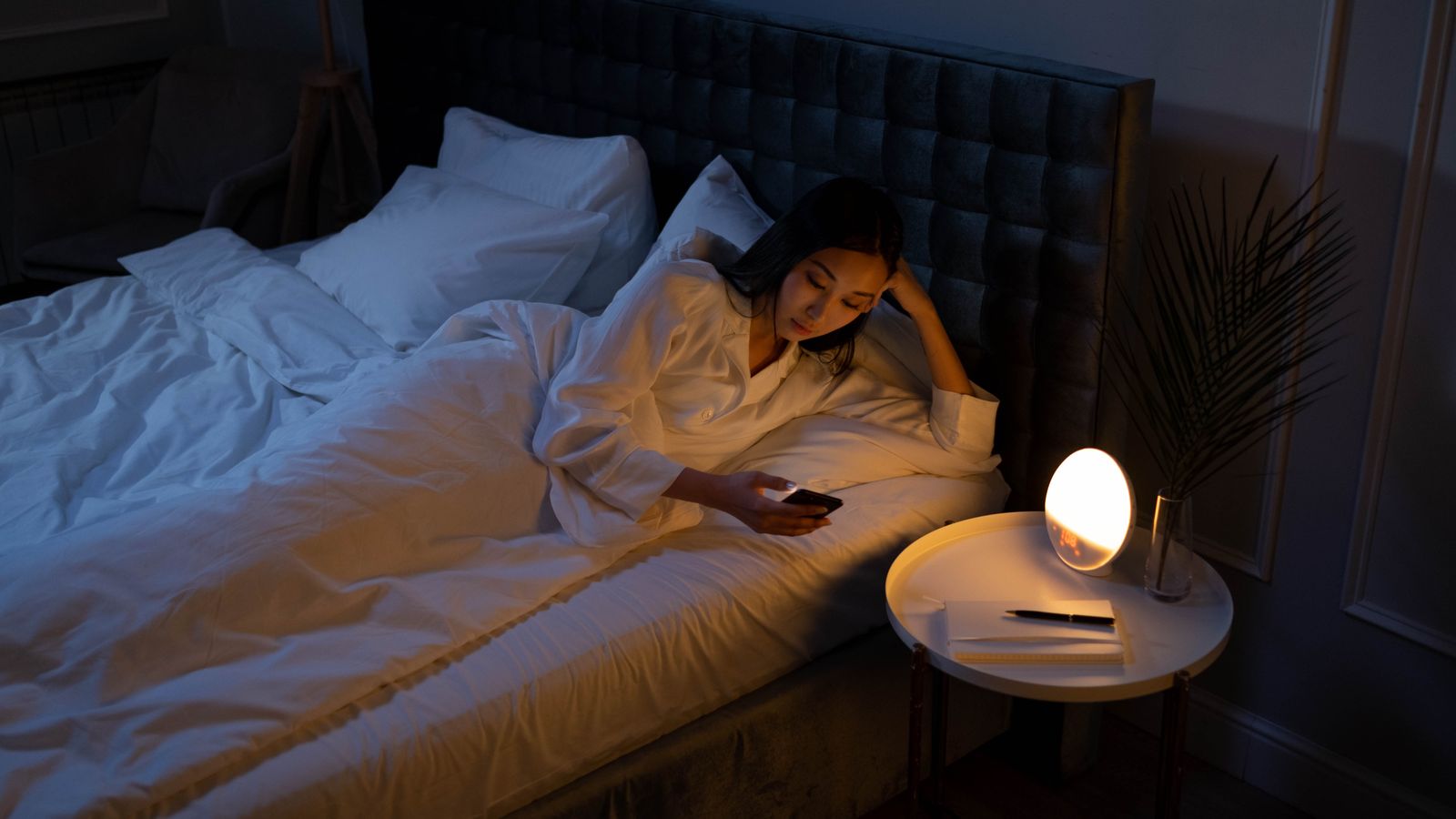
<figure class="ac-figure"><img src="https://images.pexels.com/photos/8591494/pexels-photo-8591494.jpeg?auto=compress&cs=tinysrgb&w=800&h=300&fit=crop" alt="A person resting in a dim bedroom lit by a soft round bedside lamp at night" width="800" height="300" loading="lazy" decoding="async"><figcaption>Sleep rhythms grow more fragile with age, so a calming, consistent wind-down does more for the second half of the night than any single trick.</figcaption></figure>
<div class="ac-band"><div class="inner"><div class="big">5</div><div><div class="q">Why you cannot force it</div><h3>The Worry Loop Is the Real Thief</h3></div></div></div>
<p>The cruelest twist is that trying hard to sleep almost guarantees you will not. People with insomnia tend to become preoccupied with sleep and anxious about the consequences of a bad night, <a href="https://www.health.harvard.edu/sleep/awake-at-3-am-strategies-to-help-you-to-get-back-to-sleep" target="_blank" rel="noopener">Harvard sleep experts</a> explain, and that spiral is exactly what stretches a five-minute waking into two lost hours of ceiling-staring.</p>
<p>The way out is counterintuitive. If you are not back asleep within about 20 minutes, do not lie there fighting it. Get up, keep the lights low, and do something quiet and dull until you feel sleepy again. Above all, leave the phone alone, because its bright light tells your brain that the day has started.</p>
<div class="ac-midcap"><h4>Take the 3 a.m. reset with you</h4><p class="sub">Your free 2-page guide: why the small hours are your lightest sleep, the bedside triggers worth cutting, and the 20-minute rule that ends the worry loop.</p><div class="mcform"><input type="email" placeholder="Your email address" aria-label="Email address"><button type="button">Send My Plan (Free)</button></div><div class="fine">One email. No spam. Unsubscribe anytime.</div></div>
<div class="ac-assess-promo"><p class="eyebrow">Free Lifestyle Assessment</p><h4>How Healthy Is Your Current Lifestyle?</h4><p class="ap-body">Answer honestly for five minutes and walk away with your personal scorecard: all six areas of your health rated, the one that needs your attention first, and a 30-day plan built from your answers. It shows up the second you finish.</p><a class="ap-cta" href="/#assessment">See How the Assessment Works →</a><p class="ap-fine">Free. About 5 minutes. Your results appear instantly.</p></div>
<div class="ac-plan" id="coach-recommendations"><div class="ptitle">📋 Your Coach's Recommendations</div><div class="step"><div class="n">1</div><div><div class="sh">Give It 20 Minutes, Then Get Out of Bed</div><div class="sd">If you wake and drift back within 15 to 20 minutes, do nothing at all. If you are still awake and frustrated, get up and do something quiet and boring in dim light until you feel sleepy. Lying in bed willing yourself to sleep only trains your brain to treat the bed as a place to be wide awake.</div></div></div><div class="step"><div class="n">2</div><div><div class="sh">Fix the Inputs You Actually Control</div><div class="sd">Have your last alcoholic drink at least three hours before bed, keep the room dark, cool and quiet, and move afternoon caffeine earlier in the day. None of this guarantees an unbroken night, but together these steps remove the easy triggers that turn a light moment into a full waking.</div></div></div><div class="step"><div class="n">3</div><div><div class="sh">If It Is Chronic, Ask About CBT-I, Not a Pill</div><div class="sd">When sleep-maintenance insomnia drags on for months, the first-line treatment is not a sleeping pill. It is cognitive behavioral therapy for insomnia, which Harvard notes is as effective as medication and safer over time. Ask your provider about it before reaching for anything on a pharmacy shelf.</div></div></div><div class="actions">
<div class="ac-primary-row">
<button type="button" class="ac-btn-primary-wide" data-ac-cal>
<span class="icon"><svg viewBox="0 0 24 24" fill="none" stroke="currentColor" stroke-width="2" stroke-linecap="round" stroke-linejoin="round"><rect x="3" y="4" width="18" height="18" rx="2"></rect><path d="M16 2v4M8 2v4M3 10h18"></path></svg></span>
<span class="label"><span class="top">Add <em>Your Coach's Recommendations to Your Calendar</em></span></span>
</button>
<details class="ac-cal-help"><summary aria-label="What does this do?">?</summary><div class="tip"><strong>How it works.</strong> Just a quiet check-in, not an alert and not a recurring nag. The event lands as a 30-minute slot at 9am two weeks from today, with your plan in the notes and a link back to this article. Works with Apple Calendar, Google Calendar, and Outlook. Yours to move, snooze, or delete whenever.</div></details>
</div>
<button type="button" class="ac-btn-share-wide" data-ac-share><svg viewBox="0 0 24 24" fill="none" stroke="currentColor" stroke-width="2" stroke-linecap="round" stroke-linejoin="round"><path d="M4 12v8a2 2 0 002 2h12a2 2 0 002-2v-8"></path><polyline points="16 6 12 2 8 6"></polyline><line x1="12" y1="2" x2="12" y2="15"></line></svg> Share this article</button>
</div>
</div>
<div class="ac-capture" data-state="trigger" data-article-slug="why-you-keep-waking-up-at-3-am" data-pdf-url="https://cdn.prod.website-files.com/69be1026a027224999b7936b/6a71ad987c6a7ceeaf45e1ac_ac-3am-reset-plan.pdf" data-plan-title="The 3 a.m. Reset" data-plan-desc="Your free 2-page guide: why the small hours are your lightest sleep, the bedside triggers worth cutting, and the 20-minute rule that ends the worry loop."><div class="st-trigger cap-state"><h4>Keep this plan</h4><p class="sub">Get the 2-page guide: why 3 a.m. is your lightest sleep, the triggers worth cutting, and the 20-minute rule.</p><button class="bigbtn" type="button" data-cap="form">📩 Email Me This Plan (Free PDF)</button><div class="fine">One email. No spam. Unsubscribe anytime.</div></div><div class="st-form cap-state"><h4>Where should we send it?</h4><p class="sub">Your 3 a.m. reset plan, straight to your inbox.</p><form class="capform"><input type="email" name="email" required placeholder="Your email address" aria-label="Email address"><button type="submit">Send My Plan</button></form><div class="fine">We send the plan plus one short evidence brief each week. Unsubscribe anytime.</div></div><div class="st-sent cap-state"><div class="sent-check">✓</div><h4>It is on the way</h4><p class="sub">Check your inbox in the next minute. Your first Ageless Brief arrives this week: one study, translated, no hype.</p><a class="dl" href="https://cdn.prod.website-files.com/69be1026a027224999b7936b/6a71ad987c6a7ceeaf45e1ac_ac-3am-reset-plan.pdf" download>⬇ Download your plan (PDF)</a></div></div>
<style>
.ac-exlib{--ac-ex-fog:#F0F7F7;--ac-ex-border:#A8C4C4;--ac-ex-teal:#0C8C88;--ac-ex-ink-teal:#0A6F6C;--ac-ex-dark:#0D1B2A;--ac-ex-body:#49505f;--ac-ex-muted:#5F6773;--ac-ex-serif:"Source Serif 4",Georgia,serif;--ac-ex-sans:Inter,-apple-system,"Segoe UI",sans-serif;background:linear-gradient(180deg,var(--ac-ex-fog),#fff);border:1.5px solid var(--ac-ex-border);border-radius:16px;padding:24px 26px;margin:36px 0 0;box-sizing:border-box}
.ac-exlib *{box-sizing:border-box}
.ac-exlib .ac-ex-eb{font:800 11.5px/1 var(--ac-ex-sans);letter-spacing:2.4px;text-transform:uppercase;color:var(--ac-ex-ink-teal);margin:0 0 10px}
.ac-exlib .ac-ex-h{font-family:var(--ac-ex-serif);font-size:22px;line-height:1.25;font-weight:800;color:var(--ac-ex-dark);margin:0 0 10px}
.ac-exlib .ac-ex-p{font:500 16px/1.6 var(--ac-ex-sans);color:var(--ac-ex-body);margin:0 0 16px}
.ac-exlib .ac-ex-go{display:inline-flex;align-items:center;gap:8px;border:1.5px solid var(--ac-ex-teal);color:var(--ac-ex-ink-teal);background:#fff;font:800 14px/1 var(--ac-ex-sans);padding:15px 24px;border-radius:50px;text-decoration:none;min-height:44px}
.ac-exlib .ac-ex-go:hover,.ac-exlib .ac-ex-go:focus{background:var(--ac-ex-fog);color:var(--ac-ex-ink-teal)}
.ac-exlib .ac-ex-go:focus-visible{outline:2px solid var(--ac-ex-ink-teal);outline-offset:3px}
.ac-exlib .ac-ex-go svg{width:14px;height:14px;stroke:currentColor;fill:none;stroke-width:2.4;flex:none}
.ac-exlib .ac-ex-note{font:500 12px/1.6 var(--ac-ex-sans);color:var(--ac-ex-muted);margin:14px 0 0}
@media(max-width:560px){.ac-exlib{padding:20px 18px}.ac-exlib .ac-ex-h{font-size:20px}.ac-exlib .ac-ex-go{width:100%;justify-content:center}}
</style>
<aside class="ac-exlib" data-template="L-examine" aria-label="Further reading">
<p class="ac-ex-eb">Read the research yourself</p>
<h3 class="ac-ex-h">We read the studies. You can too.</h3>
<p class="ac-ex-p">Everything above is sourced and linked. If you want to go deeper than one article can go, Examine maintains independent, continuously updated research summaries on insomnia and around a thousand supplements. They sell no supplements of their own. That is the reason we send people there rather than somewhere else.</p>
<a class="ac-ex-go" href="https://examine.com/refer/qed0mm2?loc=/conditions/insomnia&utm_source=agelesscoach&utm_medium=article&utm_content=tmpl-L-examine" rel="noopener sponsored" target="_blank">
See Examine's insomnia research
<svg viewBox="0 0 24 24" aria-hidden="true"><path d="M5 12h14M13 6l6 6-6 6" stroke-linecap="round" stroke-linejoin="round"/></svg>
</a>
<p class="ac-ex-note">Ageless Coach may earn a commission if you subscribe, at no additional cost to you. We were not paid to write this and it does not affect what we recommend.</p>
</aside>
<div class="ac-sig"><div class="rule"></div><p class="toyour">To your health,</p><svg width="320" height="72" viewBox="0 0 320 72" role="img" aria-label="Ageless Coach. Age Strong. Live Long." xmlns="http://www.w3.org/2000/svg" xmlns:xlink="http://www.w3.org/1999/xlink"><defs><clipPath id="acSigIconClip"><rect x="0" y="6" width="60" height="60" rx="12" ry="12"/></clipPath></defs><image x="0" y="6" width="60" height="60" clip-path="url(#acSigIconClip)" preserveAspectRatio="xMidYMid slice" href="https://cdn.prod.website-files.com/69be1026a027224999b7936b/6a0b22c6afd5d6fd115b9c1a_ac-closing-brand-icon.webp" xlink:href="https://cdn.prod.website-files.com/69be1026a027224999b7936b/6a0b22c6afd5d6fd115b9c1a_ac-closing-brand-icon.webp"/><text x="76" y="42" style="font-family:Inter,system-ui,-apple-system,'Helvetica Neue',Arial,sans-serif;font-size:27px;letter-spacing:-0.3px"><tspan style="font-weight:800;fill:#0D1B2A">Ageless</tspan><tspan style="font-weight:300;fill:rgba(13,27,42,0.6)">Coach</tspan><tspan dy="-12" style="font-size:16px;font-weight:600;fill:rgba(13,27,42,0.6)">™</tspan></text><text x="76" y="60" style="font-family:Inter,system-ui,-apple-system,'Helvetica Neue',Arial,sans-serif;font-size:10.5px;letter-spacing:2.5px;font-weight:500;fill:#0C8C88;text-transform:uppercase">AGE STRONG. LIVE LONG.</text></svg></div>
<div class="ac-faq"><h2>Frequently Asked Questions</h2><details><summary>Why do I keep waking up at almost exactly 3 a.m.?</summary><div class="a">For most people who sleep on a standard schedule, 3 a.m. falls in a light, REM-heavy stretch of the night, so small disturbances wake you easily. Your body can also become conditioned to wake at a familiar time, which is why the clock so often reads the same numbers.</div></details><details><summary>Is waking up in the night a sign of something serious?</summary><div class="a">Usually not. Brief nighttime awakenings are normal and happen to everyone. If they are frequent, come with loud snoring or gasping, or leave you exhausted every day, see a provider to rule out conditions like sleep apnea or an underlying sleep disorder.</div></details><details><summary>Should I look at the clock when I wake up at night?</summary><div class="a">It is better not to. Checking the time invites the mental math about how long is left until morning, and that worry is what keeps you awake. Turn the clock away from the bed so a normal waking does not turn into an anxious one.</div></details><details><summary>Does drinking alcohol make it worse?</summary><div class="a">Yes. A drink can help you fall asleep, but sleep becomes fragmented in the second half of the night as the alcohol clears. Cleveland Clinic suggests having your last drink at least three hours before bed.</div></details><details><summary>What should I do if I cannot fall back asleep?</summary><div class="a">Give yourself about 20 minutes. If you are still awake and frustrated, get out of bed and do something quiet and dull in dim light until you feel sleepy, then return to bed. Keep the phone off, since its light signals your brain to wake up.</div></details><details><summary>Is this medical advice?</summary><div class="a">No. This article is educational and is not a substitute for your clinician. If poor sleep is affecting your daily life, talk to your provider, who may recommend cognitive behavioral therapy for insomnia before any medication.</div></details></div>
<div class="ac-assess-line">Curious where you stand? Take the free <a href="/#assessment">5-minute lifestyle assessment</a> and your personal scorecard appears the second you finish.</div>
<p class="ac-articlemeta">By the Ageless Coach Editorial Team · Published August 4, 2026 · Last updated August 4, 2026</p>

Get Better Health, Weekly