The exercises that help knee pain are the low impact ones: cycling, the elliptical, water work and walking, plus strength training at least two days a week. Warm the joint for about 20 minutes first, ice it for up to 20 minutes after, and stop at sharp pain or pain worse than your usual ache. That is the whole plan, and it is free.
1Low impact first · a stationary or recumbent bike, an elliptical, or exercise in water is easiest on the joint
2Strength twice a week · strong thigh muscles carry load the knee would otherwise carry alone
3Heat before, ice after · about 20 minutes of warmth to start, up to 20 minutes of ice to finish
4150 minutes a week · the aerobic target, and short bouts through the day count the same
5Stop at sharp pain · pain worse than your usual joint pain is a signal, not a hurdle to push through
Knee pain is one of the most common reasons people stop moving, and stopping is exactly what makes the next month harder. The muscles that hold the joint steady get weaker when they are not used, and weaker muscles hand more of the load back to the joint itself. So the pain that made you sit down quietly arranges for more pain later.
There is a way out of that loop, and it is not complicated. It is the right kind of movement, done on a schedule, with a warm up at the front and ice at the back. Below is the list of what helps, the list of what to skip, and the two clocks that sit either side of the workout.
1
Why resting backfires
Weak Thigh Muscles Leave the Knee Carrying More
Strong muscles support your joints. Not exercising weakens those supporting muscles, and weak muscles put more stress on joints, which can make pain worse. That is the loop in one sentence, and it comes straight from Mayo Clinic. Exercise is what breaks it, which is why it sits at the top of almost every knee pain plan rather than at the end.
The knee is the biggest joint in your body and it absorbs and supports a large share of your weight every time you move, which is part of why it is one of the most commonly injured, Cleveland Clinic notes. Anything that moves some of that load onto muscle is working in your favor, permanently and for free.
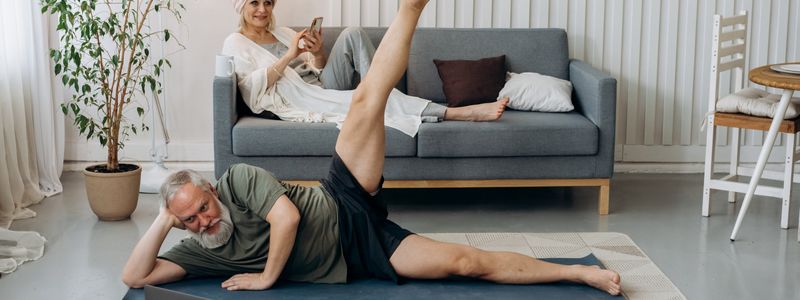
Floor work is where most knee strength plans start, because the joint carries almost none of your weight.
2
What helps, part one
Pick the Movements That Are Easiest on the Joint
Low impact is the whole idea. Stationary or recumbent cycling, an elliptical trainer, and exercise in water are all gentler on the knee than anything with a landing in it. Walking counts too, in shoes that actually fit. Gentle yoga and tai chi belong here as well: they improve balance and lower fall risk, which matters when a knee occasionally lets you down.
The aerobic target is about 150 minutes a week of somewhat hard activity, and short sessions spread through the day count exactly the same as one long one. Aim for a level where your breathing is harder than usual but you can still hold a conversation. Most days of the week is the goal, though two days a week still helps.
A stationary or recumbent bike, which keeps your weight off the joint entirely
An elliptical trainer, for the walking motion without the impact
Water walking or water aerobics, where the pool carries most of your weight
Ordinary walking, in properly fitted shoes, at a pace you can talk through
Gentle yoga or tai chi, for the balance work that protects you from falls
Weak muscles put more stress on joints, which can make pain worse.
This is the argument for exercising a joint that hurts, stated in one line. The rest of the plan is just the safe way to do it.
Mayo Clinic, 2026
3
What helps, part two
Two Strength Sessions a Week Do the Heavy Work
Weight training belongs in the plan at least two days a week, using resistance bands, hand weights, machines or nothing but your own body weight. Include all the major muscle groups rather than only the sore leg, because your hips, trunk and opposite side all decide how much load the knee ends up absorbing on a flight of stairs.
Range of motion work is the daily companion to that. Putting the joint through its full range keeps stiffness down, and most of these movements can be done every day without a rest day in between. Strength builds the support structure. Range of motion keeps the door swinging freely on it. You want both, and neither takes long.
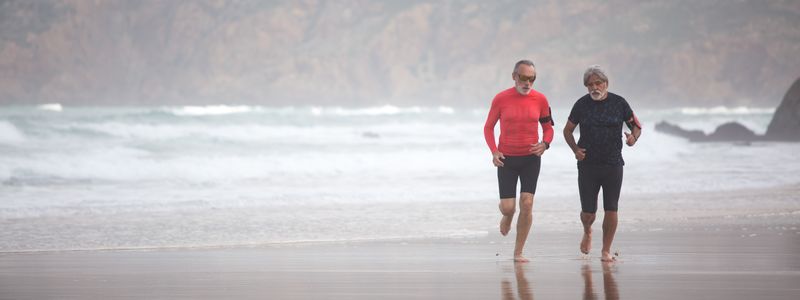
Walking is the low impact option most people already own. Shoes that fit do more for the knee than most gadgets.
4
The other list
What to Skip, and the Signal to Stop
Do not play through it. Pain during or after activity is information, not weakness, and sharp pain, or pain that is worse than your usual joint pain, means something is wrong rather than something is working. Slow down if you see swelling or a change in skin color around the joint. Those are the moments to stop the session, not to finish it.
Doing too much too fast is the other classic mistake. If you have not exercised in a while, start small and build, because a week lost to a flare costs more than the extra set was ever worth. Shorter or less frequent sessions are the correct fix when pain lingers after exercise, not a heavier week to make up for it.
Playing through pain during or after activity
Sharp pain, or pain noticeably worse than your usual ache
Jumping straight into long or hard sessions after time off
Working a swollen or discolored joint hard without checking in first
Standing on chairs, tables or countertops to reach things
5
The two clocks
Heat Before, Ice After, Every Session
Warm towels, a hot pack or a warm shower for about 20 minutes before you start relaxes the muscle and takes the edge off the first few minutes. Warm, not painfully hot. Then give the joint five to ten minutes of gentle range of motion before you move on to anything strenuous. That warm up is the cheapest injury insurance in the plan.
Afterward, ice for up to 20 minutes helps with swelling, and it matters most when the joint is already puffy. Heat and cold therapies both lower joint pain, the National Institute of Arthritis and Musculoskeletal and Skin Diseases notes, alongside braces, canes and shoe inserts for the days the joint needs backup.
Pain that lasts more than a few days in a row
Pain bad enough to change your daily routine
A knee that is hard to move, or that feels loose or unstable
Any knee pain after a fall or a crash, which is an emergency room visit
Those four are the line between a home plan and a professional one. A physical therapist can also build the exercise list around your specific knee, which beats any general list on the internet, this one included.
Take the knee routine with you
Your free one-page guide: the low impact list, the twice weekly strength plan, the heat and ice clock, and the stop signals.
One email. No spam. Unsubscribe anytime.
Free Lifestyle Assessment
How Healthy Is Your Current Lifestyle?
Answer honestly for five minutes and walk away with your personal scorecard: all six areas of your health rated, the one that needs your attention first, and a 30-day plan built from your answers. It shows up the second you finish.
Free. About 5 minutes. Your results appear instantly.
📋 Your Coach's Recommendations
1
Start with the low impact list, most weeks
A stationary or recumbent bike, an elliptical, water walking, or ordinary walking in shoes that fit. Build toward 150 minutes a week of somewhat hard effort, broken into short bouts if that is easier on the joint.
2
Add two strength sessions a week
Resistance bands, hand weights, machines or body weight, covering all the major muscle groups rather than only the sore leg. Add gentle range of motion work on the days in between, which can be done daily.
3
Run the heat and ice clock around every session
About 20 minutes of warmth before, then five to ten minutes of gentle range of motion, then your workout, then up to 20 minutes of ice. Stop at sharp pain, swelling or a color change, and see a provider if pain lasts more than a few days.
?
How it works. Just a quiet check-in, not an alert and not a recurring nag. The event lands as a 30-minute slot at 9am two weeks from today, with your plan in the notes and a link back to this article. Works with Apple Calendar, Google Calendar, and Outlook. Yours to move, snooze, or delete whenever.
Keep this routine
Get the one-page guide: what to do, how often, and the exact signals that mean stop for today.
One email. No spam. Unsubscribe anytime.
Where should we send it?
Your knee exercise routine, straight to your inbox.
We send the plan plus one short evidence brief each week. Unsubscribe anytime.
✓
It is on the way
Check your inbox in the next minute. Your first Ageless Brief arrives this week: one study, translated, no hype.
The low impact ones. A stationary or recumbent bike, an elliptical trainer, exercise in water and ordinary walking are all easier on the joint than anything with a landing in it. Add strength training at least two days a week, plus daily range of motion work.
Should I exercise a knee that already hurts?
Usually yes, and gently. Not exercising weakens the muscles that support the joint, and weaker muscles put more stress on it. Stop at sharp pain or pain worse than your usual ache, and talk to a healthcare professional before starting.
How much exercise should I aim for?
About 150 minutes a week of somewhat hard aerobic activity, plus strength training on at least two days. Short sessions spread through the day count the same as one long one, which is often easier on a sore knee.
Do I use heat or ice?
Both, at different times. Warmth for about 20 minutes before exercise relaxes muscle and eases pain. Ice for up to 20 minutes after activity helps with swelling, and matters most if the joint is already swollen.
When should I see a doctor about knee pain?
If the pain lasts more than a few days in a row, is bad enough to affect your daily routine, or makes the knee hard to move. Go to an emergency room after a fall or crash, or if you cannot move the knee or leg.
Is this medical advice?
No. This article is educational and is not a substitute for your clinician. The best exercises depend on what is causing your knee pain, and a physical therapist can build the list around your joint specifically.
Curious where you stand? Take the free 5-minute lifestyle assessment and your personal scorecard appears the second you finish.
By the Ageless Coach Editorial Team · Published August 14, 2026 · Last updated August 14, 2026
<style>
:root{--dark-base:#0D1B2A;--dark-mid:#1B3A4B;--teal:#0EA5A0;--teal-dark:#0C8C88;--teal-bright:#14D4CD;--fog:#D8E8E8;--deep-fog:#C8DCDC;--fog-border:#A8C4C4;--ink:#313743;--ink-soft:#49505f;--muted:#6b7280;--warm:#9A6841;--warm-light:#be7b4c;--serif:"Source Serif 4",Georgia,serif;--sans:Inter,-apple-system,BlinkMacSystemFont,"Segoe UI",sans-serif}
.w-richtext p,.w-richtext li,.w-richtext td{font-size:20.5px;line-height:1.7;color:var(--ink-soft)}
.w-richtext ul{list-style-type:disc;padding-left:24px;margin:12px 0}
.w-richtext ul li{margin-bottom:8px}
.ac-answer{background:#fff;border:1px solid #D4E4E4;border-top:5px solid var(--teal);border-radius:16px;padding:22px 24px 18px;margin:16px 0 28px;box-shadow:0 6px 22px rgba(13,27,42,.07)}
.ac-answer .aa-eyebrow{font:800 12px/1 var(--sans);letter-spacing:2.5px;text-transform:uppercase;color:var(--teal-dark);margin-bottom:8px}
.ac-answer .aa-head{font-family:var(--serif);font-size:24px;line-height:1.2;font-weight:800;color:var(--dark-base);margin:0 0 16px}
.ac-answer .aa-list{list-style:none;margin:0;padding:0}
.ac-answer .aa-list li{display:flex;gap:12px;align-items:baseline;padding:11px 0;border-bottom:1px solid #EDF3F3;font:700 16.5px/1.4 var(--sans);color:var(--ink)}
.ac-answer .aa-list li:last-child{border-bottom:none}
.ac-answer .aa-n{flex-shrink:0;width:24px;height:24px;border-radius:50%;background:var(--teal-dark);color:#fff;font:800 12px/24px var(--sans);text-align:center}
.ac-answer .aa-food{color:var(--teal-dark);font-weight:800}
.ac-answer .aa-cue{margin-top:18px;text-align:center}
.ac-answer .aa-cta{display:inline-flex;align-items:center;gap:10px;background:var(--teal-dark);color:#fff;font:800 14px/1 var(--sans);letter-spacing:.2px;padding:14px 26px;border-radius:50px;text-decoration:none;box-shadow:0 6px 16px rgba(12,140,136,.30)}
.ac-answer .aa-cta:hover{background:#0A7A76}
.ac-answer .aa-arw{display:inline-block;animation:aa-nudge 1.4s ease-in-out infinite}
@keyframes aa-nudge{0%,100%{transform:translateY(0)}50%{transform:translateY(4px)}}
@media(max-width:560px){.ac-answer{padding:20px 18px 16px}.ac-answer .aa-head{font-size:21px}.ac-answer .aa-list li{font-size:15px}}
.ac-band{margin:56px 0 24px;padding:26px 24px 12px;background:linear-gradient(180deg,#F0F7F7,#fff);border-radius:16px}
.ac-band.hype{background:linear-gradient(180deg,#FAF3EB,#fff)}
.ac-band .inner{display:flex;gap:20px;align-items:center}
.ac-band .big{font:900 72px/1 var(--sans);color:var(--deep-fog);flex-shrink:0}
.ac-band.hype .big{color:#EAD9C6}
.ac-band .q{font:700 13px/1.4 var(--sans);letter-spacing:2px;text-transform:uppercase;color:var(--teal-dark)}
.ac-band.hype .q{color:var(--warm)}
.ac-band h3{font-family:var(--serif);font-size:30px;line-height:1.2;font-weight:800;color:var(--ink);margin:0}
.ac-callout{border-left:4px solid var(--teal);background:#F4FAFA;border-radius:0 12px 12px 0;padding:18px 22px;margin:28px 0}
.ac-callout .n{font:800 20px/1.35 var(--sans);color:var(--dark-mid);margin-bottom:6px}
.ac-callout .d{font:500 15px/1.55 var(--sans);color:var(--ink-soft)}
.ac-callout .c{font:600 11.5px/1 var(--sans);letter-spacing:1.5px;text-transform:uppercase;color:var(--muted);margin-top:10px}
.ac-plan{background:linear-gradient(135deg,#F4FAFA 0%,#fff 100%);border-left:5px solid var(--teal-dark);border-radius:14px;padding:30px 26px;margin:40px 0 0;box-shadow:0 2px 12px rgba(0,0,0,.06);scroll-margin-top:100px}
.ac-plan .ptitle{font-family:var(--serif);font-size:24px;font-weight:800;color:var(--ink);margin-bottom:22px}
.ac-plan .step{display:flex;gap:16px;margin-bottom:18px;align-items:flex-start}
.ac-plan .step .n{min-width:38px;width:38px;height:38px;background:var(--teal-dark);border-radius:50%;color:#fff;font:800 17px/38px var(--sans);text-align:center;flex-shrink:0}
.ac-plan .sh{font:800 16.5px/1.4 var(--sans);color:var(--ink);margin-bottom:3px}
.ac-plan .sd{font:400 15px/1.6 var(--sans);color:var(--muted)}
.ac-plan .actions{border-top:1px solid #D8E8E8;margin-top:16px;padding-top:20px}
.ac-primary-row{display:flex;align-items:center;gap:10px;padding:0 4px}
.ac-btn-primary-wide{flex:1;background:var(--teal);color:#fff;border:1.5px solid var(--teal);border-radius:14px;padding:12px 22px;box-shadow:0 4px 14px rgba(14,165,160,.22);font-family:var(--sans);cursor:pointer;display:grid;grid-template-columns:auto 1fr;gap:14px;align-items:center;transition:all .18s ease}
.ac-btn-primary-wide:hover{background:var(--teal-dark);border-color:var(--teal-dark)}
.ac-btn-primary-wide .icon svg{width:22px;height:22px;color:#fff;display:block}
.ac-btn-primary-wide .label{text-align:left;line-height:1.25}
.ac-btn-primary-wide .label .top{display:block;font-weight:700;font-size:15.5px;color:#fff}
.ac-btn-primary-wide .label .top em{font-style:italic;font-weight:700}
.ac-cal-help{position:relative;flex-shrink:0}
.ac-cal-help summary{list-style:none;width:24px;height:24px;border-radius:50%;background:#E4F1F1;border:1px solid var(--fog-border);color:var(--dark-mid);font:700 13px/22px var(--sans);text-align:center;cursor:pointer;display:block}
.ac-cal-help summary::-webkit-details-marker{display:none}
.ac-cal-help .tip{position:absolute;right:0;top:32px;z-index:50;width:290px;background:var(--dark-base);color:var(--fog);border-radius:12px;padding:14px 16px;font:500 12.5px/1.55 var(--sans);box-shadow:0 10px 30px rgba(13,27,42,.35)}
.ac-cal-help .tip strong{color:#fff}
.ac-btn-share-wide{display:flex;width:100%;align-items:center;justify-content:center;gap:10px;background:#fff;color:var(--teal-dark);border:1.5px solid var(--teal-dark);border-radius:14px;padding:12px 22px;margin-top:10px;font:800 15px/1 var(--sans);cursor:pointer}
.ac-btn-share-wide svg{width:18px;height:18px}
.ac-midcap{background:linear-gradient(180deg,#F0F7F7,#fff);border:1.5px solid var(--fog-border);border-radius:16px;padding:24px 22px;margin:34px 0;text-align:center}
.ac-midcap h4{font-family:var(--serif);font-size:22px;font-weight:800;color:var(--ink);margin:0 0 6px}
.ac-midcap .sub{font:500 14px/1.55 var(--sans);color:var(--ink-soft);margin:0 auto 14px;max-width:400px}
.ac-midcap .mcform{display:flex;gap:8px;max-width:400px;margin:0 auto}
.ac-midcap .mcform input{flex:1;border:1.5px solid var(--fog-border);border-radius:50px;padding:12px 18px;font:500 14px/1 var(--sans);min-width:0}
.ac-midcap .mcform button{background:var(--teal-dark);color:#fff;border:none;border-radius:50px;padding:12px 20px;font:800 13.5px/1 var(--sans);cursor:pointer;white-space:nowrap}
.ac-midcap .fine{font:500 11.5px/1.5 var(--sans);color:var(--muted);margin-top:10px}
@media (max-width:520px){.ac-midcap .mcform{flex-direction:column}}
.ac-assess-promo{background:linear-gradient(135deg,#D8E8E8,#C8DCDC);border:1px solid var(--fog-border);border-radius:16px;padding:34px 30px;margin:44px 0;text-align:center}
.ac-assess-promo .eyebrow{color:var(--teal-dark);font:800 12px/1 var(--sans);letter-spacing:2.5px;text-transform:uppercase;margin:0 0 10px}
.ac-assess-promo h4{font-family:var(--serif);color:var(--dark-base);font-size:26px;font-weight:800;margin:0 0 12px}
.w-embed .ac-assess-promo p.ap-body,.ac-assess-promo p.ap-body{font-family:Georgia,serif;color:#3A5555;font-size:15.5px;font-weight:500;line-height:1.65;max-width:540px;margin:0 auto 22px}
.ac-assess-promo .ap-cta{display:inline-block;background:var(--teal-bright);color:var(--dark-base);font:800 15px/1 var(--sans);padding:15px 30px;border-radius:50px;text-decoration:none}
.ac-assess-promo .ap-fine{color:#4E6B6B;font:500 13px/1.5 var(--sans);margin:14px 0 0}
.ac-assess-line{border-top:1px solid #E2ECEC;margin-top:30px;padding:22px 10px 0;text-align:center;font:500 15.5px/1.6 var(--sans);color:#3A5555}
.w-embed .ac-assess-line a,.ac-assess-line a{color:var(--teal-dark);font-weight:700;text-decoration:underline;text-underline-offset:3px}
.ac-articlemeta{font:500 12.5px/1.6 var(--sans);color:#98a0a6;text-align:center;margin:24px 0 0}
.ac-capture{background:linear-gradient(180deg,#F0F7F7,#fff);border:1.5px solid var(--fog-border);border-radius:16px;padding:30px 28px;margin:26px 0 44px;text-align:center}
.ac-capture .cap-state{display:none}
.ac-capture[data-state="trigger"] .st-trigger{display:block}
.ac-capture[data-state="form"] .st-form{display:block}
.ac-capture[data-state="sent"] .st-sent{display:block}
.ac-capture h4{font-family:var(--serif);font-size:24px;font-weight:800;color:var(--ink);margin:0 0 8px}
.ac-capture .sub{font:500 15px/1.55 var(--sans);color:var(--ink-soft);margin:0 auto 18px;max-width:430px}
.ac-capture .bigbtn{display:inline-flex;align-items:center;gap:10px;background:var(--teal-dark);color:#fff;border:none;border-radius:50px;padding:16px 30px;font:800 16px/1 var(--sans);cursor:pointer;box-shadow:0 6px 18px rgba(12,140,136,.28)}
.ac-capture .capform{display:flex;gap:10px;max-width:430px;margin:0 auto}
.ac-capture .capform input{flex:1;border:1.5px solid var(--fog-border);border-radius:50px;padding:14px 20px;font:500 15px/1 var(--sans)}
.ac-capture .capform button{background:var(--teal-dark);color:#fff;border:none;border-radius:50px;padding:14px 24px;font:800 14px/1 var(--sans);cursor:pointer}
.ac-capture .sent-check{width:52px;height:52px;border-radius:50%;background:var(--teal);color:#fff;font:800 26px/52px var(--sans);margin:0 auto 12px}
.ac-capture .dl{display:inline-block;margin-top:6px;color:var(--teal-dark);font:700 15px/1 var(--sans);text-decoration:underline;cursor:pointer}
.ac-capture .fine{font:500 12px/1.5 var(--sans);color:var(--muted);margin-top:12px}
.ac-sig{margin-top:36px}
.ac-sig .rule{width:60px;height:2px;background:linear-gradient(90deg,var(--teal-dark),var(--teal-bright));margin-bottom:18px;border-radius:2px}
.ac-sig .toyour{font-family:var(--serif);font-size:16px;font-style:italic;color:#777;margin:0 0 10px;padding-left:2px}
.ac-faq{margin-top:40px;border-top:1px solid #e5e7eb;padding-top:30px;margin-bottom:40px}
.ac-faq h2{font-family:var(--serif);font-size:23px;font-weight:800;color:var(--ink);margin:0 0 18px}
.ac-faq details{border:1px solid #e5e7eb;border-radius:10px;margin-bottom:10px}
.ac-faq summary{padding:15px 18px;font:700 16px/1.4 var(--sans);color:var(--ink);cursor:pointer;display:flex;justify-content:space-between;align-items:center;list-style:none}
.ac-faq summary:after{content:"\25BE";color:var(--warm)}
.ac-faq .a{padding:0 18px 16px;font-size:17px;line-height:1.65;color:#555}
.article-header-section .article-container{max-width:1080px !important;margin:0 auto !important;padding:0 20px !important}
.article-header-section .article-hero-image{display:block;width:100%;max-width:660px;margin:0}
.article-header-section .article-title{display:block !important;font-family:var(--serif);font-size:32px;line-height:1.25;font-weight:700;color:#313743;margin:20px 0 12px 0;text-align:left;max-width:660px}
@media (max-width:767px){.article-header-section .article-title{font-size:26px}.article-header-section .article-hero-image{max-width:100%}}
@media (max-width:640px){.ac-band .big{font-size:52px}}
@media (max-width:520px){.ac-capture .capform{flex-direction:column}}
.ac-figure{margin:30px 0}.ac-figure img{display:block;width:100%;border-radius:14px;height:auto;aspect-ratio:800/300}.ac-figure figcaption{font:500 13px/1.5 var(--sans);color:var(--muted);margin-top:9px}</style><div class="ac-answer"><div class="aa-eyebrow">What the evidence actually says</div><h2 class="aa-head">The exercises that help knee pain are the low impact ones: cycling, the elliptical, water work and walking, plus strength training at least two days a week. Warm the joint for about 20 minutes first, ice it for up to 20 minutes after, and stop at sharp pain or pain worse than your usual ache. That is the whole plan, and it is free.</h2><ol class="aa-list"><li><span class="aa-n">1</span><span><span class="aa-food">Low impact first</span> · a stationary or recumbent bike, an elliptical, or exercise in water is easiest on the joint</span></li><li><span class="aa-n">2</span><span><span class="aa-food">Strength twice a week</span> · strong thigh muscles carry load the knee would otherwise carry alone</span></li><li><span class="aa-n">3</span><span><span class="aa-food">Heat before, ice after</span> · about 20 minutes of warmth to start, up to 20 minutes of ice to finish</span></li><li><span class="aa-n">4</span><span><span class="aa-food">150 minutes a week</span> · the aerobic target, and short bouts through the day count the same</span></li><li><span class="aa-n">5</span><span><span class="aa-food">Stop at sharp pain</span> · pain worse than your usual joint pain is a signal, not a hurdle to push through</span></li></ol><div class="aa-cue"><a class="aa-cta" href="#coach-recommendations">Get Your Coach's 3-Step Plan <span class="aa-arw">↓</span></a></div></div><p>Knee pain is one of the most common reasons people stop moving, and stopping is exactly what makes the next month harder. The muscles that hold the joint steady get weaker when they are not used, and weaker muscles hand more of the load back to the joint itself. So the pain that made you sit down quietly arranges for more pain later.</p><p>There is a way out of that loop, and it is not complicated. It is the right kind of movement, done on a schedule, with a warm up at the front and ice at the back. Below is the list of what helps, the list of what to skip, and the two clocks that sit either side of the workout.</p><div class="ac-band"><div class="inner"><div class="big">1</div><div><div class="q">Why resting backfires</div><h3>Weak Thigh Muscles Leave the Knee Carrying More</h3></div></div></div><p>Strong muscles support your joints. Not exercising weakens those supporting muscles, and weak muscles put more stress on joints, which can make pain worse. That is the loop in one sentence, and it comes straight from <a href="https://www.mayoclinic.org/diseases-conditions/arthritis/in-depth/arthritis/art-20047971" target="_blank" rel="noopener">Mayo Clinic</a>. Exercise is what breaks it, which is why it sits at the top of almost every knee pain plan rather than at the end.</p><p>The knee is the biggest joint in your body and it absorbs and supports a large share of your weight every time you move, which is part of why it is one of the most commonly injured, <a href="https://my.clevelandclinic.org/health/symptoms/21207-knee-pain" target="_blank" rel="noopener">Cleveland Clinic</a> notes. Anything that moves some of that load onto muscle is working in your favor, permanently and for free.</p><figure class="ac-figure"><img src="https://images.pexels.com/photos/7530016/pexels-photo-7530016.jpeg?auto=compress&cs=tinysrgb&w=800&h=300&fit=crop" alt="A man doing a floor leg exercise on a mat at home" width="800" height="300" loading="lazy" decoding="async"><figcaption>Floor work is where most knee strength plans start, because the joint carries almost none of your weight.</figcaption></figure><div class="ac-band"><div class="inner"><div class="big">2</div><div><div class="q">What helps, part one</div><h3>Pick the Movements That Are Easiest on the Joint</h3></div></div></div><p>Low impact is the whole idea. Stationary or recumbent cycling, an elliptical trainer, and exercise in water are all gentler on the knee than anything with a landing in it. Walking counts too, in shoes that actually fit. Gentle yoga and tai chi belong here as well: they improve balance and lower fall risk, which matters when a knee occasionally lets you down.</p><p>The aerobic target is about 150 minutes a week of somewhat hard activity, and short sessions spread through the day count exactly the same as one long one. Aim for a level where your breathing is harder than usual but you can still hold a conversation. Most days of the week is the goal, though two days a week still helps.</p><ul><li>A stationary or recumbent bike, which keeps your weight off the joint entirely</li><li>An elliptical trainer, for the walking motion without the impact</li><li>Water walking or water aerobics, where the pool carries most of your weight</li><li>Ordinary walking, in properly fitted shoes, at a pace you can talk through</li><li>Gentle yoga or tai chi, for the balance work that protects you from falls</li></ul><div class="ac-callout"><div class="n">Weak muscles put more stress on joints, which can make pain worse.</div><div class="d">This is the argument for exercising a joint that hurts, stated in one line. The rest of the plan is just the safe way to do it.</div><div class="c">Mayo Clinic, 2026</div></div><div class="ac-band"><div class="inner"><div class="big">3</div><div><div class="q">What helps, part two</div><h3>Two Strength Sessions a Week Do the Heavy Work</h3></div></div></div><p>Weight training belongs in the plan at least two days a week, using resistance bands, hand weights, machines or nothing but your own body weight. Include all the major muscle groups rather than only the sore leg, because your hips, trunk and opposite side all decide how much load the knee ends up absorbing on a flight of stairs.</p><p>Range of motion work is the daily companion to that. Putting the joint through its full range keeps stiffness down, and most of these movements can be done every day without a rest day in between. Strength builds the support structure. Range of motion keeps the door swinging freely on it. You want both, and neither takes long.</p><figure class="ac-figure"><img src="https://images.pexels.com/photos/8637982/pexels-photo-8637982.jpeg?auto=compress&cs=tinysrgb&w=800&h=300&fit=crop" alt="Two men walking together on a beach in the morning" width="800" height="300" loading="lazy" decoding="async"><figcaption>Walking is the low impact option most people already own. Shoes that fit do more for the knee than most gadgets.</figcaption></figure><div class="ac-band hype"><div class="inner"><div class="big">4</div><div><div class="q">The other list</div><h3>What to Skip, and the Signal to Stop</h3></div></div></div><p>Do not play through it. Pain during or after activity is information, not weakness, and sharp pain, or pain that is worse than your usual joint pain, means something is wrong rather than something is working. Slow down if you see swelling or a change in skin color around the joint. Those are the moments to stop the session, not to finish it.</p><p>Doing too much too fast is the other classic mistake. If you have not exercised in a while, start small and build, because a week lost to a flare costs more than the extra set was ever worth. Shorter or less frequent sessions are the correct fix when pain lingers after exercise, not a heavier week to make up for it.</p><ul><li>Playing through pain during or after activity</li><li>Sharp pain, or pain noticeably worse than your usual ache</li><li>Jumping straight into long or hard sessions after time off</li><li>Working a swollen or discolored joint hard without checking in first</li><li>Standing on chairs, tables or countertops to reach things</li></ul><div class="ac-band"><div class="inner"><div class="big">5</div><div><div class="q">The two clocks</div><h3>Heat Before, Ice After, Every Session</h3></div></div></div><p>Warm towels, a hot pack or a warm shower for about 20 minutes before you start relaxes the muscle and takes the edge off the first few minutes. Warm, not painfully hot. Then give the joint five to ten minutes of gentle range of motion before you move on to anything strenuous. That warm up is the cheapest injury insurance in the plan.</p><p>Afterward, ice for up to 20 minutes helps with swelling, and it matters most when the joint is already puffy. Heat and cold therapies both lower joint pain, <a href="https://www.niams.nih.gov/health-topics/osteoarthritis" target="_blank" rel="noopener">the National Institute of Arthritis and Musculoskeletal and Skin Diseases</a> notes, alongside braces, canes and shoe inserts for the days the joint needs backup.</p><ul><li>Pain that lasts more than a few days in a row</li><li>Pain bad enough to change your daily routine</li><li>A knee that is hard to move, or that feels loose or unstable</li><li>Any knee pain after a fall or a crash, which is an emergency room visit</li></ul><p>Those four are the line between a home plan and a professional one. A physical therapist can also build the exercise list around your specific knee, which beats any general list on the internet, this one included.</p><div class="ac-midcap"><h4>Take the knee routine with you</h4><p class="sub">Your free one-page guide: the low impact list, the twice weekly strength plan, the heat and ice clock, and the stop signals.</p><div class="mcform"><input type="email" placeholder="Your email address" aria-label="Email address"><button type="button">Send My Plan (Free)</button></div><div class="fine">One email. No spam. Unsubscribe anytime.</div></div><div class="ac-assess-promo"><p class="eyebrow">Free Lifestyle Assessment</p><h4>How Healthy Is Your Current Lifestyle?</h4><p class="ap-body">Answer honestly for five minutes and walk away with your personal scorecard: all six areas of your health rated, the one that needs your attention first, and a 30-day plan built from your answers. It shows up the second you finish.</p><a class="ap-cta" href="/#assessment">See How the Assessment Works →</a><p class="ap-fine">Free. About 5 minutes. Your results appear instantly.</p></div><div class="ac-plan" id="coach-recommendations"><div class="ptitle">📋 Your Coach's Recommendations</div><div class="step"><div class="n">1</div><div><div class="sh">Start with the low impact list, most weeks</div><div class="sd">A stationary or recumbent bike, an elliptical, water walking, or ordinary walking in shoes that fit. Build toward 150 minutes a week of somewhat hard effort, broken into short bouts if that is easier on the joint.</div></div></div><div class="step"><div class="n">2</div><div><div class="sh">Add two strength sessions a week</div><div class="sd">Resistance bands, hand weights, machines or body weight, covering all the major muscle groups rather than only the sore leg. Add gentle range of motion work on the days in between, which can be done daily.</div></div></div><div class="step"><div class="n">3</div><div><div class="sh">Run the heat and ice clock around every session</div><div class="sd">About 20 minutes of warmth before, then five to ten minutes of gentle range of motion, then your workout, then up to 20 minutes of ice. Stop at sharp pain, swelling or a color change, and see a provider if pain lasts more than a few days.</div></div></div><div class="actions"><div class="ac-primary-row"><button type="button" class="ac-btn-primary-wide" data-ac-cal><span class="icon"><svg viewBox="0 0 24 24" fill="none" stroke="currentColor" stroke-width="2" stroke-linecap="round" stroke-linejoin="round"><rect x="3" y="4" width="18" height="18" rx="2"></rect><path d="M16 2v4M8 2v4M3 10h18"></path></svg></span><span class="label"><span class="top">Add <em>Your Coach's Recommendations to Your Calendar</em></span></span></button><details class="ac-cal-help"><summary aria-label="What does this do?">?</summary><div class="tip"><strong>How it works.</strong> Just a quiet check-in, not an alert and not a recurring nag. The event lands as a 30-minute slot at 9am two weeks from today, with your plan in the notes and a link back to this article. Works with Apple Calendar, Google Calendar, and Outlook. Yours to move, snooze, or delete whenever.</div></details></div><button type="button" class="ac-btn-share-wide" data-ac-share><svg viewBox="0 0 24 24" fill="none" stroke="currentColor" stroke-width="2" stroke-linecap="round" stroke-linejoin="round"><path d="M4 12v8a2 2 0 002 2h12a2 2 0 002-2v-8"></path><polyline points="16 6 12 2 8 6"></polyline><line x1="12" y1="2" x2="12" y2="15"></line></svg> Share this article</button></div></div><div class="ac-capture" data-state="trigger" data-article-slug="knee-pain-exercises-what-helps-and-what-to-skip" data-pdf-url="https://cdn.prod.website-files.com/69be1026a027224999b7936b/6a7f0a960ff2ba1721b24233_ac-knee-exercise-routine.pdf" data-plan-title="The Knee Exercise Routine" data-plan-desc="The low impact list, the twice weekly strength plan, the heat and ice clock, and the signals to stop."><div class="st-trigger cap-state"><h4>Keep this routine</h4><p class="sub">Get the one-page guide: what to do, how often, and the exact signals that mean stop for today.</p><button class="bigbtn" type="button" data-cap="form">📩 Email Me This Plan (Free PDF)</button><div class="fine">One email. No spam. Unsubscribe anytime.</div></div><div class="st-form cap-state"><h4>Where should we send it?</h4><p class="sub">Your knee exercise routine, straight to your inbox.</p><form class="capform"><input type="email" name="email" required placeholder="Your email address" aria-label="Email address"><button type="submit">Send My Plan</button></form><div class="fine">We send the plan plus one short evidence brief each week. Unsubscribe anytime.</div></div><div class="st-sent cap-state"><div class="sent-check">✓</div><h4>It is on the way</h4><p class="sub">Check your inbox in the next minute. Your first Ageless Brief arrives this week: one study, translated, no hype.</p><a class="dl" href="https://cdn.prod.website-files.com/69be1026a027224999b7936b/6a7f0a960ff2ba1721b24233_ac-knee-exercise-routine.pdf" download>⬇ Download your plan (PDF)</a></div></div><div class="ac-sig"><div class="rule"></div><p class="toyour">To your health,</p><svg width="320" height="72" viewBox="0 0 320 72" role="img" aria-label="Ageless Coach. Age Strong. Live Long." xmlns="http://www.w3.org/2000/svg" xmlns:xlink="http://www.w3.org/1999/xlink"><defs><clipPath id="acSigIconClip"><rect x="0" y="6" width="60" height="60" rx="12" ry="12"/></clipPath></defs><image x="0" y="6" width="60" height="60" clip-path="url(#acSigIconClip)" preserveAspectRatio="xMidYMid slice" href="https://cdn.prod.website-files.com/69be1026a027224999b7936b/6a0b22c6afd5d6fd115b9c1a_ac-closing-brand-icon.webp" xlink:href="https://cdn.prod.website-files.com/69be1026a027224999b7936b/6a0b22c6afd5d6fd115b9c1a_ac-closing-brand-icon.webp"/><text x="76" y="42" style="font-family:Inter,system-ui,-apple-system,'Helvetica Neue',Arial,sans-serif;font-size:27px;letter-spacing:-0.3px"><tspan style="font-weight:800;fill:#0D1B2A">Ageless</tspan><tspan style="font-weight:300;fill:rgba(13,27,42,0.6)">Coach</tspan><tspan dy="-12" style="font-size:16px;font-weight:600;fill:rgba(13,27,42,0.6)">™</tspan></text><text x="76" y="60" style="font-family:Inter,system-ui,-apple-system,'Helvetica Neue',Arial,sans-serif;font-size:10.5px;letter-spacing:2.5px;font-weight:500;fill:#0C8C88;text-transform:uppercase">AGE STRONG. LIVE LONG.</text></svg></div><div class="ac-faq"><h2>Frequently Asked Questions</h2><details><summary>Which exercises are best for knee pain?</summary><div class="a">The low impact ones. A stationary or recumbent bike, an elliptical trainer, exercise in water and ordinary walking are all easier on the joint than anything with a landing in it. Add strength training at least two days a week, plus daily range of motion work.</div></details><details><summary>Should I exercise a knee that already hurts?</summary><div class="a">Usually yes, and gently. Not exercising weakens the muscles that support the joint, and weaker muscles put more stress on it. Stop at sharp pain or pain worse than your usual ache, and talk to a healthcare professional before starting.</div></details><details><summary>How much exercise should I aim for?</summary><div class="a">About 150 minutes a week of somewhat hard aerobic activity, plus strength training on at least two days. Short sessions spread through the day count the same as one long one, which is often easier on a sore knee.</div></details><details><summary>Do I use heat or ice?</summary><div class="a">Both, at different times. Warmth for about 20 minutes before exercise relaxes muscle and eases pain. Ice for up to 20 minutes after activity helps with swelling, and matters most if the joint is already swollen.</div></details><details><summary>When should I see a doctor about knee pain?</summary><div class="a">If the pain lasts more than a few days in a row, is bad enough to affect your daily routine, or makes the knee hard to move. Go to an emergency room after a fall or crash, or if you cannot move the knee or leg.</div></details><details><summary>Is this medical advice?</summary><div class="a">No. This article is educational and is not a substitute for your clinician. The best exercises depend on what is causing your knee pain, and a physical therapist can build the list around your joint specifically.</div></details></div><div class="ac-assess-line">Curious where you stand? Take the free <a href="/#assessment">5-minute lifestyle assessment</a> and your personal scorecard appears the second you finish.</div><p class="ac-articlemeta">By the Ageless Coach Editorial Team · Published August 14, 2026 · Last updated August 14, 2026</p>
Subscribe to the Free Newsletter
One article a week. Trusted research made simple. Start making smarter health decisions today.