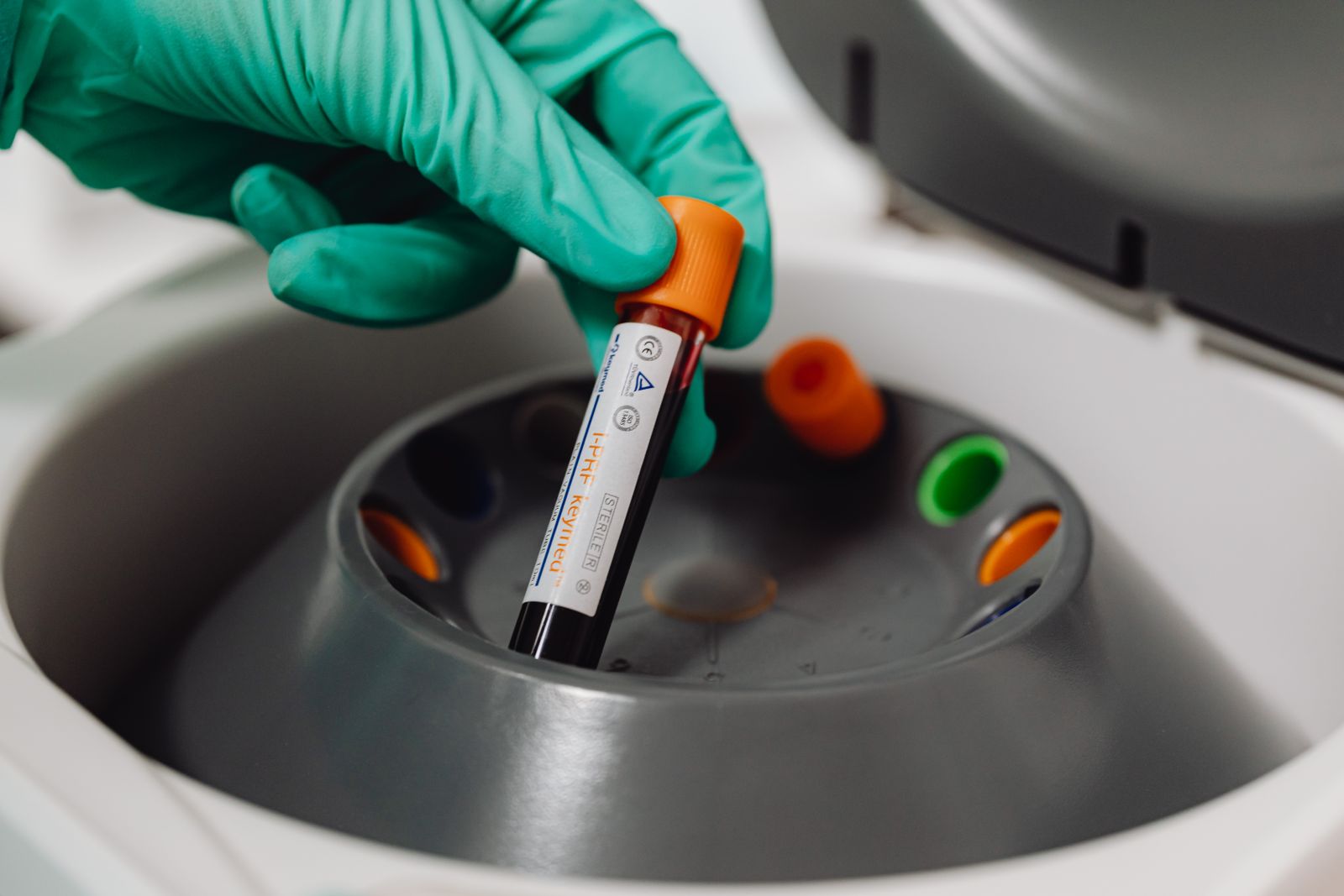
Your standard cholesterol panel weighs the cholesterol in your blood. It does not count the particles carrying it, and that count is what drives artery damage. An apolipoprotein B test measures it directly, and Cleveland Clinic and Harvard Health both call it a sharper risk read than LDL for many people.
1One to one · each apoB molecule rides a single artery-clogging particle, so the test gives an exact count, per Cleveland Clinic
2Above 130 mg/dL · the level both sources tie to a much higher risk of heart and blood vessel disease
3Normal LDL, high apoB · Harvard says you can have both at once, and a standard panel would not show it
4Around $60 · what Harvard says the test costs at major labs, and it is widely available
5At least 1 in 4 · the share Harvard says has metabolic warning signs and should consider the test
You get your cholesterol checked, the numbers land in the normal range, and you move on. For most people that is a reasonable read. But a standard panel can miss a form of risk it was never built to see, and there is a single blood test that catches it.
That test measures apolipoprotein B. According to Cleveland Clinic, apoB is the protein that carries the harmful lipids around your blood, the low-density lipoprotein (LDL) and very-low-density lipoprotein (VLDL) that build plaque in your arteries. It never rides with HDL, the good kind. Where you find apoB, LDL is there too.
1
What it measures
The Number a Standard Panel Skips
A standard cholesterol test reports how much cholesterol is floating in your blood. Harvard Health explains that this includes your total cholesterol and often a non-HDL figure, which captures all the cholesterol in the harmful particles. What it never reveals is the actual number of those particles, and two people with the very same cholesterol reading can carry very different counts.
That gap matters because every atherogenic particle, the kind that clogs arteries, carries exactly one apoB molecule on its surface. Harvard Health notes this is true across LDL, IDL, VLDL, chylomicrons and lipoprotein(a). Measure the apoB and you have effectively counted the particles themselves, one molecule for every particle.
2
The particle problem
Why Counting Beats Weighing
Here is the catch a weight cannot show. LDL particles come in a range of sizes, and per Harvard Health, if yours run small you carry more of them for any given LDL cholesterol number. More particles means more chances for one to slip into an artery wall and start the plaque that narrows it.
So your LDL cholesterol can read normal, or even low, while your particle count runs high. As Dr. Samia Mora of Harvard Medical School puts it, an apoB result is a better indicator of heart disease risk than an LDL value, which is an estimate rather than a direct measurement. Cleveland Clinic agrees the one-to-one ratio is what makes the count accurate.
An apoB test uses the same simple blood draw as a lipid panel. Cleveland Clinic notes you do not need to fast for it unless a lipid panel is done at the same time.
Timing is another reason a provider reaches for it. Cleveland Clinic notes that doctors may order an apoB test after you start a statin, as a way to confirm how far treatment has actually driven down the particles doing the damage, rather than trusting an estimate built from cholesterol weight alone.
3
Who it is for
Who the Standard Panel Misses
For plenty of people, LDL cholesterol tracks closely with apoB, so the standard panel is a fair proxy and no extra test is needed. The mismatch shows up in a specific group. Harvard Health reports that people with prediabetes, a large waist, high triglycerides or fatty liver are far more likely to carry a high apoB behind a reassuring LDL.
The scale is not small. Dr. Mora estimates that at least a quarter of the population fits this metabolic pattern and should consider the test, along with anyone who has a family history of heart disease. Cleveland Clinic makes the same point for diabetes and metabolic syndrome, where LDL tends to run denser and smaller.
4
Reading the result
What a Good Number Looks Like
The units are the same milligrams per deciliter you already know from cholesterol. Harvard Health puts an acceptable apoB below 90 mg/dL in healthy people, calls 90 to 129 borderline high to moderately elevated, and links anything above 130 to a much higher cardiovascular risk.
Cleveland Clinic draws the high-risk line at the same 130 mg/dL, and notes that some cardiology guidelines set tighter goals, below 65 or 80 mg/dL, for people aged 40 to 75 who take a statin. If you already have heart disease, Dr. Mora says a desirable apoB is under 70, well below the level that counts as fine for a healthy person.
Each apoB molecule carries exactly one artery-clogging particle. Count the apoB and you have counted the particles, which is the number your standard panel never shows you.
That one-to-one ratio is the whole reason a direct measurement can beat an estimate built from cholesterol weight.
Cleveland Clinic and Harvard Health
There is also a reason to test even when your numbers already look good. Harvard Health notes that people with a low LDL sometimes want the confidence that they have addressed all of their LDL-related risk, and a direct particle count is the cleanest way to confirm nothing is hiding.
5
Lowering it
How to Move the Number
A high apoB responds to the same steps that lower LDL, because they are the same particles you would be treating either way. Cleveland Clinic lists 30 minutes or more of daily exercise, plenty of fruits and vegetables, limiting saturated fat, staying at a healthy weight and avoiding tobacco, with a cholesterol-lowering drug when needed.
Harvard Health is honest about how far habits go on their own: a Mediterranean-style eating pattern and regular exercise modestly lower apoB, while statins and related medicines do more, and the two work best together. The point of the test is not another worry. It is a clearer target to aim at.
Harvard Health says a Mediterranean-style eating pattern and regular exercise modestly lower apoB, with medication doing more when it is needed.
Take the apoB cheat sheet with you
Your free 2-page guide: what apoB measures, the numbers that count as high, and the exact questions to ask your provider before your next blood draw.
One email. No spam. Unsubscribe anytime.
Free Lifestyle Assessment
How Healthy Is Your Current Lifestyle?
Answer honestly for five minutes and walk away with your personal scorecard: all six areas of your health rated, the one that needs your attention first, and a 30-day plan built from your answers. It shows up the second you finish.
Free. About 5 minutes. Your results appear instantly.
📋 Your Coach's Recommendations
1
Ask Whether apoB Fits Your Picture
Harvard Health says the test earns its place if you have prediabetes, a large waist, high triglycerides, fatty liver, a family history of heart disease, or a low LDL you want to be sure about. If that is you, ask your provider to add apoB to your next blood draw. Cleveland Clinic notes you do not need to fast for it on its own.
2
Read the Result Against 90 and 130
Harvard Health puts an acceptable apoB under 90 mg/dL, borderline from 90 to 129, and high above 130. Cleveland Clinic draws the same high-risk line at 130. If you take a statin or already have heart disease, your provider may aim lower, so ask what target fits you.
3
Aim at the Number, Do Not Just Watch It
Both sources say a high apoB responds to the same moves as high LDL: daily exercise, more plants, less saturated fat, a healthy weight, no tobacco, and medication when your provider recommends it. Harvard Health notes habits lower it modestly and statins do more, and they work best together.
?
How it works. Just a quiet check-in, not an alert and not a recurring nag. The event lands as a 30-minute slot at 9am two weeks from today, with your plan in the notes and a link back to this article. Works with Apple Calendar, Google Calendar, and Outlook. Yours to move, snooze, or delete whenever.
Keep this plan
Get the 2-page guide: what apoB measures, the numbers that count as high, and the questions to ask before your next blood draw.
One email. No spam. Unsubscribe anytime.
Where should we send it?
Your apoB cheat sheet, straight to your inbox.
We send the plan plus one short evidence brief each week. Unsubscribe anytime.
✓
It is on the way
Check your inbox in the next minute. Your first Ageless Brief arrives this week: one study, translated, no hype.
To your health,
Frequently Asked Questions
Is apoB the same as LDL cholesterol?
No. Cleveland Clinic explains that apoB is a protein that carries LDL and other harmful particles, so it is not the same as LDL, but measuring apoB tells you how many of those particles you have. LDL cholesterol is a weight; apoB is a count.
Why isn't the apoB test done routinely?
Harvard Health gives two reasons: standard cholesterol testing is deeply ingrained after decades of research, and for most people LDL cholesterol is a good proxy for apoB. The test matters most when the two are likely to disagree, such as in metabolic conditions.
Can my LDL be normal while my apoB is high?
Yes. Harvard Health says that if your LDL particles run small, you carry more of them for any given cholesterol level, so your apoB can be elevated even when your LDL cholesterol reads normal or low. That is exactly the case the test is built to catch.
What apoB number is considered high?
Harvard Health considers an apoB under 90 mg/dL acceptable in healthy people, 90 to 129 borderline high, and above 130 linked to much higher cardiovascular risk. Cleveland Clinic also flags above 130 as higher risk, with tighter goals for some people on statins.
How much does an apoB test cost?
Harvard Health says apoB testing is widely available and averages around $60 at major labs. Cleveland Clinic notes independent labs in the United States offer it for less than $100. Check with your provider or insurer for your local cost.
Is this medical advice?
No. This article is educational and is not a substitute for advice from your doctor. Whether an apoB test is right for you depends on your history and risk factors, so ask your provider whether to add it to your next blood draw.
Curious where you stand? Take the free 5-minute lifestyle assessment and your personal scorecard appears the second you finish.
By the Ageless Coach Editorial Team · Published July 26, 2026 · Last updated July 26, 2026
<style>
:root{--dark-base:#0D1B2A;--dark-mid:#1B3A4B;--teal:#0EA5A0;--teal-dark:#0C8C88;--teal-bright:#14D4CD;--fog:#D8E8E8;--deep-fog:#C8DCDC;--fog-border:#A8C4C4;--ink:#313743;--ink-soft:#49505f;--muted:#6b7280;--warm:#9A6841;--warm-light:#be7b4c;--serif:"Source Serif 4",Georgia,serif;--sans:Inter,-apple-system,BlinkMacSystemFont,"Segoe UI",sans-serif}
.w-richtext p,.w-richtext li,.w-richtext td{font-size:20.5px;line-height:1.7;color:var(--ink-soft)}
.w-richtext ul{list-style-type:disc;padding-left:24px;margin:12px 0}
.w-richtext ul li{margin-bottom:8px}
.ac-answer{background:#fff;border:1px solid #D4E4E4;border-top:5px solid var(--teal);border-radius:16px;padding:22px 24px 18px;margin:16px 0 28px;box-shadow:0 6px 22px rgba(13,27,42,.07)}
.ac-answer .aa-eyebrow{font:800 12px/1 var(--sans);letter-spacing:2.5px;text-transform:uppercase;color:var(--teal-dark);margin-bottom:8px}
.ac-answer .aa-head{font-family:var(--serif);font-size:24px;line-height:1.2;font-weight:800;color:var(--dark-base);margin:0 0 16px}
.ac-answer .aa-list{list-style:none;margin:0;padding:0}
.ac-answer .aa-list li{display:flex;gap:12px;align-items:baseline;padding:11px 0;border-bottom:1px solid #EDF3F3;font:700 16.5px/1.4 var(--sans);color:var(--ink)}
.ac-answer .aa-list li:last-child{border-bottom:none}
.ac-answer .aa-n{flex-shrink:0;width:24px;height:24px;border-radius:50%;background:var(--teal-dark);color:#fff;font:800 12px/24px var(--sans);text-align:center}
.ac-answer .aa-food{color:var(--teal-dark);font-weight:800}
.ac-answer .aa-cue{margin-top:18px;text-align:center}
.ac-answer .aa-cta{display:inline-flex;align-items:center;gap:10px;background:var(--teal-dark);color:#fff;font:800 14px/1 var(--sans);letter-spacing:.2px;padding:14px 26px;border-radius:50px;text-decoration:none;box-shadow:0 6px 16px rgba(12,140,136,.30)}
.ac-answer .aa-cta:hover{background:#0A7A76}
.ac-answer .aa-arw{display:inline-block;animation:aa-nudge 1.4s ease-in-out infinite}
@keyframes aa-nudge{0%,100%{transform:translateY(0)}50%{transform:translateY(4px)}}
@media(max-width:560px){.ac-answer{padding:20px 18px 16px}.ac-answer .aa-head{font-size:21px}.ac-answer .aa-list li{font-size:15px}}
.ac-band{margin:56px 0 24px;padding:26px 24px 12px;background:linear-gradient(180deg,#F0F7F7,#fff);border-radius:16px}
.ac-band.hype{background:linear-gradient(180deg,#FAF3EB,#fff)}
.ac-band .inner{display:flex;gap:20px;align-items:center}
.ac-band .big{font:900 72px/1 var(--sans);color:var(--deep-fog);flex-shrink:0}
.ac-band.hype .big{color:#EAD9C6}
.ac-band .q{font:700 13px/1.4 var(--sans);letter-spacing:2px;text-transform:uppercase;color:var(--teal-dark)}
.ac-band.hype .q{color:var(--warm)}
.ac-band h3{font-family:var(--serif);font-size:30px;line-height:1.2;font-weight:800;color:var(--ink);margin:0}
.ac-callout{border-left:4px solid var(--teal);background:#F4FAFA;border-radius:0 12px 12px 0;padding:18px 22px;margin:28px 0}
.ac-callout .n{font:800 20px/1.35 var(--sans);color:var(--dark-mid);margin-bottom:6px}
.ac-callout .d{font:500 15px/1.55 var(--sans);color:var(--ink-soft)}
.ac-callout .c{font:600 11.5px/1 var(--sans);letter-spacing:1.5px;text-transform:uppercase;color:var(--muted);margin-top:10px}
.ac-plan{background:linear-gradient(135deg,#F4FAFA 0%,#fff 100%);border-left:5px solid var(--teal-dark);border-radius:14px;padding:30px 26px;margin:40px 0 0;box-shadow:0 2px 12px rgba(0,0,0,.06);scroll-margin-top:100px}
.ac-plan .ptitle{font-family:var(--serif);font-size:24px;font-weight:800;color:var(--ink);margin-bottom:22px}
.ac-plan .step{display:flex;gap:16px;margin-bottom:18px;align-items:flex-start}
.ac-plan .step .n{min-width:38px;width:38px;height:38px;background:var(--teal-dark);border-radius:50%;color:#fff;font:800 17px/38px var(--sans);text-align:center;flex-shrink:0}
.ac-plan .sh{font:800 16.5px/1.4 var(--sans);color:var(--ink);margin-bottom:3px}
.ac-plan .sd{font:400 15px/1.6 var(--sans);color:var(--muted)}
.ac-plan .actions{border-top:1px solid #D8E8E8;margin-top:16px;padding-top:20px}
.ac-primary-row{display:flex;align-items:center;gap:10px;padding:0 4px}
.ac-btn-primary-wide{flex:1;background:var(--teal);color:#fff;border:1.5px solid var(--teal);border-radius:14px;padding:12px 22px;box-shadow:0 4px 14px rgba(14,165,160,.22);font-family:var(--sans);cursor:pointer;display:grid;grid-template-columns:auto 1fr;gap:14px;align-items:center;transition:all .18s ease}
.ac-btn-primary-wide:hover{background:var(--teal-dark);border-color:var(--teal-dark)}
.ac-btn-primary-wide .icon svg{width:22px;height:22px;color:#fff;display:block}
.ac-btn-primary-wide .label{text-align:left;line-height:1.25}
.ac-btn-primary-wide .label .top{display:block;font-weight:700;font-size:15.5px;color:#fff}
.ac-btn-primary-wide .label .top em{font-style:italic;font-weight:700}
.ac-cal-help{position:relative;flex-shrink:0}
.ac-cal-help summary{list-style:none;width:24px;height:24px;border-radius:50%;background:#E4F1F1;border:1px solid var(--fog-border);color:var(--dark-mid);font:700 13px/22px var(--sans);text-align:center;cursor:pointer;display:block}
.ac-cal-help summary::-webkit-details-marker{display:none}
.ac-cal-help .tip{position:absolute;right:0;top:32px;z-index:50;width:290px;background:var(--dark-base);color:var(--fog);border-radius:12px;padding:14px 16px;font:500 12.5px/1.55 var(--sans);box-shadow:0 10px 30px rgba(13,27,42,.35)}
.ac-cal-help .tip strong{color:#fff}
.ac-btn-share-wide{display:flex;width:100%;align-items:center;justify-content:center;gap:10px;background:#fff;color:var(--teal-dark);border:1.5px solid var(--teal-dark);border-radius:14px;padding:12px 22px;margin-top:10px;font:800 15px/1 var(--sans);cursor:pointer}
.ac-btn-share-wide svg{width:18px;height:18px}
.ac-midcap{background:linear-gradient(180deg,#F0F7F7,#fff);border:1.5px solid var(--fog-border);border-radius:16px;padding:24px 22px;margin:34px 0;text-align:center}
.ac-midcap h4{font-family:var(--serif);font-size:22px;font-weight:800;color:var(--ink);margin:0 0 6px}
.ac-midcap .sub{font:500 14px/1.55 var(--sans);color:var(--ink-soft);margin:0 auto 14px;max-width:400px}
.ac-midcap .mcform{display:flex;gap:8px;max-width:400px;margin:0 auto}
.ac-midcap .mcform input{flex:1;border:1.5px solid var(--fog-border);border-radius:50px;padding:12px 18px;font:500 14px/1 var(--sans);min-width:0}
.ac-midcap .mcform button{background:var(--teal-dark);color:#fff;border:none;border-radius:50px;padding:12px 20px;font:800 13.5px/1 var(--sans);cursor:pointer;white-space:nowrap}
.ac-midcap .fine{font:500 11.5px/1.5 var(--sans);color:var(--muted);margin-top:10px}
@media (max-width:520px){.ac-midcap .mcform{flex-direction:column}}
.ac-assess-promo{background:linear-gradient(135deg,#D8E8E8,#C8DCDC);border:1px solid var(--fog-border);border-radius:16px;padding:34px 30px;margin:44px 0;text-align:center}
.ac-assess-promo .eyebrow{color:var(--teal-dark);font:800 12px/1 var(--sans);letter-spacing:2.5px;text-transform:uppercase;margin:0 0 10px}
.ac-assess-promo h4{font-family:var(--serif);color:var(--dark-base);font-size:26px;font-weight:800;margin:0 0 12px}
.w-embed .ac-assess-promo p.ap-body,.ac-assess-promo p.ap-body{font-family:Georgia,serif;color:#3A5555;font-size:15.5px;font-weight:500;line-height:1.65;max-width:540px;margin:0 auto 22px}
.ac-assess-promo .ap-cta{display:inline-block;background:var(--teal-bright);color:var(--dark-base);font:800 15px/1 var(--sans);padding:15px 30px;border-radius:50px;text-decoration:none}
.ac-assess-promo .ap-fine{color:#4E6B6B;font:500 13px/1.5 var(--sans);margin:14px 0 0}
.ac-assess-line{border-top:1px solid #E2ECEC;margin-top:30px;padding:22px 10px 0;text-align:center;font:500 15.5px/1.6 var(--sans);color:#3A5555}
.w-embed .ac-assess-line a,.ac-assess-line a{color:var(--teal-dark);font-weight:700;text-decoration:underline;text-underline-offset:3px}
.ac-articlemeta{font:500 12.5px/1.6 var(--sans);color:#98a0a6;text-align:center;margin:24px 0 0}
.ac-capture{background:linear-gradient(180deg,#F0F7F7,#fff);border:1.5px solid var(--fog-border);border-radius:16px;padding:30px 28px;margin:26px 0 44px;text-align:center}
.ac-capture .cap-state{display:none}
.ac-capture[data-state="trigger"] .st-trigger{display:block}
.ac-capture[data-state="form"] .st-form{display:block}
.ac-capture[data-state="sent"] .st-sent{display:block}
.ac-capture h4{font-family:var(--serif);font-size:24px;font-weight:800;color:var(--ink);margin:0 0 8px}
.ac-capture .sub{font:500 15px/1.55 var(--sans);color:var(--ink-soft);margin:0 auto 18px;max-width:430px}
.ac-capture .bigbtn{display:inline-flex;align-items:center;gap:10px;background:var(--teal-dark);color:#fff;border:none;border-radius:50px;padding:16px 30px;font:800 16px/1 var(--sans);cursor:pointer;box-shadow:0 6px 18px rgba(12,140,136,.28)}
.ac-capture .capform{display:flex;gap:10px;max-width:430px;margin:0 auto}
.ac-capture .capform input{flex:1;border:1.5px solid var(--fog-border);border-radius:50px;padding:14px 20px;font:500 15px/1 var(--sans)}
.ac-capture .capform button{background:var(--teal-dark);color:#fff;border:none;border-radius:50px;padding:14px 24px;font:800 14px/1 var(--sans);cursor:pointer}
.ac-capture .sent-check{width:52px;height:52px;border-radius:50%;background:var(--teal);color:#fff;font:800 26px/52px var(--sans);margin:0 auto 12px}
.ac-capture .dl{display:inline-block;margin-top:6px;color:var(--teal-dark);font:700 15px/1 var(--sans);text-decoration:underline;cursor:pointer}
.ac-capture .fine{font:500 12px/1.5 var(--sans);color:var(--muted);margin-top:12px}
.ac-sig{margin-top:36px}
.ac-sig .rule{width:60px;height:2px;background:linear-gradient(90deg,var(--teal-dark),var(--teal-bright));margin-bottom:18px;border-radius:2px}
.ac-sig .toyour{font-family:var(--serif);font-size:16px;font-style:italic;color:#777;margin:0 0 10px;padding-left:2px}
.ac-faq{margin-top:40px;border-top:1px solid #e5e7eb;padding-top:30px;margin-bottom:40px}
.ac-faq h2{font-family:var(--serif);font-size:23px;font-weight:800;color:var(--ink);margin:0 0 18px}
.ac-faq details{border:1px solid #e5e7eb;border-radius:10px;margin-bottom:10px}
.ac-faq summary{padding:15px 18px;font:700 16px/1.4 var(--sans);color:var(--ink);cursor:pointer;display:flex;justify-content:space-between;align-items:center;list-style:none}
.ac-faq summary:after{content:"\25BE";color:var(--warm)}
.ac-faq .a{padding:0 18px 16px;font-size:17px;line-height:1.65;color:#555}
.article-header-section .article-container{max-width:1080px !important;margin:0 auto !important;padding:0 20px !important}
.article-header-section .article-hero-image{display:block;width:100%;max-width:660px;margin:0}
.article-header-section .article-title{display:block !important;font-family:var(--serif);font-size:32px;line-height:1.25;font-weight:700;color:#313743;margin:20px 0 12px 0;text-align:left;max-width:660px}
@media (max-width:767px){.article-header-section .article-title{font-size:26px}.article-header-section .article-hero-image{max-width:100%}}
@media (max-width:640px){.ac-band .big{font-size:52px}}
@media (max-width:520px){.ac-capture .capform{flex-direction:column}}
.ac-figure{margin:30px 0}.ac-figure img{display:block;width:100%;border-radius:14px;height:auto;aspect-ratio:800/300}.ac-figure figcaption{font:500 13px/1.5 var(--sans);color:var(--muted);margin-top:9px}</style><div class="ac-answer"><div class="aa-eyebrow">What the evidence actually says</div><h2 class="aa-head">Your standard cholesterol panel weighs the cholesterol in your blood. It does not count the particles carrying it, and that count is what drives artery damage. An apolipoprotein B test measures it directly, and Cleveland Clinic and Harvard Health both call it a sharper risk read than LDL for many people.</h2><ol class="aa-list"><li><span class="aa-n">1</span><span><span class="aa-food">One to one</span> · each apoB molecule rides a single artery-clogging particle, so the test gives an exact count, per Cleveland Clinic</span></li><li><span class="aa-n">2</span><span><span class="aa-food">Above 130 mg/dL</span> · the level both sources tie to a much higher risk of heart and blood vessel disease</span></li><li><span class="aa-n">3</span><span><span class="aa-food">Normal LDL, high apoB</span> · Harvard says you can have both at once, and a standard panel would not show it</span></li><li><span class="aa-n">4</span><span><span class="aa-food">Around $60</span> · what Harvard says the test costs at major labs, and it is widely available</span></li><li><span class="aa-n">5</span><span><span class="aa-food">At least 1 in 4</span> · the share Harvard says has metabolic warning signs and should consider the test</span></li></ol><div class="aa-cue"><a class="aa-cta" href="#coach-recommendations">Get Your Coach's 3-Step Plan <span class="aa-arw">↓</span></a></div></div><p>You get your cholesterol checked, the numbers land in the normal range, and you move on. For most people that is a reasonable read. But a standard panel can miss a form of risk it was never built to see, and there is a single blood test that catches it.</p><p>That test measures apolipoprotein B. According to <a href="https://my.clevelandclinic.org/health/diagnostics/24992-apolipoprotein-b-test" target="_blank" rel="noopener">Cleveland Clinic</a>, apoB is the protein that carries the harmful lipids around your blood, the low-density lipoprotein (LDL) and very-low-density lipoprotein (VLDL) that build plaque in your arteries. It never rides with HDL, the good kind. Where you find apoB, LDL is there too.</p><div class="ac-band"><div class="inner"><div class="big">1</div><div><div class="q">What it measures</div><h3>The Number a Standard Panel Skips</h3></div></div></div><p>A standard cholesterol test reports how much cholesterol is floating in your blood. <a href="https://www.health.harvard.edu/heart-health/is-an-apob-test-a-better-way-to-check-your-cholesterol" target="_blank" rel="noopener">Harvard Health</a> explains that this includes your total cholesterol and often a non-HDL figure, which captures all the cholesterol in the harmful particles. What it never reveals is the actual number of those particles, and two people with the very same cholesterol reading can carry very different counts.</p><p>That gap matters because every atherogenic particle, the kind that clogs arteries, carries exactly one apoB molecule on its surface. <a href="https://www.health.harvard.edu/heart-health/is-an-apob-test-a-better-way-to-check-your-cholesterol" target="_blank" rel="noopener">Harvard Health</a> notes this is true across LDL, IDL, VLDL, chylomicrons and lipoprotein(a). Measure the apoB and you have effectively counted the particles themselves, one molecule for every particle.</p><div class="ac-band hype"><div class="inner"><div class="big">2</div><div><div class="q">The particle problem</div><h3>Why Counting Beats Weighing</h3></div></div></div><p>Here is the catch a weight cannot show. LDL particles come in a range of sizes, and per <a href="https://www.health.harvard.edu/heart-health/is-an-apob-test-a-better-way-to-check-your-cholesterol" target="_blank" rel="noopener">Harvard Health</a>, if yours run small you carry more of them for any given LDL cholesterol number. More particles means more chances for one to slip into an artery wall and start the plaque that narrows it.</p><p>So your LDL cholesterol can read normal, or even low, while your particle count runs high. As Dr. Samia Mora of Harvard Medical School puts it, an apoB result is a better indicator of heart disease risk than an LDL value, which is an estimate rather than a direct measurement. <a href="https://my.clevelandclinic.org/health/diagnostics/24992-apolipoprotein-b-test" target="_blank" rel="noopener">Cleveland Clinic</a> agrees the one-to-one ratio is what makes the count accurate.</p><figure class="ac-figure"><img src="https://images.pexels.com/photos/12227661/pexels-photo-12227661.jpeg?auto=compress&cs=tinysrgb&w=800&h=300&fit=crop" alt="A gloved clinician drawing a blood sample from a person's arm with a blue tourniquet" width="800" height="300" loading="lazy" decoding="async"><figcaption>An apoB test uses the same simple blood draw as a lipid panel. Cleveland Clinic notes you do not need to fast for it unless a lipid panel is done at the same time.</figcaption></figure><p>Timing is another reason a provider reaches for it. <a href="https://my.clevelandclinic.org/health/diagnostics/24992-apolipoprotein-b-test" target="_blank" rel="noopener">Cleveland Clinic</a> notes that doctors may order an apoB test after you start a statin, as a way to confirm how far treatment has actually driven down the particles doing the damage, rather than trusting an estimate built from cholesterol weight alone.</p><div class="ac-band"><div class="inner"><div class="big">3</div><div><div class="q">Who it is for</div><h3>Who the Standard Panel Misses</h3></div></div></div><p>For plenty of people, LDL cholesterol tracks closely with apoB, so the standard panel is a fair proxy and no extra test is needed. The mismatch shows up in a specific group. <a href="https://www.health.harvard.edu/heart-health/is-an-apob-test-a-better-way-to-check-your-cholesterol" target="_blank" rel="noopener">Harvard Health</a> reports that people with prediabetes, a large waist, high triglycerides or fatty liver are far more likely to carry a high apoB behind a reassuring LDL.</p><p>The scale is not small. Dr. Mora estimates that at least a quarter of the population fits this metabolic pattern and should consider the test, along with anyone who has a family history of heart disease. <a href="https://my.clevelandclinic.org/health/diagnostics/24992-apolipoprotein-b-test" target="_blank" rel="noopener">Cleveland Clinic</a> makes the same point for diabetes and metabolic syndrome, where LDL tends to run denser and smaller.</p><div class="ac-band"><div class="inner"><div class="big">4</div><div><div class="q">Reading the result</div><h3>What a Good Number Looks Like</h3></div></div></div><p>The units are the same milligrams per deciliter you already know from cholesterol. <a href="https://www.health.harvard.edu/heart-health/is-an-apob-test-a-better-way-to-check-your-cholesterol" target="_blank" rel="noopener">Harvard Health</a> puts an acceptable apoB below 90 mg/dL in healthy people, calls 90 to 129 borderline high to moderately elevated, and links anything above 130 to a much higher cardiovascular risk.</p><p><a href="https://my.clevelandclinic.org/health/diagnostics/24992-apolipoprotein-b-test" target="_blank" rel="noopener">Cleveland Clinic</a> draws the high-risk line at the same 130 mg/dL, and notes that some cardiology guidelines set tighter goals, below 65 or 80 mg/dL, for people aged 40 to 75 who take a statin. If you already have heart disease, Dr. Mora says a desirable apoB is under 70, well below the level that counts as fine for a healthy person.</p><div class="ac-callout"><div class="n">Each apoB molecule carries exactly one artery-clogging particle. Count the apoB and you have counted the particles, which is the number your standard panel never shows you.</div><div class="d">That one-to-one ratio is the whole reason a direct measurement can beat an estimate built from cholesterol weight.</div><div class="c">Cleveland Clinic and Harvard Health</div></div><p>There is also a reason to test even when your numbers already look good. <a href="https://www.health.harvard.edu/heart-health/is-an-apob-test-a-better-way-to-check-your-cholesterol" target="_blank" rel="noopener">Harvard Health</a> notes that people with a low LDL sometimes want the confidence that they have addressed all of their LDL-related risk, and a direct particle count is the cleanest way to confirm nothing is hiding.</p><div class="ac-band"><div class="inner"><div class="big">5</div><div><div class="q">Lowering it</div><h3>How to Move the Number</h3></div></div></div><p>A high apoB responds to the same steps that lower LDL, because they are the same particles you would be treating either way. <a href="https://my.clevelandclinic.org/health/diagnostics/24992-apolipoprotein-b-test" target="_blank" rel="noopener">Cleveland Clinic</a> lists 30 minutes or more of daily exercise, plenty of fruits and vegetables, limiting saturated fat, staying at a healthy weight and avoiding tobacco, with a cholesterol-lowering drug when needed.</p><p><a href="https://www.health.harvard.edu/heart-health/is-an-apob-test-a-better-way-to-check-your-cholesterol" target="_blank" rel="noopener">Harvard Health</a> is honest about how far habits go on their own: a Mediterranean-style eating pattern and regular exercise modestly lower apoB, while statins and related medicines do more, and the two work best together. The point of the test is not another worry. It is a clearer target to aim at.</p><figure class="ac-figure"><img src="https://images.pexels.com/photos/8130687/pexels-photo-8130687.jpeg?auto=compress&cs=tinysrgb&w=800&h=300&fit=crop" alt="An overhead Mediterranean spread of vegetables, feta, olives and hummus" width="800" height="300" loading="lazy" decoding="async"><figcaption>Harvard Health says a Mediterranean-style eating pattern and regular exercise modestly lower apoB, with medication doing more when it is needed.</figcaption></figure><div class="ac-midcap"><h4>Take the apoB cheat sheet with you</h4><p class="sub">Your free 2-page guide: what apoB measures, the numbers that count as high, and the exact questions to ask your provider before your next blood draw.</p><div class="mcform"><input type="email" placeholder="Your email address" aria-label="Email address"><button type="button">Send My Plan (Free)</button></div><div class="fine">One email. No spam. Unsubscribe anytime.</div></div><div class="ac-assess-promo"><p class="eyebrow">Free Lifestyle Assessment</p><h4>How Healthy Is Your Current Lifestyle?</h4><p class="ap-body">Answer honestly for five minutes and walk away with your personal scorecard: all six areas of your health rated, the one that needs your attention first, and a 30-day plan built from your answers. It shows up the second you finish.</p><a class="ap-cta" href="/#assessment">See How the Assessment Works →</a><p class="ap-fine">Free. About 5 minutes. Your results appear instantly.</p></div><div class="ac-plan" id="coach-recommendations"><div class="ptitle">📋 Your Coach's Recommendations</div><div class="step"><div class="n">1</div><div><div class="sh">Ask Whether apoB Fits Your Picture</div><div class="sd">Harvard Health says the test earns its place if you have prediabetes, a large waist, high triglycerides, fatty liver, a family history of heart disease, or a low LDL you want to be sure about. If that is you, ask your provider to add apoB to your next blood draw. Cleveland Clinic notes you do not need to fast for it on its own.</div></div></div><div class="step"><div class="n">2</div><div><div class="sh">Read the Result Against 90 and 130</div><div class="sd">Harvard Health puts an acceptable apoB under 90 mg/dL, borderline from 90 to 129, and high above 130. Cleveland Clinic draws the same high-risk line at 130. If you take a statin or already have heart disease, your provider may aim lower, so ask what target fits you.</div></div></div><div class="step"><div class="n">3</div><div><div class="sh">Aim at the Number, Do Not Just Watch It</div><div class="sd">Both sources say a high apoB responds to the same moves as high LDL: daily exercise, more plants, less saturated fat, a healthy weight, no tobacco, and medication when your provider recommends it. Harvard Health notes habits lower it modestly and statins do more, and they work best together.</div></div></div><div class="actions"><div class="ac-primary-row"><button type="button" class="ac-btn-primary-wide" data-ac-cal><span class="icon"><svg viewBox="0 0 24 24" fill="none" stroke="currentColor" stroke-width="2" stroke-linecap="round" stroke-linejoin="round"><rect x="3" y="4" width="18" height="18" rx="2"></rect><path d="M16 2v4M8 2v4M3 10h18"></path></svg></span><span class="label"><span class="top">Add <em>Your Coach's Recommendations to Your Calendar</em></span></span></button><details class="ac-cal-help"><summary aria-label="What does this do?">?</summary><div class="tip"><strong>How it works.</strong> Just a quiet check-in, not an alert and not a recurring nag. The event lands as a 30-minute slot at 9am two weeks from today, with your plan in the notes and a link back to this article. Works with Apple Calendar, Google Calendar, and Outlook. Yours to move, snooze, or delete whenever.</div></details></div><button type="button" class="ac-btn-share-wide" data-ac-share><svg viewBox="0 0 24 24" fill="none" stroke="currentColor" stroke-width="2" stroke-linecap="round" stroke-linejoin="round"><path d="M4 12v8a2 2 0 002 2h12a2 2 0 002-2v-8"></path><polyline points="16 6 12 2 8 6"></polyline><line x1="12" y1="2" x2="12" y2="15"></line></svg> Share this article</button></div></div><div class="ac-capture" data-state="trigger" data-article-slug="the-cholesterol-number-your-panel-leaves-out" data-pdf-url="" data-plan-title="The apoB Cheat Sheet" data-plan-desc="Your free 2-page guide: what apoB measures, the numbers that count as high, and the questions to ask your provider before your next blood draw."><div class="st-trigger cap-state"><h4>Keep this plan</h4><p class="sub">Get the 2-page guide: what apoB measures, the numbers that count as high, and the questions to ask before your next blood draw.</p><button class="bigbtn" type="button" data-cap="form">📩 Email Me This Plan (Free PDF)</button><div class="fine">One email. No spam. Unsubscribe anytime.</div></div><div class="st-form cap-state"><h4>Where should we send it?</h4><p class="sub">Your apoB cheat sheet, straight to your inbox.</p><form class="capform"><input type="email" name="email" required placeholder="Your email address" aria-label="Email address"><button type="submit">Send My Plan</button></form><div class="fine">We send the plan plus one short evidence brief each week. Unsubscribe anytime.</div></div><div class="st-sent cap-state"><div class="sent-check">✓</div><h4>It is on the way</h4><p class="sub">Check your inbox in the next minute. Your first Ageless Brief arrives this week: one study, translated, no hype.</p></div></div><div class="ac-sig"><div class="rule"></div><p class="toyour">To your health,</p><svg width="320" height="72" viewBox="0 0 320 72" role="img" aria-label="Ageless Coach. Age Strong. Live Long." xmlns="http://www.w3.org/2000/svg" xmlns:xlink="http://www.w3.org/1999/xlink"><defs><clipPath id="acSigIconClip"><rect x="0" y="6" width="60" height="60" rx="12" ry="12"/></clipPath></defs><image x="0" y="6" width="60" height="60" clip-path="url(#acSigIconClip)" preserveAspectRatio="xMidYMid slice" href="https://cdn.prod.website-files.com/69be1026a027224999b7936b/6a0b22c6afd5d6fd115b9c1a_ac-closing-brand-icon.webp" xlink:href="https://cdn.prod.website-files.com/69be1026a027224999b7936b/6a0b22c6afd5d6fd115b9c1a_ac-closing-brand-icon.webp"/><text x="76" y="42" style="font-family:Inter,system-ui,-apple-system,'Helvetica Neue',Arial,sans-serif;font-size:27px;letter-spacing:-0.3px"><tspan style="font-weight:800;fill:#0D1B2A">Ageless</tspan><tspan style="font-weight:300;fill:rgba(13,27,42,0.6)">Coach</tspan><tspan dy="-12" style="font-size:16px;font-weight:600;fill:rgba(13,27,42,0.6)">™</tspan></text><text x="76" y="60" style="font-family:Inter,system-ui,-apple-system,'Helvetica Neue',Arial,sans-serif;font-size:10.5px;letter-spacing:2.5px;font-weight:500;fill:#0C8C88;text-transform:uppercase">AGE STRONG. LIVE LONG.</text></svg></div><div class="ac-faq"><h2>Frequently Asked Questions</h2><details><summary>Is apoB the same as LDL cholesterol?</summary><div class="a">No. Cleveland Clinic explains that apoB is a protein that carries LDL and other harmful particles, so it is not the same as LDL, but measuring apoB tells you how many of those particles you have. LDL cholesterol is a weight; apoB is a count.</div></details><details><summary>Why isn't the apoB test done routinely?</summary><div class="a">Harvard Health gives two reasons: standard cholesterol testing is deeply ingrained after decades of research, and for most people LDL cholesterol is a good proxy for apoB. The test matters most when the two are likely to disagree, such as in metabolic conditions.</div></details><details><summary>Can my LDL be normal while my apoB is high?</summary><div class="a">Yes. Harvard Health says that if your LDL particles run small, you carry more of them for any given cholesterol level, so your apoB can be elevated even when your LDL cholesterol reads normal or low. That is exactly the case the test is built to catch.</div></details><details><summary>What apoB number is considered high?</summary><div class="a">Harvard Health considers an apoB under 90 mg/dL acceptable in healthy people, 90 to 129 borderline high, and above 130 linked to much higher cardiovascular risk. Cleveland Clinic also flags above 130 as higher risk, with tighter goals for some people on statins.</div></details><details><summary>How much does an apoB test cost?</summary><div class="a">Harvard Health says apoB testing is widely available and averages around $60 at major labs. Cleveland Clinic notes independent labs in the United States offer it for less than $100. Check with your provider or insurer for your local cost.</div></details><details><summary>Is this medical advice?</summary><div class="a">No. This article is educational and is not a substitute for advice from your doctor. Whether an apoB test is right for you depends on your history and risk factors, so ask your provider whether to add it to your next blood draw.</div></details></div><div class="ac-assess-line">Curious where you stand? Take the free <a href="/#assessment">5-minute lifestyle assessment</a> and your personal scorecard appears the second you finish.</div><p class="ac-articlemeta">By the Ageless Coach Editorial Team · Published July 26, 2026 · Last updated July 26, 2026</p>
Subscribe to the Free Newsletter
One article a week. Trusted research made simple. Start making smarter health decisions today.